Real physical systems are rarely solvable exactly. Perturbationtheory is a recipe for approximate calculations, where the problem is split into an ideal, exactly solvable 'skeleton' and weak complicating factors (perturbations). The answer is sought as a chain of corrections, each successive one smaller than the previous. This approach dominates quantum mechanics, astrophysics, and field theory—anywhere a small parameter exists. For example, in quantum electrodynamics, the interaction of electrons with light is calculated as a series in the fine-structure constant (a number around 1/137).
History
Henri Poincaré in the 1890s developed methods of series in a small parameter for the three-body problem in celestial mechanics. In the 1920s, Paul Dirac formulated time-dependent perturbationtheory for calculating quantum transitions. John Archibald Wheeler applied perturbation theory in general relativity and for analyzing the scattering of gravitational waves.
How it works
In stationary non-relativistic perturbationtheory, the first-order energy correction is E_n^(1) = ⟨n^(0)|V|n^(0)⟩, where |n^(0)⟩ are the eigenvectors of H0. In second order, E_n^(2) = Σ_{m≠n} |⟨m^(0)|V|n^(0)⟩|^2/(E_n^(0) - E_m^(0)). The series are often asymptotic, so they converge only for sufficiently small perturbation. In quantum electrodynamics, the expansion in α≈1/137 gives excellent convergence; in quantum chromodynamics at low energies, the coupling constant is large, and non-perturbative methods (lattice calculations) are needed. Thus, like an astronomer refining Uranus's orbit correction by correction, the physicist step by step approaches the truth until small additions no longer change the result.
In practice
Today, satellite orbits, the behavior of atoms in laser light, and the evolution of galactic clusters are calculated this way.
Fun fact
Using perturbationtheory, the anomalous magnetic moment of the electron was calculated, and the result matched experiment to the 12th decimal place — as if you measured the distance from the Earth to the Moon with an error equal to the thickness of a hair.
A fraction of a second after the big bang, the universe was a searing hot soup of particles and antiparticles. By all rights, they should have annihilated each other completely, leaving only emptiness. But for some unknown reason, one "extra" matter particle survived for every billion pairs. It was from these surviving scraps that galaxies, stars, and people eventually formed.
A cloud of waves collapses under its own gravity. While it's loose, everything goes by the book: the field oscillates gently in nearly flat space, and approximate formulas work perfectly. But add just a bit more energy, and the picture changes.
Physicists used a numerical model to catch the moment when simple calculations stop describing reality.
Gravity is the invisible glue that holds stars and planets together. But what if this glue has a tiny mass? In massive gravity, the carrier particles (called gravitons) weigh a minuscule but nonzero amount. This changes the rules near black holes.
The authors of the new study built on a mathematical tool — eigenvalue decomposition.
A driver on a slippery road doesn't know exactly how the car will respond to the steering wheel, and learns on the go, leaving room for error. A smart control algorithm behaves in a similar way.
An orchestra plays without a conductor, and you hear the tempo speeding up and slowing down. All you have is a recording of the sound, not the score. Can you tell from that recording which string to pluck to make the whole orchestra play more steadily?
A taut sheet wrinkles. If you tug a corner, a smooth wave runs across; if you sharply bunch the fabric, a sharp crease forms. Space and time in Einstein's equations behave much the same way. Gravitational waves resemble the gentle ripples of the sheet, while shock fronts are like stiff folds where matter's properties change abruptly.
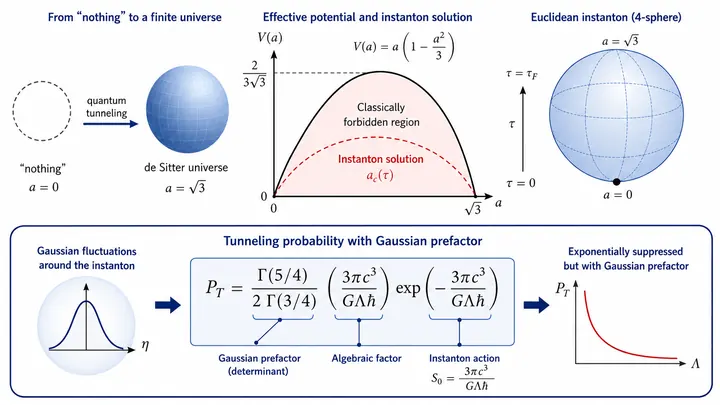
Quantum nothingness resembles water in a pot just before boiling. From time to time, a bubble spontaneously swells up — but not of steam, but of an entire universe. Such a bubble doesn't collapse; instead, it inflates into spacetime, triggering its own Big Bang. The only question is how often this happens.
The quantum world does not like being pinned down to exact numbers. Physicists usually expand a complex interaction into a long series, like a sum of ever-smaller corrections.
A balloon in your hand springs back equally in all directions. But a bottle of soda behaves differently: along the neck it is stiff, while across it is easily squeezed. This is roughly how pressure works inside some stars: it can be unequal in different directions. Such stars are called anisotropic, and their behavior has so far been described by disparate methods.
A Network That Decides When to Stop
A crowd grows: each new person joins the group with a probability that depends on how large the group already is. If the group is small, joining is easy; if it is huge, people start to hesitate, and growth slows down. This mechanism, called feedback, changes the entire behavior of the network.
According to the Big Bang theory, developed by Georges Lemaître, the Universe began from a hot dense point and then rapidly expanded — an inflation proposed by Alan Guth. Echoes of that time reach us as a faint glow — the ancient light.