Red Novae: Stellar Mergers in a Haze express
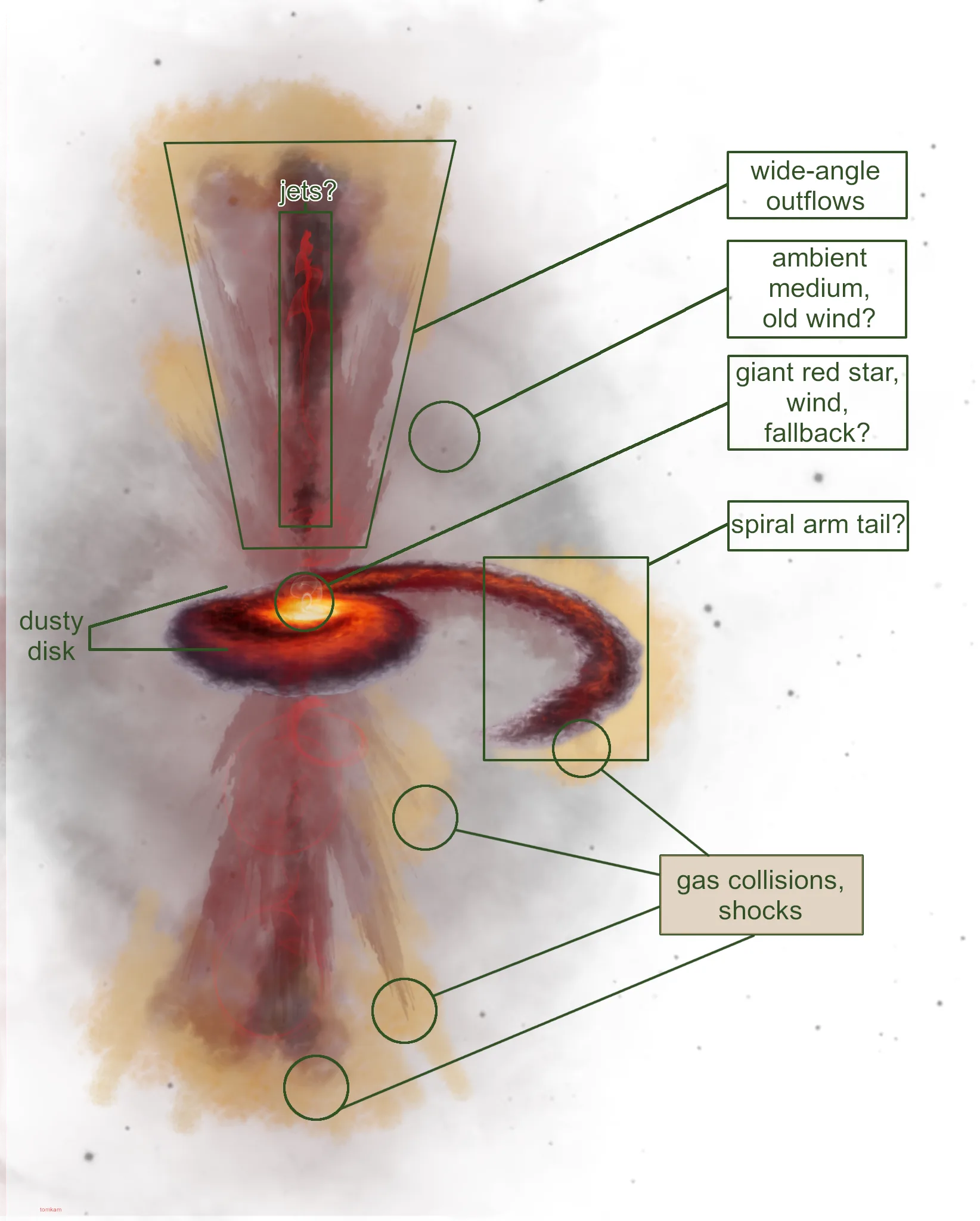
Two stars circle each other like dancers in a slow waltz. This dance is not eternal: the partners gradually draw closer until they collide and merge into a single entity. At that very moment, a red nova is born — a flash that lights up the sky for a few weeks, then slowly fades, enveloped in a dense cloud of dust.
An ordinary nova occurs when matter falls onto a white dwarf (a very dense, hot star the size of Earth). A supernova is a grand explosion at the end of a massive star's life. A red nova occupies an intermediate position. It shines with a cold reddish light, and its shells expand relatively slowly. By studying such outbursts, astronomers peer into the thick of the action: how matter flows from one star to another, how gas clumps are ejected, and how dust is born in this chaos.
Over the past twenty years, astronomers have accumulated enough observations to see the big picture. It turns out that red novae can arise in a wide variety of pairs: from small stars like the Sun to huge, bloated giants. Interestingly, many of them erupt after one of the stars has already aged and left the main sequence: that is, moved to the next stage of its life. This means we are seeing the finale of a long evolution spanning billions of years.
Scientists are trying to predict such events and estimate how often they occur. So far it is difficult, but data from new sky surveys show that in the nearby universe, the brightest red novae may occur even more often than the collapse of massive star cores. This means they are an important part of galactic life, influencing how many compact binary objects (neutron stars or black holes) are born, which later merge and trigger a burst of gravitational waves.
Each red nova is not just a flash, but a snapshot of a stellar merger. By peeling back its layers, we learn to read the history of binary systems and better understand where pairs of black holes come from, whose mergers are detected by gravitational wave observatories. And every time the waltz of two stars ends, a new object is born, wrapped in a dusty shroud.
Original abstract
as written by the authors arXiv:2605.17005
Red novae or luminous red novae are a class of optical transients that have emerged over the past two decades. They occupy an intermediate luminosity regime between classical novae and supernovae and are characterized by cool, slowly expanding ejecta and a pronounced evolution toward red, dust-enshrouded remnants. These events are now widely interpreted as the outcome of binary coalescence involving non-compact stars, providing a rare opportunity to directly observe the dynamical phases of stellar mergers and their immediate aftermath. Observational studies of red novae provide a glimpse into the still poorly understood physics of unstable mass transfer and common-envelope evolution in binary stars, responsible for the formation of high-energy astrophysical phenomena, compact binary systems, and gravitational wave sources. In this review, we synthesize current observational knowledge of red novae, including their outburst properties, population characteristics, and long-term remnants. Observations of light curves, spectra, and circumstellar environments reveal a complex interplay between mass ejection, collisions, radiative processes, and dust formation. Archival detections of red novae progenitors show a diversity of systems, ranging from low-mass contact binaries to massive evolved stars, with a notable representation of post-main-sequence stars. We examine current efforts to predict red nova outbursts and establish robust event rates, both of which remain challenging. The growing sample of extragalactic transients suggests that the brightest red novae may be even more frequent than core-collapse SNe in the local Universe, underscoring their importance for binary evolution and stellar population studies. Finally, we outline future prospects, including the impact of large-scale time-domain surveys and the potential connection between stellar mergers and gravitational-wave sources.
The red nova V1309 Scorpii erupted in 2008, and astronomers managed to spot it before its peak: for several years prior, the system showed rapid orbital decay, as if the stars were "in a hurry" to merge.
In Greg Bear's novel "The Forge of God," there is a description of contact with an alien life form that arose from the merging of two stellar cultures, a metaphor echoing real red novae.