Red Novae: Stellar Mergers in a Haze express
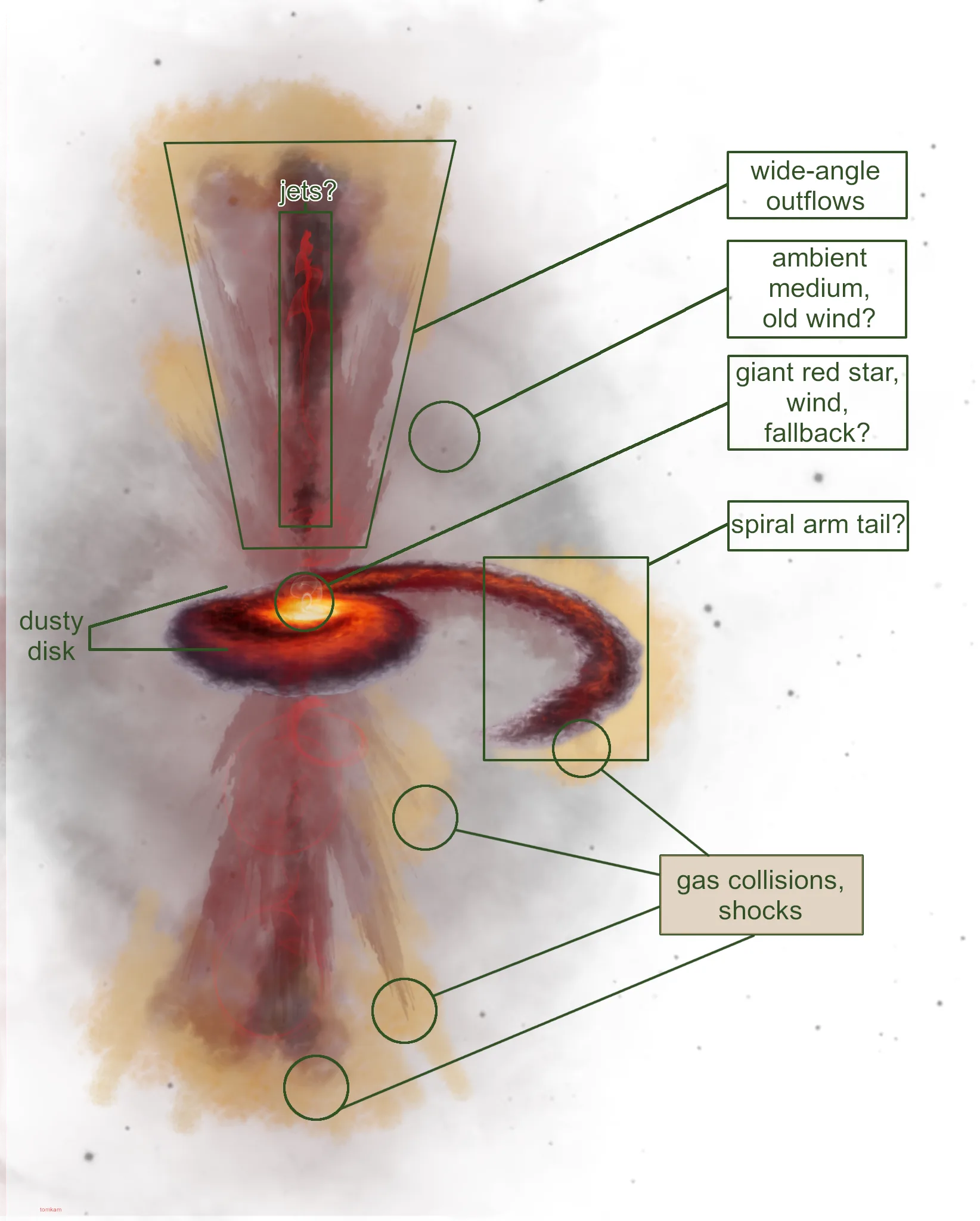
Two stars circle each other like dancers in a slow waltz. This dance is not eternal: the partners gradually draw closer until they collide and merge into a single entity. At that very moment, a red nova is born — a flash that lights up the sky for a few weeks, then slowly fades, enveloped in a dense cloud of dust.
An ordinary nova occurs when matter falls onto a white dwarf (a very dense, hot star the size of Earth). A supernova is a grand explosion at the end of a massive star's life. A red nova occupies an intermediate position. It shines with a cold reddish light, and its shells expand relatively slowly. By studying such outbursts, astronomers peer into the thick of the action: how matter flows from one star to another, how gas clumps are ejected, and how dust is born in this chaos.
Over the past twenty years, astronomers have accumulated enough observations to see the big picture. It turns out that red novae can arise in a wide variety of pairs: from small stars like the Sun to huge, bloated giants. Interestingly, many of them erupt after one of the stars has already aged and left the main sequence: that is, moved to the next stage of its life. This means we are seeing the finale of a long evolution spanning billions of years.
Scientists are trying to predict such events and estimate how often they occur. So far it is difficult, but data from new sky surveys show that in the nearby universe, the brightest red novae may occur even more often than the collapse of massive star cores. This means they are an important part of galactic life, influencing how many compact binary objects (neutron stars or black holes) are born, which later merge and trigger a burst of gravitational waves.
Each red nova is not just a flash, but a snapshot of a stellar merger. By peeling back its layers, we learn to read the history of binary systems and better understand where pairs of black holes come from, whose mergers are detected by gravitational wave observatories. And every time the waltz of two stars ends, a new object is born, wrapped in a dusty shroud.
The red nova V1309 Scorpii erupted in 2008, and astronomers managed to spot it before its peak: for several years prior, the system showed rapid orbital decay, as if the stars were "in a hurry" to merge.
In Greg Bear's novel "The Forge of God," there is a description of contact with an alien life form that arose from the merging of two stellar cultures, a metaphor echoing real red novae.