The Brain as an Orchestra That Also Plays Jazz express
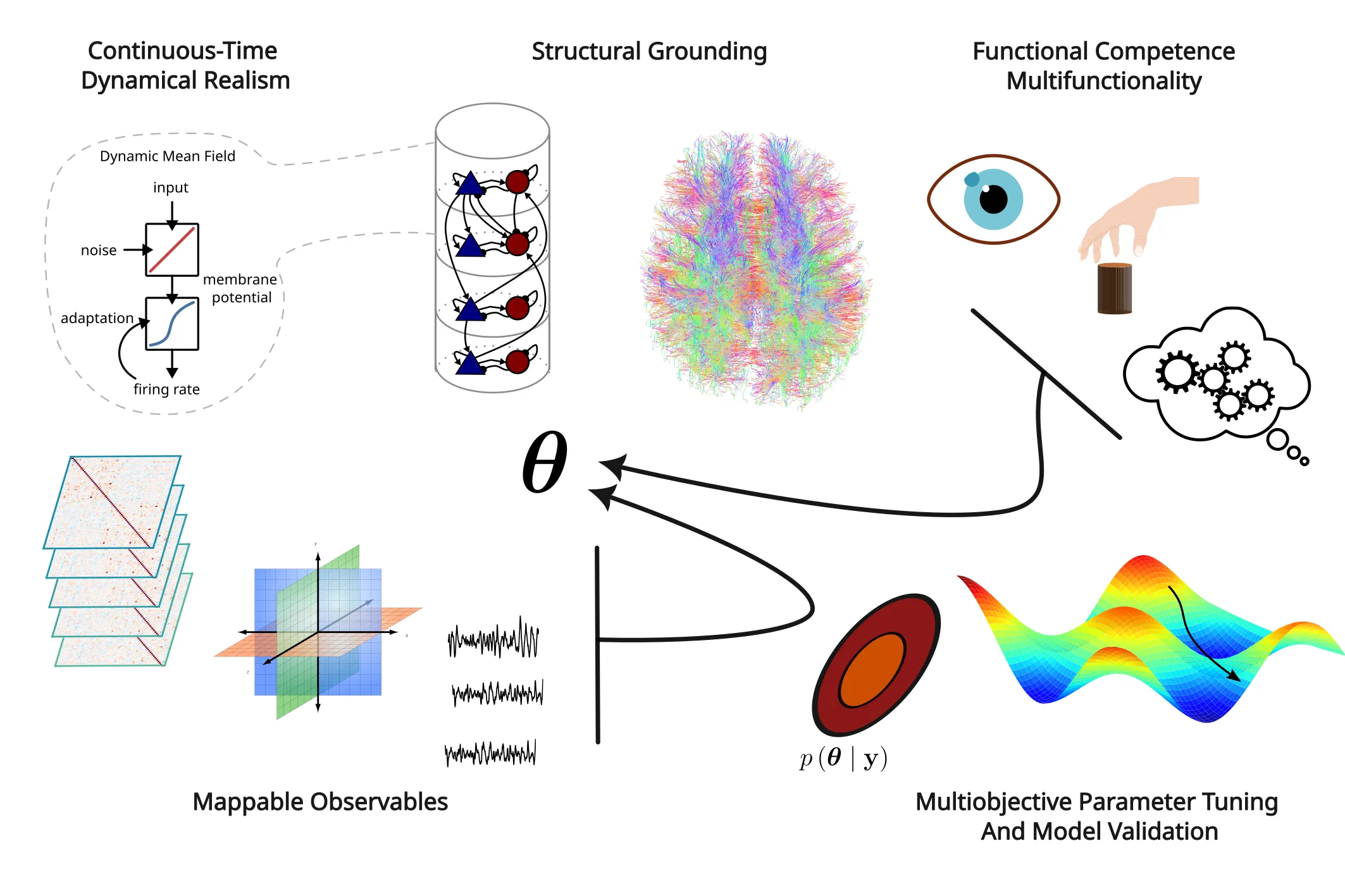
Engineers are building a car. Some assemble an exact replica of the engine, every piston and spark plug, but the car doesn't move: there's no steering wheel or wheels. Others build a fast self-driving go-kart, but its engine is made of playdough and doesn't resemble a real one. This is roughly the situation in brain science. One approach—'whole-brain modeling'—recreates neural networks with terrifying detail, down to individual cells. Another—'neuroconnectionism'—teaches artificial neural networks to play Go and translate texts, but their internal workings only vaguely resemble a living brain.
The authors of the new work, including Ashish Vaswani, propose to cross these approaches. They call the result a 'functional whole-brain model.' It's like adding real traffic flows, jams, and traffic lights (dynamics) to a detailed 3D map of all city streets (structure), and crucially, the ability for residents to get to work and back home (function). The model must meet four conditions: rely on real connectivity maps between brain regions, operate in continuous time like real neurons, solve practical tasks, from face recognition to memory, and produce signals comparable to scanner data.
The authors sketch a roadmap for years ahead. The immediate goal is to build a simple working prototype. In the long run, such models could let us peer into the very essence of thought and perhaps learn to fix its malfunctions. After all, if you have an accurate simulation of a city, you can not only predict a traffic jam but also understand how to clear it.
Original abstract
as written by the authors arXiv:2605.18118
Contemporary computational neuroscience features two prominent modeling traditions. Bottom-up whole-brain modeling (WBM) builds biophysically detailed simulations of brain structure and dynamics, whereas top-down neuroconnectionism optimizes deep neural networks for functional performance. Each has achieved remarkable success yet remains incomplete with WBMs lacking functional competence and neuroconnectionist models showing limited biological grounding. Here we propose functional whole-brain models (fWBMs) as a unified modeling paradigm that integrates structural and dynamical realism with task-performing capacity. fWBMs are defined by four minimal criteria: structural grounding in empirical connectomes and regional biology, continuous-time dynamical realism, functional competence across cognitive domains, and mappable observables to neuroimaging, electrophysiologcal and behavioral data. To formalize this integration, we establish a three-pillar roadmap across short-, mid-, and long-term horizons, and outline the scientific and clinical opportunities this paradigm enables. We argue that the disciplined pursuit of this integrative vision will generate the tools, common language, and cross-scale hypotheses needed to advance our understanding of the brain.
The human brain contains about 86 billion neurons — roughly 12 times more than the number of people on Earth. Each neuron can connect to thousands of others, creating a network more complex than all the world's computer networks combined.
In the novel 'The Diamond Age,' Neal Stephenson describes an interactive book that adapts to a child's mind to teach them perfectly. Functional brain models are a step toward understanding how to create such a 'tutor' in reality.