The Comet That Wanted to Ignite the Sun express
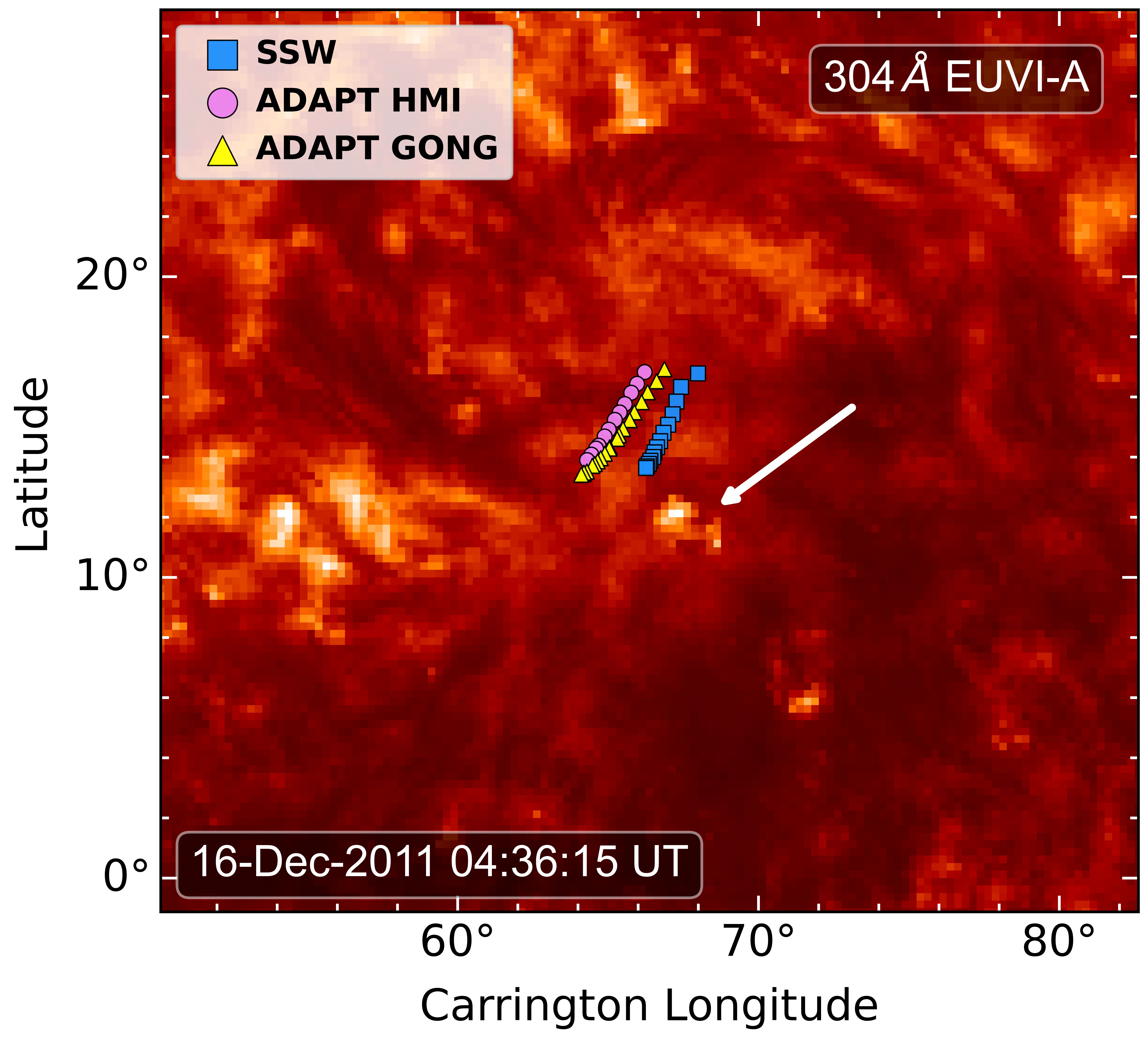
In December 2011, Comet Lovejoy boldly raced through the searing corona of the Sun. Right after — a flare. Scientists checked whether the comet could have caused it. The atmosphere of the Sun is threaded with taut magnetic loops, like a drawn bowstring. Flying through, the comet lightly brushes this string, and it releases an arrow — a powerful burst of energy. But calculations surprised: the energy of a dirty snowball (as Fred Whipple called comet nuclei) would only be enough for a toy bow. The actual flare, recorded by ultraviolet cameras, required 10–1000 times more. So, the comet wasn't the cause, but merely snapped the string of an already drawn 'bow'. Understanding such touches will help unravel storms on other stars with their planets. Paradox: diving into the solar furnace, the comet didn't perish, but blazed for earthly observers with the brightest light. It didn't ignite the Sun, the Sun ignited it.
Original abstract
as written by the authors arXiv:2605.18280
Star-planet magnetic interactions (SPMIs) can transfer energy from an exoplanet to its host star via Alfv\'en waves when the planet orbits within a sub-Alfv\'enic stellar wind. Similar conditions were encountered by the sungrazing comet Lovejoy as it passed through the solar corona in December 2011. The possibility that comets could trigger solar activity via magnetic interactions has never been investigated. The aim of this paper is to quantify the energetics of such interaction and to assess if enough energy could be deposited to either form a hotspot or trigger eruptions on the Sun. We used the magnetohydrodynamic WindPredict-AW model to reconstruct the coronal magnetic field and solar wind conditions along the comet's orbit, and determined the magnetic footpoints that connected the comet to the solar surface. By estimating the travel time of hypothetical Alfv\'en waves, we identified a brightening event observed by EUVI aboard STEREO-A that is spatially and temporally consistent with comet Lovejoy's passage. We then computed the SPMI power for all magnetic field lines anchored within 5 degrees of the brightening using SPMI power scaling laws. The resulting power distribution spans approximately 10$$^{14}$$-10$$^{16}$$ W. In comparison, the estimated radiative power of the brightening event in the STEREO-A/EUVI 195$$\r{A}$$ channel is approximately 10$$^{17}$$ W. We find that comet Lovejoy does not generate sufficient SPMI power to be the energy source of the observed brightening intensity. However, it may still act as a perturbation to existing magnetic structures, and lead to the triggering of solar flares. Confirming this hypothesis would require additional observations that do not exist for this event, which make future passages of sungrazing comets valuable opportunities to study SPMI processes within our solar system.
The nucleus of Comet Lovejoy shrank after passing through the corona, but the comet survived and became one of the brightest comets of the decade.