The Chemical Signature of Life: How to Find It by Its Elements express
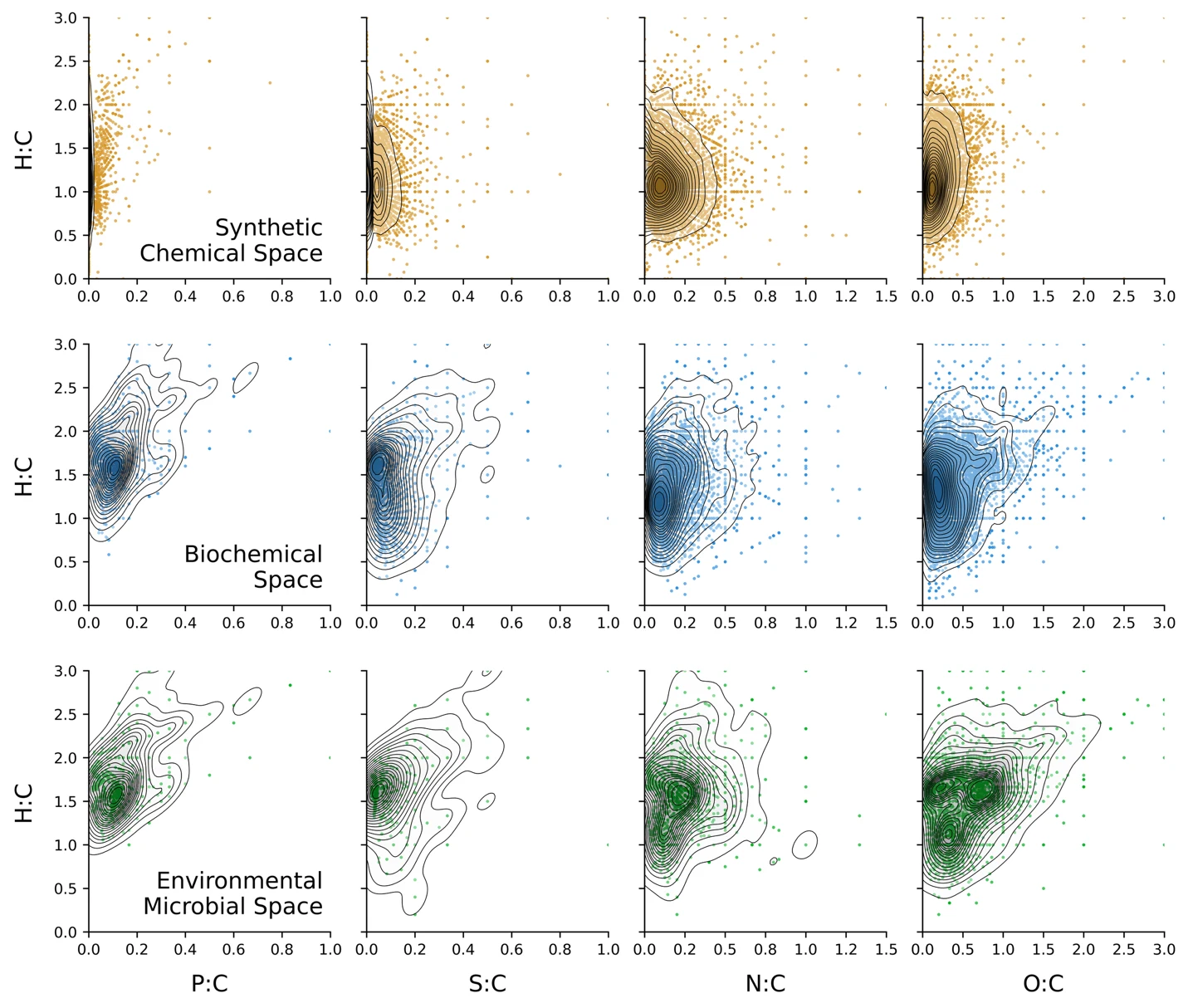
From carbon, nitrogen, oxygen, and sulfur, you can assemble 10⁶⁰ different small molecules: that's a 1 with 60 zeros, more than the stars in the visible universe. Life uses only a tiny fraction of this menu, but not randomly. In any living community, from bacteria to an oak grove, the element ratios shift in the same way: more oxygen and hydrogen, less carbon, and always a dash of sulfur and nitrogen. It's as if every living organism leaves an invisible signature in chemical ink.
Scientists tested this signature on thousands of samples — microbial communities, synthetic mixtures, even data from Mars missions. The picture is clear: living matter differs from non-living matter based solely on elemental composition. Just plot molecules as points with coordinates “oxygen-to-carbon” and “hydrogen-to-carbon,” and the cloud of living points always shifts up and to the right. A mass spectrometer onboard a rover can read such a signature in minutes.
The most surprising twist: this chemical signature is universal. It doesn't depend on specific proteins or DNA, so it's suitable for searching for any carbon-based life — even the most alien. We might already be able to recognize living material in extraterrestrial samples; we just didn't know where to look.
Original abstract
as written by the authors arXiv:2605.19252
The vast chemical space of possible small molecules, estimated at 10^60 compounds for molecules composed of just C, N, O, and S, is only sparsely occupied by biology. We propose that where life selects molecules within this space constitutes a detectable ecological signature: a fingerprint not of specific compounds, but of the statistical structure of elemental composition across molecules sam-pled from ecological systems. Here we introduce a framework combining Van Krevelen diagrams and element scaling laws to characterize the elemental composition of regions of chemical space occupied by biological systems and contrast them with other chemical systems. Applying this framework to 11,834 microbial metagenomic samples, we show that microbial metabolisms occupy a region of chemical space, which is enriched in heteroatoms such as P, S, N, and O relative to C, shifted toward higher O:C and H:C ratios. We observe sublinear element scaling with system size, yielding insights into how elemental constraints dictate how biological systems occupy chemical space. These patterns are distinct from a sample of 18,000 compounds from the comprehensive Reaxys synthetic chemical database. Critically, datasets from molecules detected in planetary science mission data occupy statistically distinct regions from both terrestrial biological and Reaxys distributions, demonstrating that with standardized methods for data collection, the approach could be developed to discriminate biotic from abiotic chemical signatures in small molecule data from planetary science missions. Our work shows how a combination of Van Krevelen fingerprinting and elemental scaling laws can provide a new class of ecological biosignatures for life detection leveraging mass spectrometric data from planetary missions, which could generalize beyond Earth's specific biochemistry.
When analyzing Martian samples and meteorites, the 'living' signature hasn't been found yet, but now we know what it looks like.
In Star Trek, tricorders instantly recognized life. Our method is a real step toward such technology: a scanner only needs to measure the ratio of elements to distinguish life from non-living matter.