A Spiral at the Heart of a Star express
A figure skater pulls their arms in, and their spin suddenly accelerates. When a massive star exhausts its fuel and its core collapses, something similar happens, but on a cosmic scale. The core shrinks to a city-sized sphere, and if it is spinning rapidly, a peculiar instability can arise. Matter in the newborn neutron star begins to move in a spiral, like water swirling down a drain.
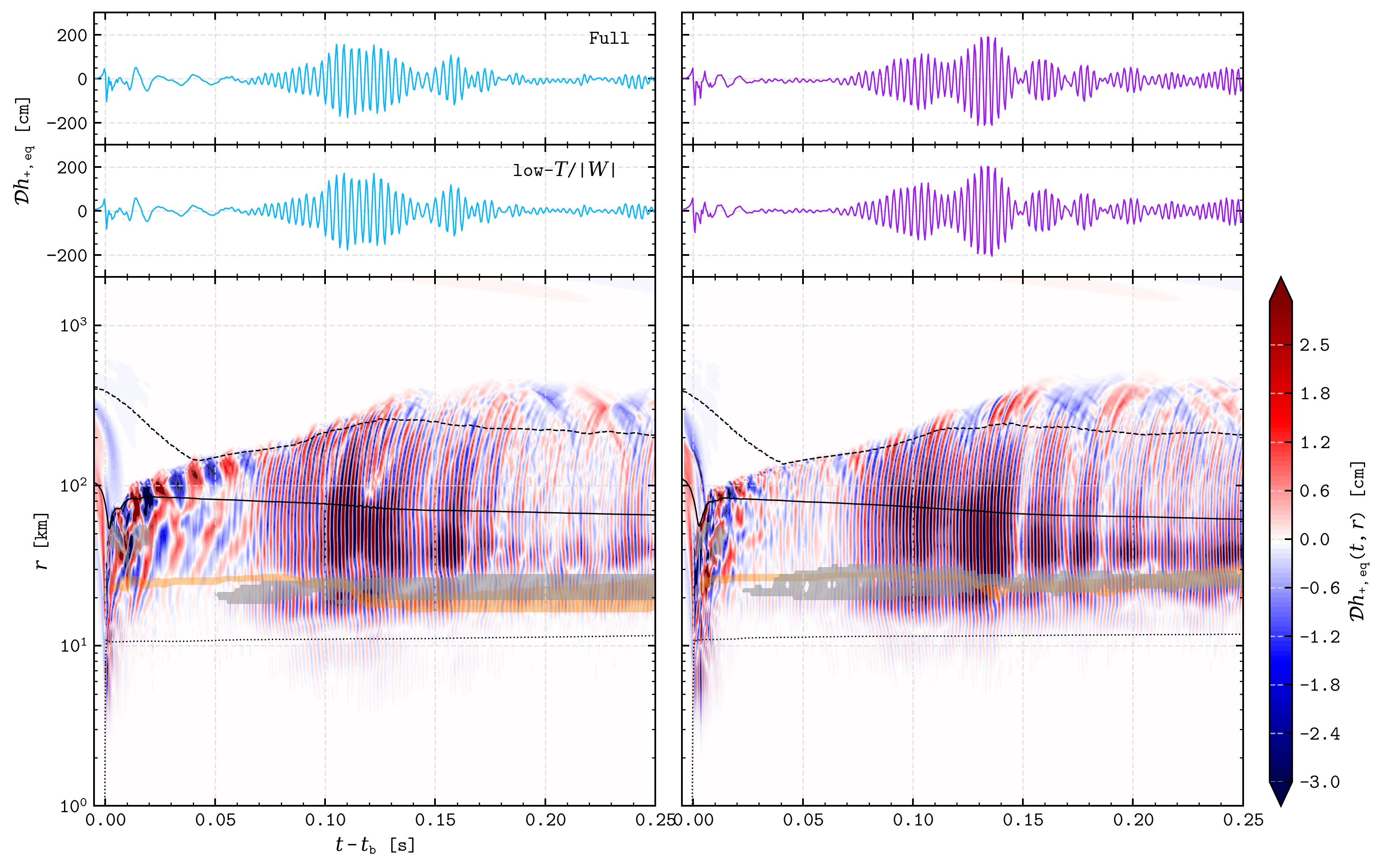
This spiral is not just pretty. It acts like a giant mixer, periodically jolting spacetime and producing gravitational waves (ripples in the fabric of the universe). At the same time, it alters the flow of neutrinos (ghostly particles that barely interact with matter), especially near the star's equator. The scientists ran five simulations of the collapse of a star with a mass of 35 Suns, each time setting a different behavior for the superdense matter. The instability appeared in all cases, but its character changed: the onset time, lifetime, and frequency of gravitational waves depended on how stiff and compact the core was.
If we catch such a signal on Earth, astronomers could look inside a neutron star and understand what it is made of. Previously, we had to rely only on neutrinos; now there is a second, independent source of information. It's like a doctor listening not only to a patient's breathing but also to their pulse — together they give a more complete picture. And so the figure skater's dance, where it all began, turns into a precise tool: the rhythm of cosmic rotation tells us about the hidden depths of matter.
Original abstract
as written by the authors arXiv:2605.28944
Rapidly rotating core-collapse supernovae are promising sources of multimessenger emission, as non-axisymmetric dynamics in the newly formed proto-neutron star can leave characteristic imprints on both gravitational waves and neutrinos. We present three-dimensional neutrino-magnetohydrodynamics simulations of the collapse of a rapidly rotating $$35\,\mathrm{M}_\odot$$ progenitor, performed with five different finite-temperature nuclear equations of state, to investigate how dense-matter physics affects the development of the low-$$T/|W|$$ instability and its associated multimessenger signatures. We find that the low-$$T/|W|$$ instability develops in all equation of state models considered, indicating that its occurrence is robust for this rapidly rotating progenitor. However, its onset time, dominant azimuthal structure, lifetime, and characteristic multimessenger frequencies vary among models, reflecting differences in the evolving proto-neutron star structure and rotation profile. The instability produces large-scale spiral modes that generate quasi-periodic gravitational wave emission and modulate the neutrino luminosities, especially along directions close to the equatorial plane. The dominant gravitational wave frequency associated with the instability correlates with the effective stiffness and compactness of the proto-neutron star: models with more compact/stiffer configurations emit at higher frequencies. This suggests that, in rapidly rotating core-collapse supernovae, the frequency of the low-$$T/|W|$$ instability-driven gravitational wave signal may provide a diagnostic of the dense-matter equation of state, complementary to the information carried by the neutrino signal.
The instability in question is called the low $T/|W|$ instability. It arises when the rotational energy of the star becomes less than a certain fraction of its gravitational energy, and it can turn a neutron star into a source of periodic gravitational waves, similar to the sound of a tuning fork.
In Carl Sagan's novel "Contact," a signal from space turns out to be not just a message but a blueprint for a machine. Here, the frequency of gravitational waves itself is a "blueprint" of the neutron star's interior.