How Defects Trigger Bubbles of a New Phase express
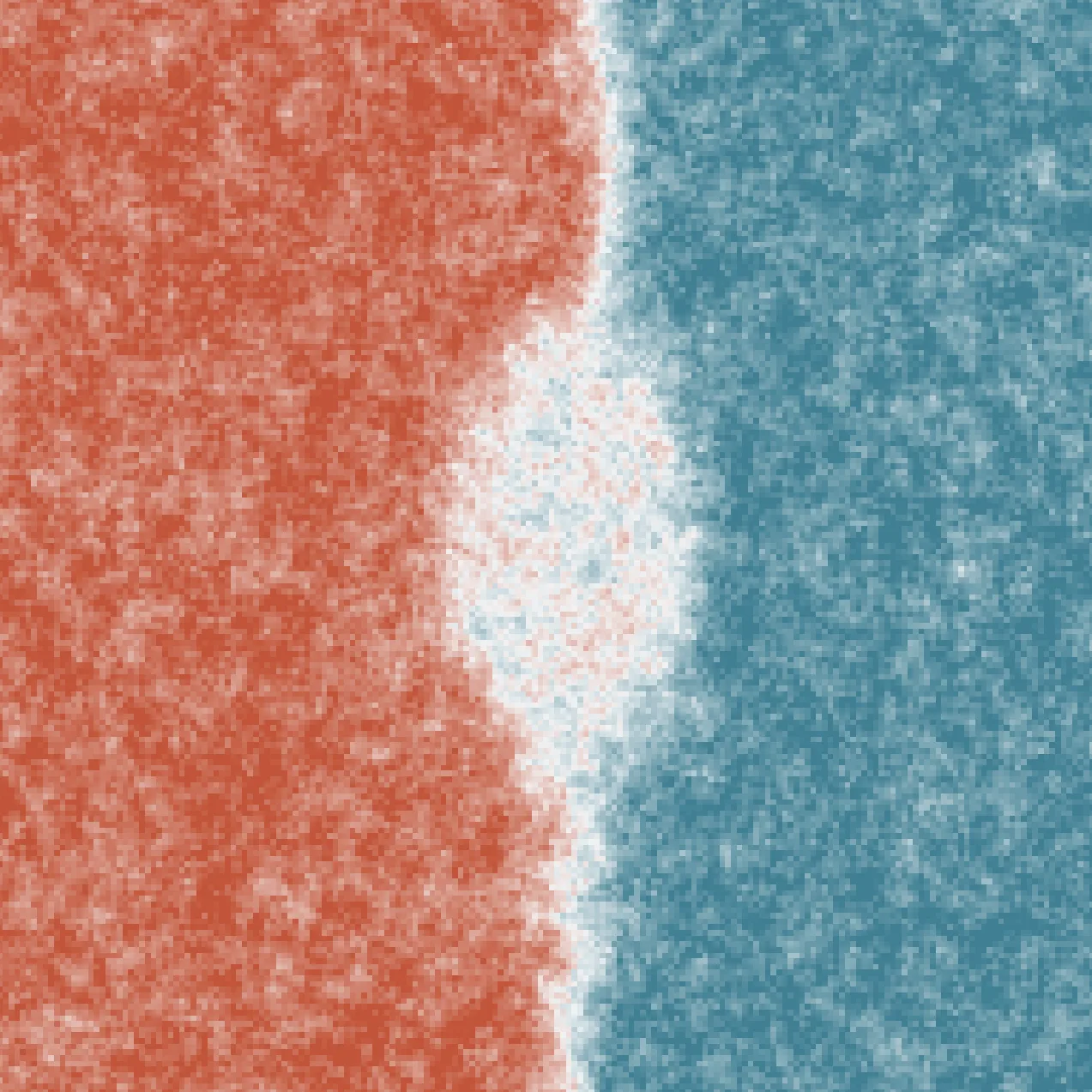
When water boils in a pot, the bubbles of steam don't appear just anywhere: they prefer to cling to scratches or dust particles on the bottom. A similar mechanism works in particle physics: as the Universe cools and transitions from one state to another, the new phase often emerges not at random points but on 'defects'—inhomogeneities left over from the previous order.
The authors took a model resembling a simplified version of the electroweak theory (which describes the Higgs boson) and, for the first time, calculated on the lattice without approximations how often bubbles of the new phase arise on such defects. Here, the defects are domain walls, akin to boundaries between crystallites in a metal. Previously, such calculations were done only approximately, assuming bubbles are perfectly spherical. Now, they accounted for their actual, slightly crumpled shape.
The result is encouraging: the complex numerical lattice experiment and the simpler semiclassical theory yielded very close numbers. This means theorists can trust their formulas even when bubbles are not perfect. It is also a step toward understanding why the Universe has more matter than antimatter — since out-of-equilibrium bubbles could well have created the necessary imbalance.
If the phase transition in the early Universe had proceeded too slowly, we simply wouldn't exist — matter and antimatter would have annihilated completely.
In the novel 'The End of Eternity,' Isaac Asimov describes a reality where people have learned to change the past by introducing tiny alterations — much like bubbles of a new phase on defects.