Quantum Squeezing of Molecules Improves Sensor Accuracy Threefold express
Any measuring device is spoiled by quantum noise — the chaotic jitters of elementary particles. To tame it, physicists used a trick on calcium fluoride molecules, much like squeezing a balloon: press in one spot, and it bulges in another. The idea is the same: quantum uncertainty is driven into a parameter that doesn't matter for the measurement, while the quantity of interest becomes three times more precise.
The molecules were held in traps made of laser light, made to spin in unison like tiny tops. Using laser pulses and clever light control, scientists built up their entanglement — the very phenomenon Einstein called 'spooky'. Remarkably, the squeezed state was written onto the molecule's internal rotation, where it lasted 100 milliseconds. It's like putting a quantum 'secret' into a safe. Now such molecular sensors can search for dark matter, test laws beyond known physics, and pick up gravitational waves.
Original abstract
as written by the authors arXiv:2606.02500
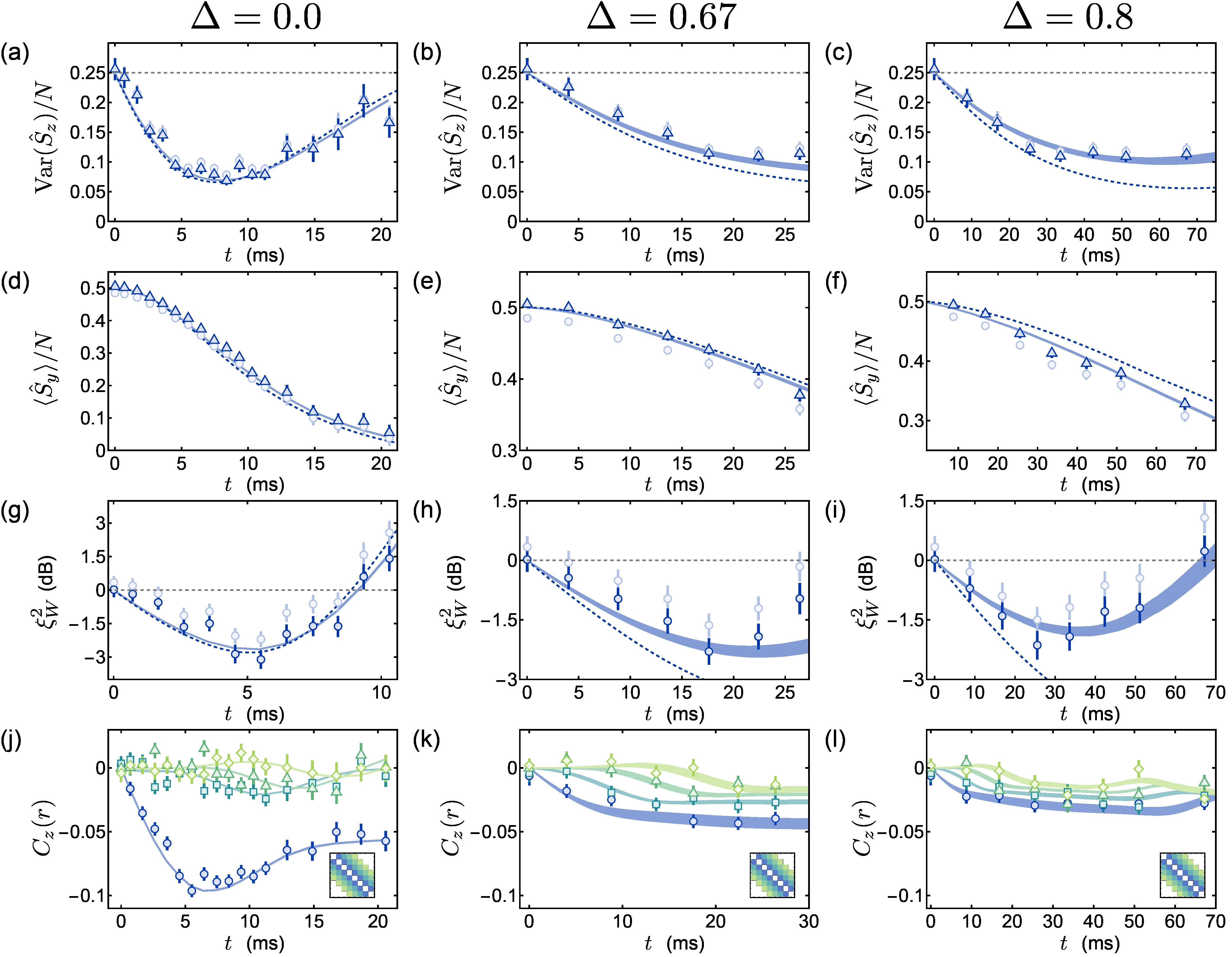
Polar molecules are a promising platform for quantum-enhanced sensing and precision tests of fundamental physics, owing to their strong long-range dipolar interactions, broad sensitivity to electromagnetic fields, and sensitivity to potential physics beyond the Standard Model. However, the creation of metrologically useful entangled states in molecular systems has remained elusive. Here, we report the first observation of a class of metrologically useful entangled states - spin-squeezed states - in polar CaF molecules trapped in an optical tweezer array. The spin degree of freedom is encoded in rotational levels which are directly coupled by dipolar exchange interactions. By harnessing appropriate dynamical decoupling schemes we observe up to 3.0(3)dB of metrological gain, (2.2(3)dB without measurement correction) from direct exchange interactions. Using Floquet engineering, we further realize richer Hamiltonians that preserve spin squeezing while enabling the development of longer-range quantum correlations. Using site- and spin-resolved measurements we demonstrate that these entangled states enhance sensitivity to both homogeneous and spatially varying fields, and reveal strong non-classical correlations, including bipartite entanglement and Einstein-Podolsky-Rosen steering. Finally, we transfer the spin-squeezed states into long-lived and non-interacting hyperfine states, where the metrological enhancement persists for up to 100ms. Our results establish molecular optical tweezer arrays as a scalable platform for generating, controlling, characterizing, and storing entangled states of molecules, opening new opportunities for quantum-enhanced sensing and precision tests of fundamental physics.
Until now, quantum squeezing had only been achieved with single atoms or ions; molecules, much more complex objects, have been used for the first time.