The Dusty Truth: Why Supernovae Finally Spoke with One Voice ✛ ✎ ✦
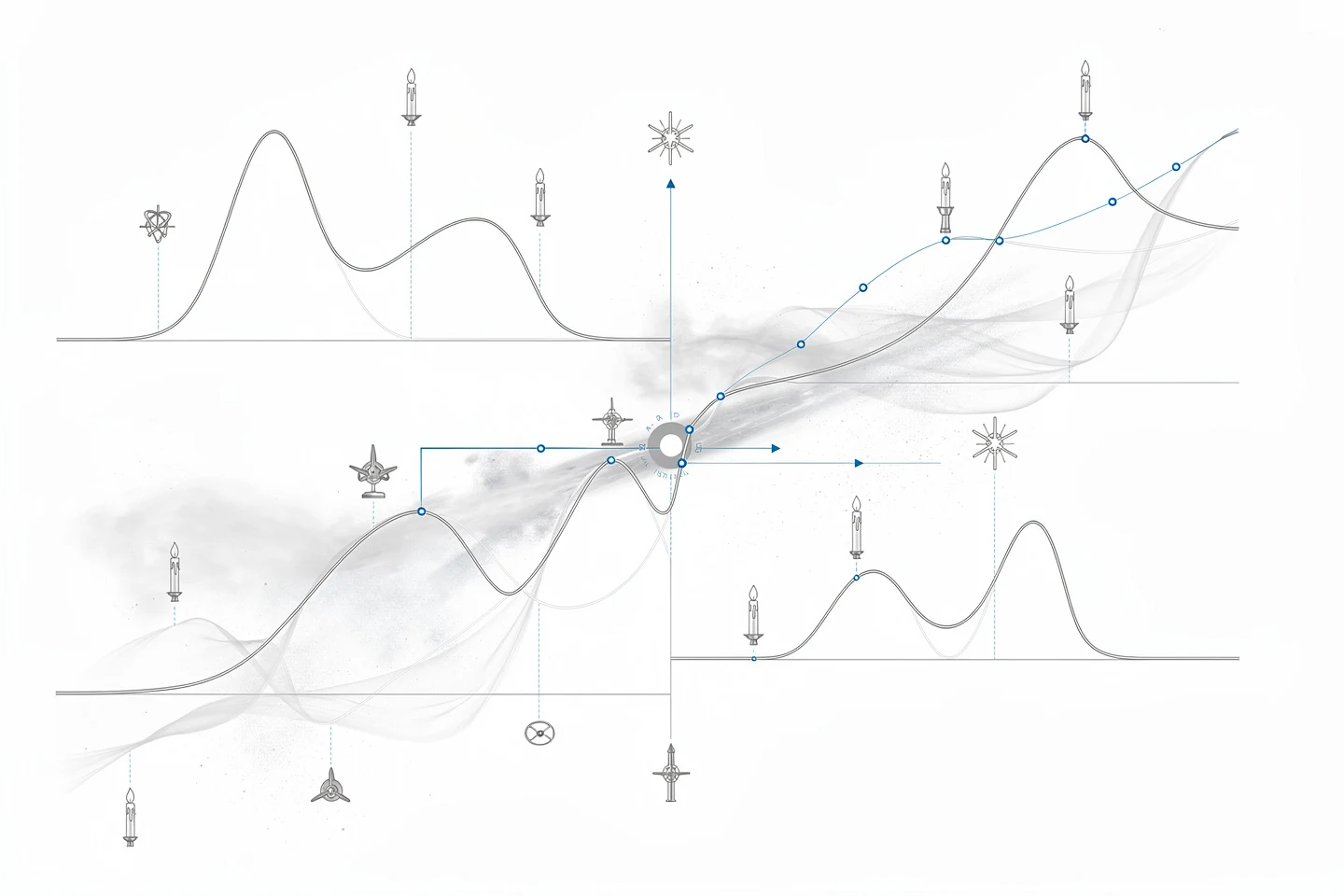
Type Ia supernovae are the final, blinding chords in the symphony of stellar evolution: when a white dwarf crosses the limit predicted by Chandrasekhar, it explodes so brightly that for a moment it outshines an entire galaxy. Fritz Zwicky first proposed using this predictable power to measure cosmic distances. Decades later, these 'standard candles' led to the discovery of accelerated expansion of the universe and the mysterious dark energy. But a stubborn paradox lurked within the canonical scenario: why are redder supernovae systematically dimmer? Two camps argued: either it's due to the internal physics of the explosion, or cosmic dust along the light path is to blame.
Imagine a restorer removing layers of darkened varnish from an old master's canvas. Underneath the grime, not damage, but the true color and depth are revealed. That's exactly how dust manifested in the new study: it's not just a cloudy glass, but a lens that brings a perfect signal out of the noise. Marco Giunto's group from SISSA applied a Bayesian hierarchical model to 902 supernovae from the Zwicky Transient Facility survey, classified using spectroscopy and photometry — and found that the intrinsic connection between color and brightness is virtually zero. The entire observed effect is the work of dust, which inscribes distance with luminous ink on the light itself.
The key number is the reddening parameter τ = 0.148, while the intrinsic color dispersion is only 0.038: the dust 'coat' is almost four times thicker than the supernova's own 'skin'. This means that the traditional linear Tripp correction is not a crutch to fix puzzling physics, but a precise tool calibrated by nature itself. There's no longer any need for cumbersome 'banana-shaped' models. The ZTF data, covering a homogeneous sample without artificial cuts for the first time, allowed us to hear the pure voice of dust, unclouded by selection noise.
The revolution is just beginning: the Vera C. Rubin Observatory (LSST) will soon launch a supernova assembly line, churning out millions of such beacons. With our new understanding of the dust code, we can calculate the equation of state of dark energy to within a percent — and perhaps understand why the universe's expansion is accelerating. The pioneering work of Adam Riess gains powerful confirmation, and physicists gain a new tool: instead of fighting dust, they are learning to use it as a universal label. Looking ahead — a joint analysis of light curves and the properties of host galaxies will finally turn supernovae into ideal beacons. Then every dust grain will become a word in the cosmic chronicle, while we are only just learning to read this dusty font.
Cosmic dust — the very noise astronomers spent centuries cleaning from their images — turned out to be a key player in the drama of the accelerating universe. Without it, we might still believe in a decelerating cosmos.