Industrial laser accelerates electrons express
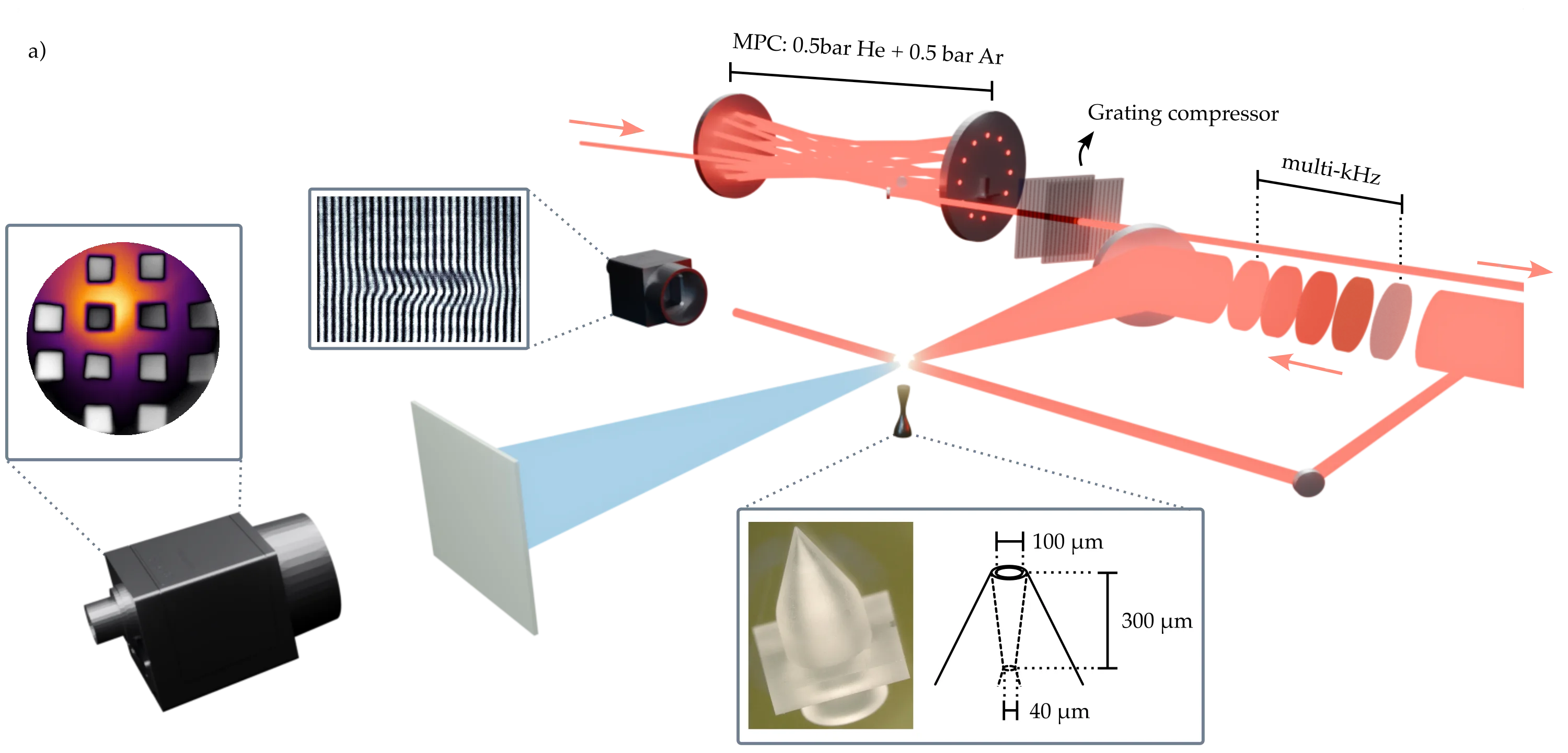
A factory laser that cuts and welds metal on production lines has been made to work as a particle accelerator for the first time. Physicists took a standard ytterbium laser, its heart is a crystal the size of a palm, and turned its flashes into a tool for accelerating electrons to nearly the speed of light. Previously, such a trick required unique laser systems the size of a room, but here an ordinary industrial device does the job.
The laser fires picosecond pulses (trillionths of a second), which are then compressed 20-fold — down to 50 femtoseconds. It's like gathering a long roll of thunder into a single flash of lightning. The compressed pulse hits a gas jet and creates a plasma bubble — a tiny cavity where electrons are caught by the wave, like surfers on a crest, and shot forward with energies of several megaelectronvolts. Meanwhile, the laser operates in burst mode: you can set from 625 to 6250 shots per second — tens of times more often than in previous experiments.
Numerical simulations showed that the acceleration runs in a self-regulating mode: the laser beam self-focuses in the plasma, creating conditions for stable acceleration. This is like a speedboat creating a wake that pushes a swimmer — only here the wave is made of electrons, and the boat is a light pulse. This approach combines the reliability of factory equipment with the efficiency of plasma acceleration, promising compact sources of fast electrons for radiation therapy, ultrafast imaging, and materials quality control.
Original abstract
as written by the authors arXiv:2606.07147
Laser plasma accelerators (LPAs) are a promising platform for compact radiation sources. For a wide range of applications, including radiotherapy, ultrafast electron diffraction and time-resolved imaging, stable operation at high repetition rates is essential in order to deliver competitive average particle flux. Here we demonstrate the first LPA driven by an industrial-grade ytterbium-doped yttrium aluminium garnet (Yb:YAG) laser, designed for high-average-power operation. The picosecond laser pulses are post-compressed in a multi-pass cell to 50 fs duration and used to drive the interaction. The electron accelerator is operated in burst mode, at repetition rates tuneable from 0.625 to 6.25 kHz, representing a substantial increase compared to the state-of-the-art. Across this range, the electron beam properties remain unchanged, with average charges of 10-12 pC per shot, divergences of 50-70 mrad, and Maxwellian-like spectra extending to a few MeV. Numerical simulations capture the key features of the experimental observations and indicate acceleration in the self-modulated regime, enabled by relativistic self-focusing in near-critical-density plasma. Combining industrial high-average-power laser technology with plasma-based acceleration, these results represent a key step toward scalable, compact high-repetition-rate electron sources for medical, imaging and industrial applications.
The ytterbium Yb:YAG crystal laser is a direct relative of the lasers that cut steel in factories; its active element, no bigger than a cookie, replaces an entire hall of scientific apparatus.