A cosmic accelerator is any natural astrophysical source that boosts charged particles to extremely high energies, often far beyond what human-made accelerators can achieve. Supernova remnants, active galactic nuclei, and pulsars are prime examples. These sources are responsible for cosmic rays — particles that bombard Earth from space with energies up to 10^20 electronvolts, millions of times higher than the LHC can produce.
History
The concept of cosmic accelerators emerged in the 1930s–1940s with the discovery of cosmic rays and the proposal of Fermi acceleration by Enrico Fermi in 1949. Supernova remnants were identified as likely sources in the 1960s–1970s.
How it works
The exact mechanism varies by source, but a common process is Fermi acceleration, where particles gain energy by repeatedly crossing shock waves in magnetizedplasma. Each crossing gives a small energy boost, and over many crossings, the particle's energy grows exponentially. Magnetic fields in the shock region confine the particle, allowing multiple encounters. For the most extreme energies, additional mechanisms like unipolar induction in rotating magnetized neutron stars may be required.
In practice
Understanding cosmic accelerators helps interpret cosmic ray data and informs the design of particle detectors, as well as providing insights into extreme plasma physics that can be applied to fusion research.
Fun fact
The highest-energy cosmic ray ever detected, the Oh-My-God particle, had an energy of about 3×10^20 eV — equivalent to a baseball moving at 60 miles per hour, but carried by a single proton.
A laser pulse slams into a gas cloud and knocks electrons out of it, leaving behind a bubble: a cavity almost devoid of particles. This bubble races through the plasma at nearly the speed of light, and its walls drag along the electrons trapped inside, much like a speedboat tows a water skier.
The night sky in neutrino light resembles a canvas worked on by two hands. One holds a broad, soft brush: these are supernova remnants, the shells left behind after stellar explosions. The other grips a fine, hard pen — microquasars, binary systems where a black hole twists matter into narrow jets.
For three days straight, a laser blasted a jet of gas, and every second it produced a beam of electrons with the energy of a tiny lightning bolt. Previously, such beams could only be produced in huge halls where the accelerator takes up an entire building. Now the whole setup fits in a room and ran without a glitch for 72 hours.
In the southern sky, behind a dense veil of dust, hides a source of gamma rays — the most energetic light in the Universe. It shines so brightly that it can be seen even through this veil, but the object itself remains invisible. Astronomers pointed the ALMA radio telescope at the neighboring gas clouds and saw a pattern that gave the invisible object away.
A regular laser beam travels straight, like the light from a flashlight. But light can be twisted into a spiral, like the thread of a corkscrew. Such a beam carries orbital angular momentum: it doesn't just illuminate, it also spins anything it encounters.
In the first moments, the Universe expanded at an enormous rate. This process is called inflation, and its driving force is the inflaton field. Its energy pushed space apart, like yeast raising dough. But physicists suspect that the dough might have left 'bubbles'—superheavy particles born from the expansion itself.
A billiard ball clicks against another in complete darkness. The sound of the impact and the clatter of balls dropping into pockets: that's all you hear. This is roughly how physicists study the interactions of elementary particles at energies that no terrestrial accelerator can reproduce.
Deep inside a neutron star, matter is squeezed so tightly that familiar protons and neutrons give way to new players. Hyperons are born there — particles that harbor a strange quark.
For a long time, astronomers searched for the 'factories' of the most energetic cosmic rays — particles that carry the macrocosm compressed to the size of an atomic nucleus. Colossal star-forming regions like Cygnus OB2, where winds from young giants collide, were prime suspects.
In 1933, Fritz Zwicky first spoke of an invisible mass holding galaxy clusters together. Decades later, Vera Rubin mapped galactic rotation, revealing the ghostly presence of dark matter. Today we know it pervades the cosmos, but its particle nature remains elusive.
In the late 1990s, the night sky delivered a surprise: Saul Perlmutter and Adam Riess found that the expansion of the Universe is accelerating. Ever since, the greatest riddle has been dark energy — a substance making up nearly 70% of the cosmos, yet evading laboratory study.
In the constellation Aquila, about 40,000 light-years away, one of the most powerful natural accelerators in the Galaxy is at work. It's the microquasar GRS 1915+105—a pair consisting of an ordinary star and a black hole.
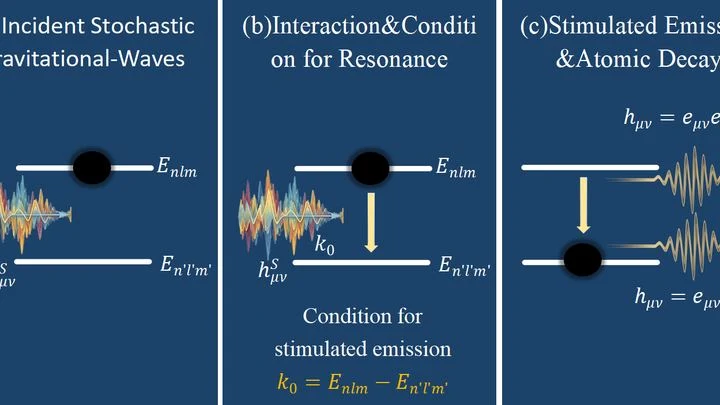
Gravitational waves — the cosmic tremors from distant cataclysms — are so faint that detecting them is like trying to hear a whisper in a hurricane. But a black hole can amplify that whisper many times over.
A factory laser that cuts and welds metal on production lines has been made to work as a particle accelerator for the first time. Physicists took a standard ytterbium laser, its heart is a crystal the size of a palm, and turned its flashes into a tool for accelerating electrons to nearly the speed of light.
Space is full of invisible sprinters — particles racing nearly at the speed of light. They are caught in the solar wind, near neutron stars, and even in the intergalactic void between galaxies. But what accelerates them where there are no shock waves or magnetic reconnections?
For almost a century, cosmologists have been grappling with the mystery: what makes the Universe expand ever faster? The standard answer — dark energy — creates a monstrous discrepancy between the theoretical vacuum density and observations. But there's another path, one that turns causality on its head.
On a scorching afternoon, a stifling haze hangs over the city, and not a single cloud is on the horizon. Usually, in such weather, all you can do is wait for nature to take pity and send some cool relief. But what if shade and rain could be switched on schedule, like a light in a room?
A stone falls into a pond, and ripples spread across the water. Likewise, light from distant galaxies spreads in all directions — calmly and steadily. But at the center of some galaxies, it's not a stone but a veritable cannon: it fires particles with monstrous force. Astronomers call such objects HSP BL Lac.
Just after the Big Bang, clumps weighing as much as a trillion Suns and with an electric charge of colossal strength, like trillions of electrified balloons, could have drifted through space.
Right after the Big Bang, space swelled at an unimaginable speed — that's inflation. Now expansion has slowed, but galaxies are moving apart faster and faster. The culprit behind the acceleration has been named dark energy.
Deep in the Mediterranean Sea, where water presses down with the force of hundreds of atmospheres, a network of light-sensitive spheres waited for a rare guest. And it came — a neutrino that carried through the bulk of the Earth an energy comparable to the impact of a flying brick.
Every second, invisible projectiles from the depths of space pierce through us. These are cosmic rays — atomic nuclei accelerated to speeds nearly indistinguishable from the speed of light. Their energy is hundreds of millions of times greater than what our most powerful accelerators can achieve. Where does this monstrous force come from?
A balloon inflates on its own, even though no one is blowing it up. That's roughly how the accelerated expansion of the universe looks, and to explain it, scientists usually invoke dark energy, an invisible and poorly understood force. But what if the balloon expands because new air molecules are continuously appearing inside it?
The universe is expanding faster and faster, and scientists blame it on dark energy. Its origin is explained in a new way: dark energy isn't eternal, but appears only after dark matter clumps together into lumps — future galaxies.
The mechanism works like a pump that turns on when pressure drops.
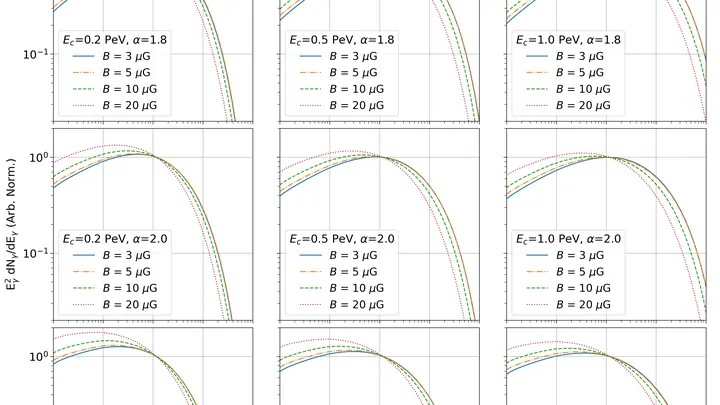
Gamma rays with energies above one hundred trillion electronvolts are like stones thrown with incredible force. For a long time, it was believed that only protons, heavy particles accelerated in cosmic accelerators, could launch such 'stones.' But new work shows that sometimes light electrons are enough.
Deep in the constellation Aquila lies a nebula that looks like an expanding bubble. It is inflated by a tiny star the size of a city — a pulsar that makes several rotations per second and loses rotational energy. Usually, such bubbles shine exactly as brightly as their pulsar is powerful.
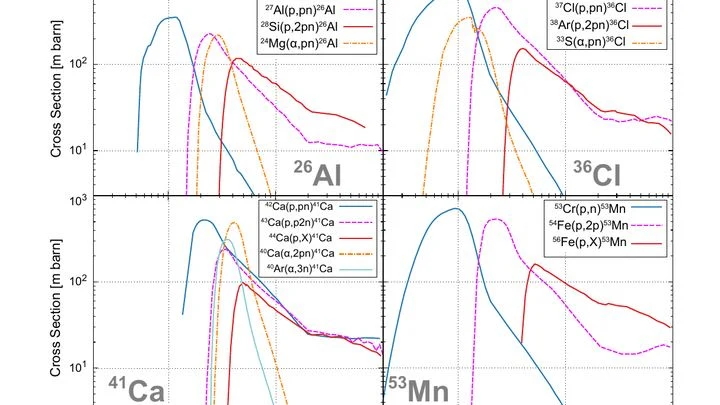
Just as yeast turns flour into fluffy dough, radioactive 'seasoning' from a supernova — the explosion of a massive star at the end of its life helps mold a rocky planet. The key ingredient here is aluminum-26, a radioactive isotope that releases heat as it decays.
In 1929, Edwin Hubble discovered that galaxies are receding — the universe is expanding, like rising dough. Today we know it's growing faster and faster, and usually the accelerator is called dark energy.
When a massive star exhausts its thermonuclear fuel, its core collapses, and the outer layers are ejected into space at speeds of thousands of kilometers per second. This is how a supernova remnant is born — an expanding cloud of shock-compressed gas spanning light-years.