Chemistry Without Points: A Field Instead of Active Sites express
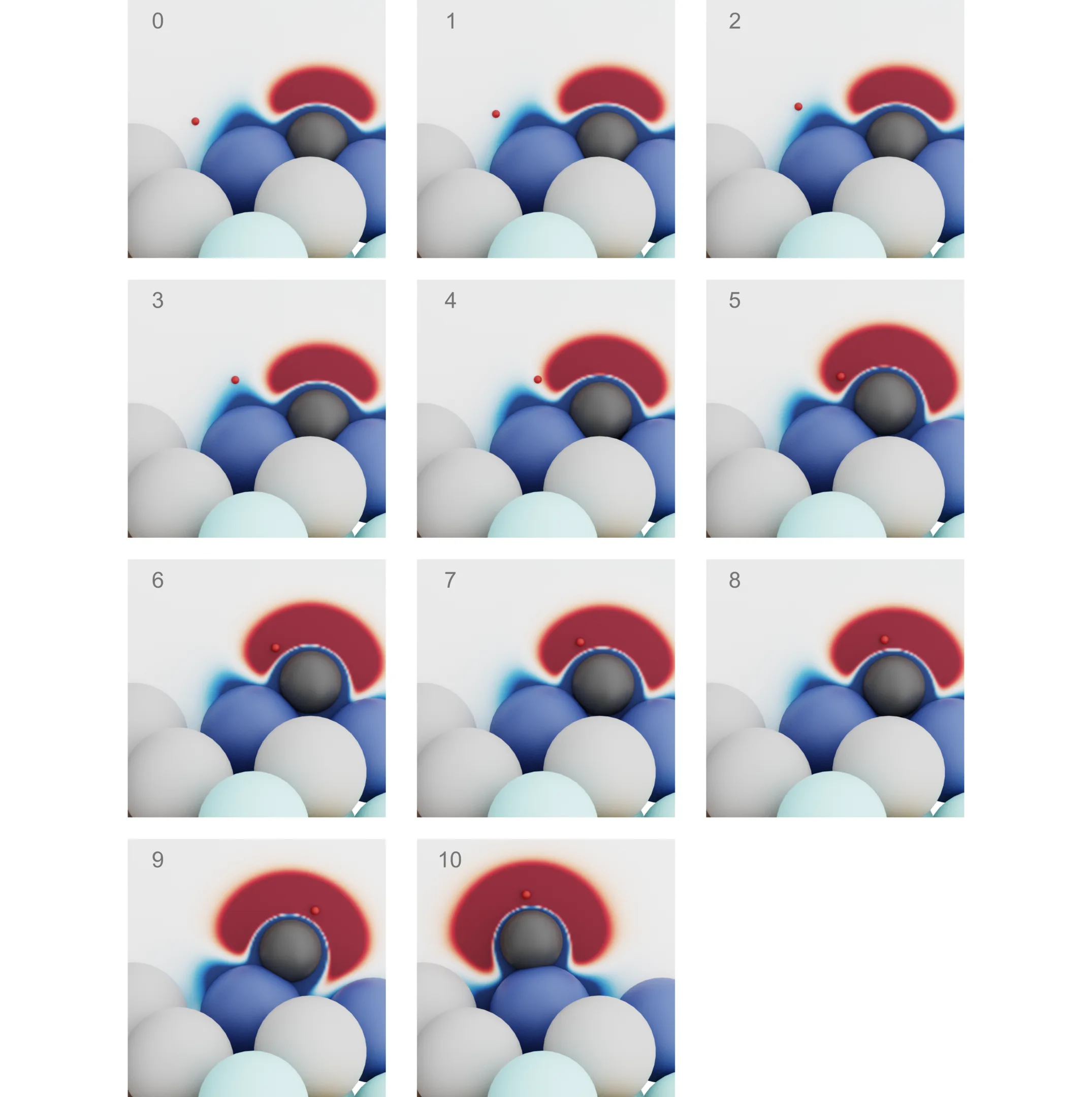
A kitchen sponge soaked in syrup: in some spots there's more syrup, and your finger sticks right away; in others, it barely touches. That's roughly how a catalyst surface works. Molecules don't react everywhere but at especially sticky points — active sites. For decades, chemists have hunted for them by looking at atomic arrangements, like treasure hunters with a map.
But the map lies. The same atom behaves differently in different surroundings, and sometimes a reaction happens where there seems to be no site at all. The authors of this work suggest throwing away the map and switching to a field. They introduce the concept of a covalent field — a continuous quantity at every point on the surface. It shows how strongly that point 'wants' to form a chemical bond. It's like temperature in a room: it makes no sense to ask at which point 'heat lives'—it's spread everywhere, just more in some places.
The field explains old puzzles. Linear relationships between energy and reaction rate (the Brønsted–Evans–Polanyi relation) were once considered an empirical trick without theory. In the new picture, they're simply correlations within the field when moving from one substance to another. And when the rule breaks, the field changes topology: a smooth hill turns into two peaks, and the bond breaks. The authors tested this on 120 thousand possible reaction pathways.
This view lifts the curse of ambiguity. You no longer have to guess which specific atom is active — the field itself highlights regions ready for reaction. It's like describing tides not by the motion of each drop but by sea level: coarser, but far more useful for navigation. The end brings us back to the beginning: the sponge with syrup is exactly a covalent field, only instead of sugar, it's electron density ready to share.
The word 'covalent' comes from Latin 'co'—together, and 'valere'—to have strength. So atoms share strength to stay together — almost like two rowers in one boat.
The idea of a field that governs reactions echoes the 'Sandworms of Dune': there, too, a continuous field (the desert) determines where active points (worms) appear, without tying them to specific coordinates.