A Genetic Anchor for Health express
You buy a new kitchen scale, but instead of exact weight, it only shows deviations from some "norm." To find out how much an apple weighs, you first have to weigh dozens of other apples and calculate the average. That's roughly how today's health monitoring systems work: they spend weeks collecting data on heart rate, blood pressure, and sleep to figure out what's usual for you and what's an anomaly. This is the cold-start problem — the model doesn't know you until it accumulates enough observations.
In a new study, scientists propose not to wait for weeks but to give the system a "cheat sheet" right away — your genetic profile. Genes don't change with stress or lack of sleep; they're like the foundation of a house, laid during construction. The researchers build a personal baseline on this foundation: they take hundreds of known genetic variants (the ones that large studies link to blood pressure, heart rhythm, metabolism) and calculate what level of heart rate or blood sugar is "programmed" specifically for you. This isn't a rigid verdict but rather an initial hypothesis that gets refined with each new measurement.
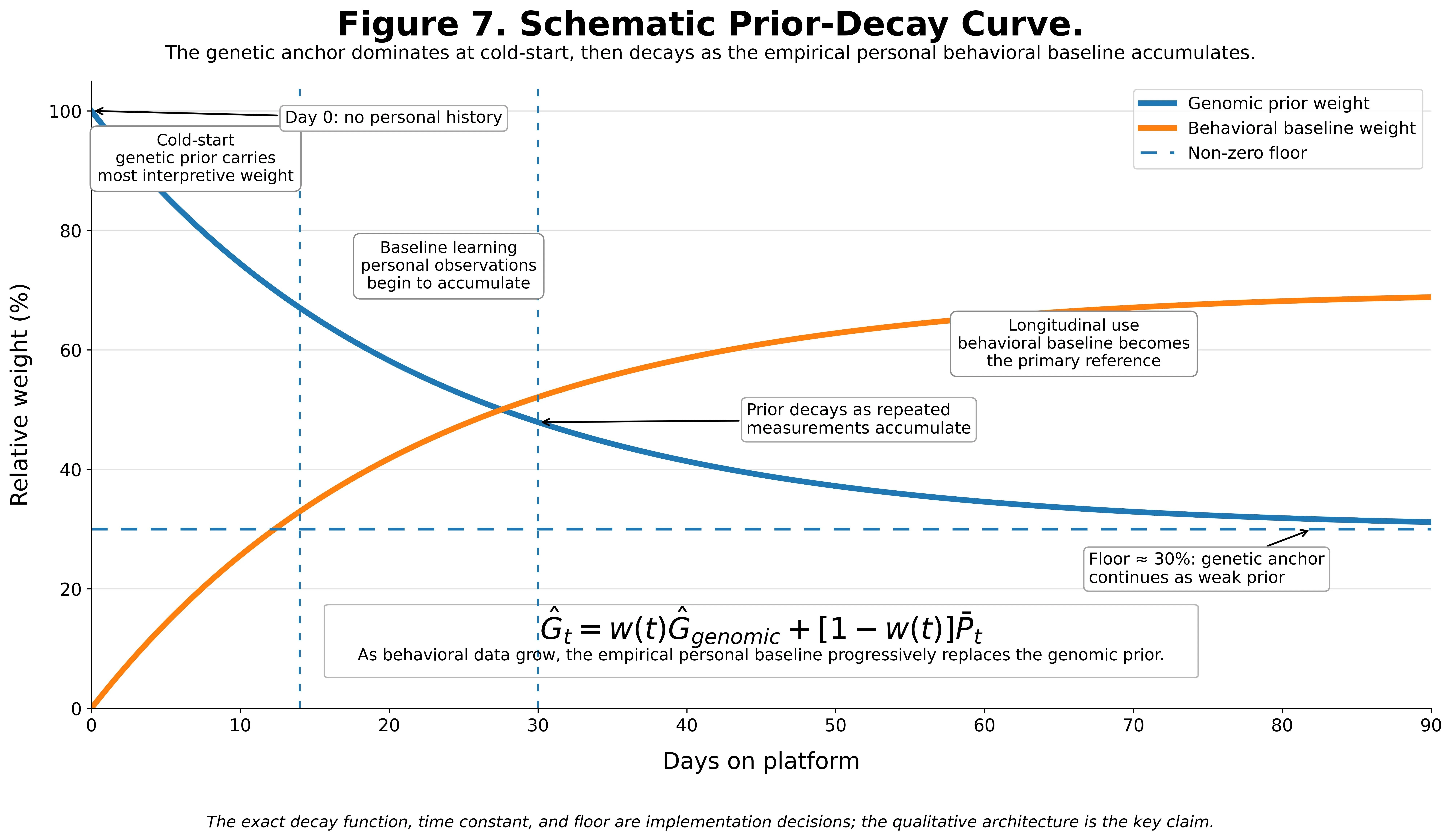
As real data comes in, the genetic "cheat sheet" gradually loses weight, giving way to live observations. The formula is simple: initially, the system relies almost entirely on the genetic prediction, and after a couple of weeks, it relies on what the fitness tracker has measured. But even at the end, the genetic anchor doesn't disappear completely: it's like an old friend who has known you since birth and helps you not to mistake a temporary cold for a chronic condition. This approach has already been tested for six physiological indicators, from heart rhythm to blood sugar levels, and uses only the most reliable, repeatedly verified genes, not dubious "aggression genes" or "happiness genes."
The difference between genetically predicted and actual heart rate can tell you more about stress than the heart rate itself: it's like a scale showing not just "70 kg" but "plus 2 kg after dinner."
In the series "Altered Carbon," a personality can be transferred to a new body, but a genetic anchor would make such technology even more complex: your "normal" is tied to DNA, not consciousness.