Quantum Computer Solves Einstein's Equations for the First Time express
Strike a tuning fork with a mallet — it vibrates, and the sound gradually fades. A black hole behaves much the same way when disturbed: it emits gravitational waves — ripples in spacetime itself — and then settles down. But to calculate this 'melody,' you need to solve Einstein's notoriously difficult equations, which describe how matter curves spacetime. Usually, this requires massive computer simulations, crunching numbers on thousands of processors.
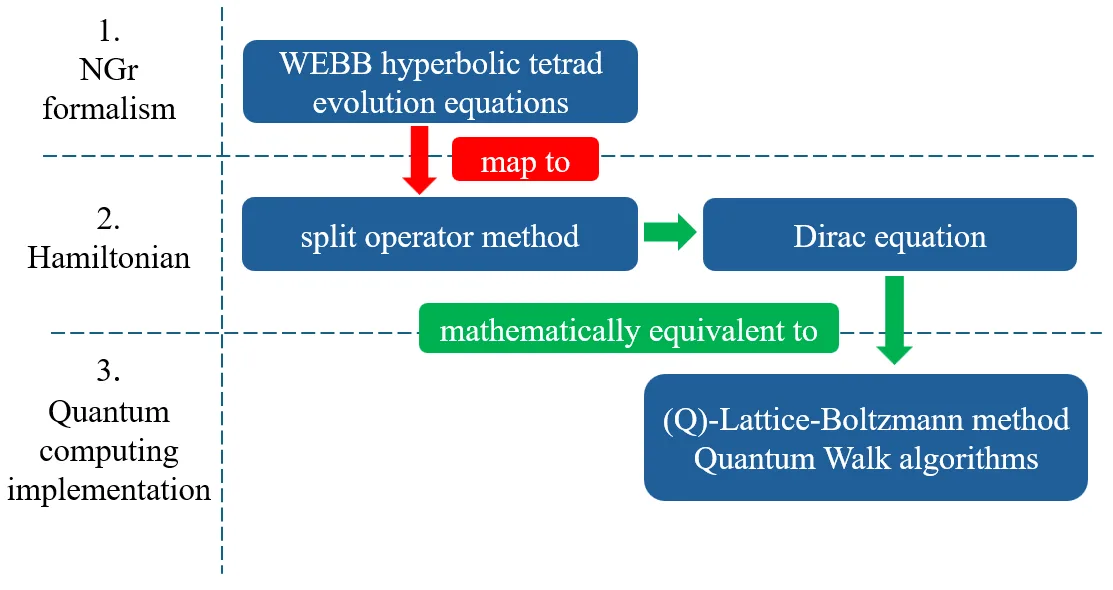
The authors of the new study tried a different approach — a quantum one. They translated Einstein's equations (specifically, a special form convenient for calculations) into the language of quantum circuits — sequences of operations on qubits. Then they took the simplest case: a Schwarzschild black hole — a massive sphere compressed to its limit, with no rotation. They 'struck' it with a small perturbation and tracked how so-called quasinormal modes emerged — damped oscillations, like the fading ring of a bell. The calculation was run on a quantum computer simulator and on a real IBM quantum processor, accessed via a cloud program.
For now, the problem is solved in a simplified form — as a proof of concept. But it's an important step: quantum computers could one day take over the hardest parts of calculations where classical machines struggle. For example, simulating the merger of two black holes with high precision, or the evolution of entire galaxy clusters. And then the tuning fork will sound at full volume.
Original abstract
as written by the authors arXiv:2606.20975
In this work, we show how simulations performed on classical computers such as those of Numerical Relativity can be tackled by quantum algorithms for solving systems of partial differential equations. We develop a proof-of-principle quantum algorithm for solving Einstein Field Equations in the Wahlquist-Estabrook-Buchman-Bardeen(WEBB) tetrad Numerical Relativity formalism [1], and test it by evolving the Schwarzschild Black Hole spacetime in the WEBB Numerical Relativity formalism [2], perturbing it to obtain gravitational Quasinormal Modes [3]. We program the algorithm components for a gate-based, digital quantum computer using the Qiskit software [4] and run it on classical simulators and physical IBM quantum computers through the UKRI National Quantum Computing Centre (NQCC) Quantum Access program and quantify the computational resources and runtime.
You can actually hear a black hole's quasinormal modes: scientists convert their frequencies into audible sound. The 'voice' of a black hole with a mass of 10 suns is a low rumble that quickly fades into silence.