Light in an Invisible Crystal: How to Control Condensation express
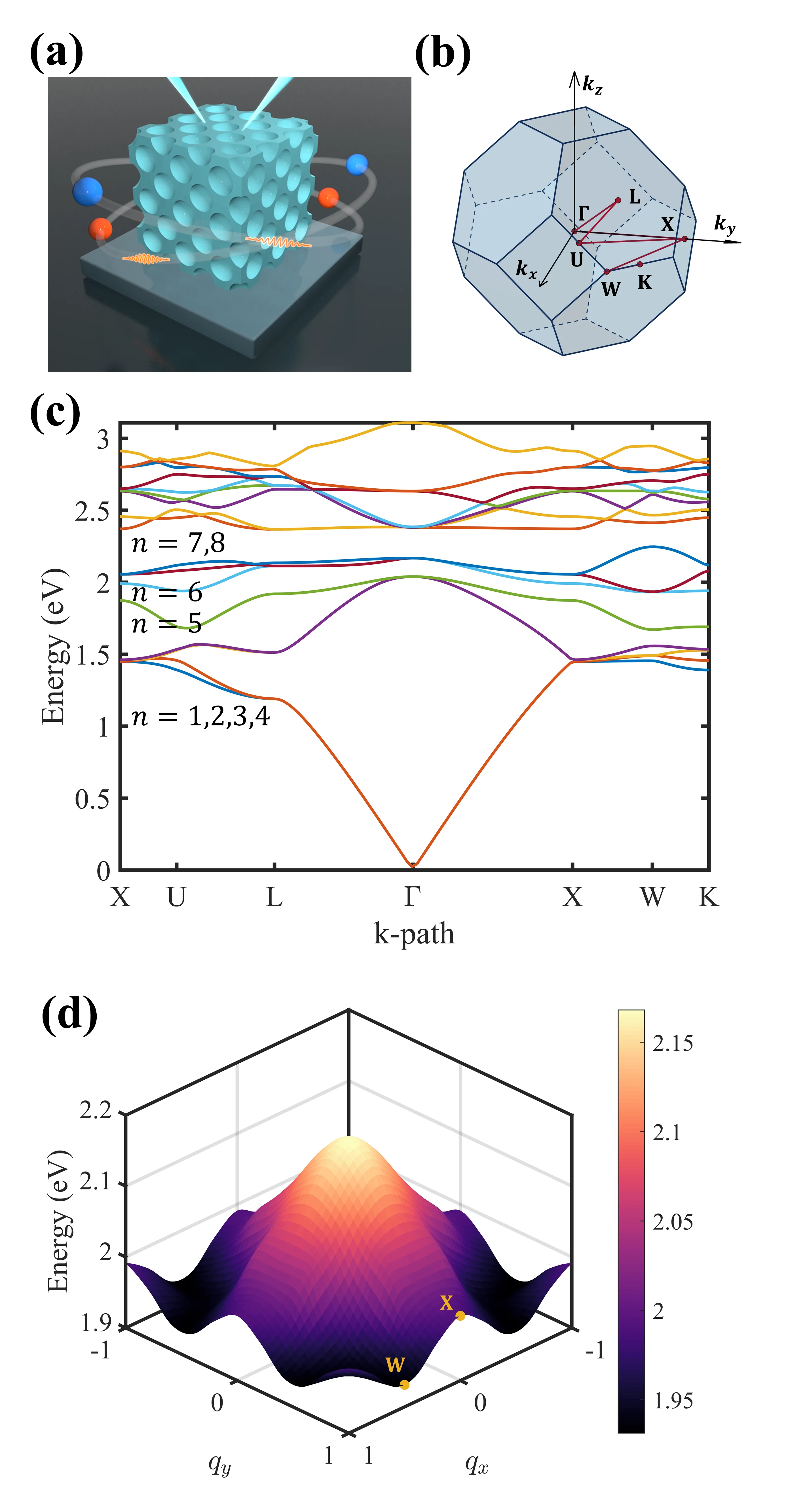
Light gets trapped in a crystal lattice, but not an ordinary one: it's turned inside out, like a honeycomb where instead of wax there's emptiness, and the edges are made of material. That's how an inverted opal is built: a three-dimensional photonic crystal that blocks light of certain colors. Inside this sponge, quantum dots were added — tiny semiconductor islands that can absorb and emit light.
When light and matter are strongly coupled, hybrid particles are born — exciton-polaritons (a mix of a photon and an excitation in a quantum dot). Their energy depends on the direction of motion, and valleys, local minima, appear on the energy map. In this work, two valleys play the main roles: the W-point (global minimum) and the X-point (a saddle point with enhanced density of states). The first sets the condensation threshold, the second acts as a reservoir: it accumulates particles and can feed the condensate if the energy difference is small.
The authors built a model that accounts not only for equilibrium Bose–Einstein condensation Bose–Einstein condensation, but also for non-equilibrium kinetics with pumping, emission, and transitions between valleys. By tuning the detuning and coupling strength, one can rearrange the relative positions of the W and X valleys, and with them the critical temperature. Under strong pumping, the system can produce a coherent state dominated by the X-valley, even if it is higher in energy. This is like an orchestra where the conductor can give the leading part not to the first violin but to the viola — if the hall's acoustics demand it.
Such an invisible crystal with quantum dots becomes a platform where condensation is not just a fall into the global minimum but a dance between valleys that can be choreographed at will.
Original abstract
as written by the authors arXiv:2606.21219
We develop a band-structure-based theory of exciton-polaritons in a three-dimensional inverse-opal photonic crystal doped with semiconductor quantum dots. Starting from a symmetry-selected bright photonic branch near the photonic gap edge, we construct an exciton-photon Hamiltonian and obtain a lower-polariton band with a W-point global minimum and a nearby X-point van-Hove-enhanced density of states. We show that the W valleys determine the equilibrium Bose-Einstein condensation threshold, while the X-point saddle provides a finite excited-state capacity that renormalizes the critical temperature when the W-X offset is thermally accessible. By tuning the exciton resonance and the light-matter coupling, the relative W-X ordering can be reconstructed, leading to a strong variation of the critical temperature. We further formulate a momentum-resolved Boltzmann model for driven-dissipative kinetics. Under non-resonant pumping, reservoir feeding, radiative decay, and inter-sector relaxation can produce either W-dominated condensation, a mixed W-X regime, or an X-dominated nonequilibrium coherent state. Our results establish three-dimensional photonic-crystal polaritons as a platform where condensation is controlled not only by the band minimum but also by valley geometry, van-Hove-enhanced phase space, and relaxation pathways.
The inverted opal is named after the mineral opal, which shimmers with different colors thanks to ordered silica spheres. In artificial opal, these spheres are packed, and the voids are filled with another material; then the original spheres are etched away — resulting in a structure with periodic voids, like perfect honeycombs in reverse.
The idea of tunable condensation in three-dimensional lattices evokes the "light crystals" from Greg Egan's novels, where quantum states serve as computational elements.