A Tiny Field, a Giant Quantum Leap
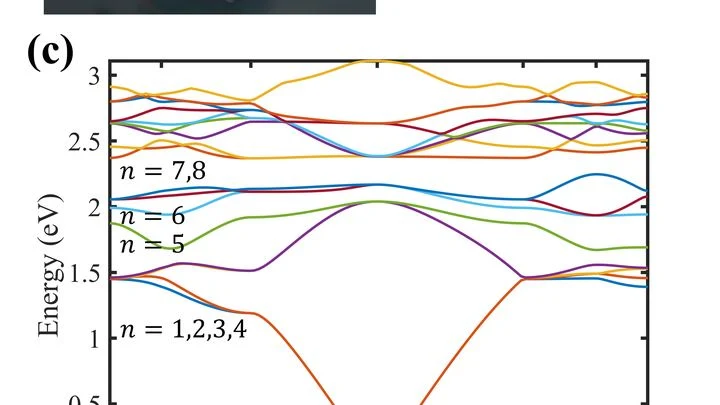
The hanmilite crystal, resembling a layered cake of copper and boron, behaves like a ladder: the copper spins are arranged in two parallel rails connected by rungs.
A hypothetical form of dark matter composed of ultralight bosons forming a cosmic Bose-Einstein condensate.Bose-Einstein condensate dark matter is a hypothetical form of dark matter composed of ultralight bosons, such as axions, that condense into a single quantum state on cosmic scales. In this state, the dark matter behaves as a coherent wave rather than individual particles, leading to unique gravitational effects. This model can explain the small-scale structure of the universe, such as the formation of galaxies and the distribution of dark matter in halos, while avoiding some issues of cold dark matter models.
The concept of Bose-Einstein condensates was first realized in laboratory gases in 1995, but the application to dark matter was proposed in the early 2000s by theorists like Wayne Hu and others, who suggested ultralight bosons could form a cosmic condensate.
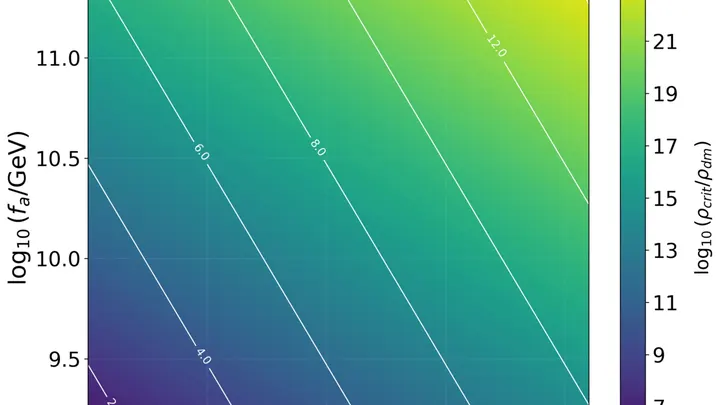
At sufficiently low temperatures and high densities, bosons occupy the same quantum ground state, forming a condensate. For dark matter, this means the particles act as a single macroscopic wave, with quantum pressure that can prevent the formation of cusps in galaxy centers and create interference patterns. The condensate's properties are governed by the particle mass and self-interaction strength, which determine the size of structures it can form.
This model is used in astrophysical simulations to predict the distribution of dark matter in galaxies and to interpret observations of gravitational lensing and galactic rotation curves, potentially distinguishing it from other dark matter candidates.
If dark matter is a Bose-Einstein condensate, it could form 'boson stars'—compact objects made entirely of the condensate—that might mimic the gravitational effects of black holes but have no event horizon.