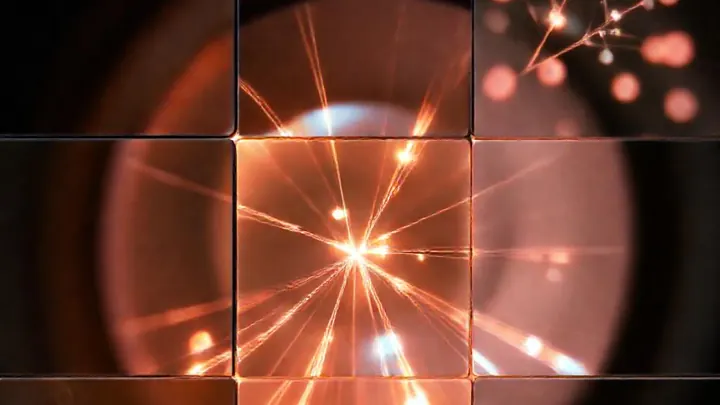
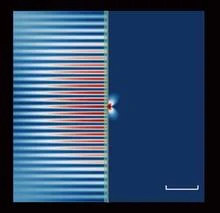
Light is not just a wave, but a stream of tiny energy packets — photons. The higher the frequency of light (the 'bluer' it is), the more energy each photon carries. It is like musical notes: high notes carry more energy than low notes. Red light is the 'bass', and violet is the 'violin'.
History
Max Planck empirically found a formula for the black-body spectrum in 1900, and to justify it, he assumed that the energy of harmonic oscillators in matter is a multiple of hν. Albert Einstein in 1905, in his work on the photoelectric effect, postulated that electromagnetic radiation itself consists of quanta with energy hν, making a decisive contribution to the development of quantum theory.
How it works
Widely used in spectroscopy, astrophysics, quantum optics and elementary particle physics to determine photon energy from wavelength or frequency. Explains threshold frequencies of the photoelectric effect, laser operation and fluorescence. In the classical limit (h→0), it reproduces wave optics; at high frequencies, it describes gamma-ray bursts and hard cosmic radiation.
Fun fact
One gamma-ray photon from a distant cosmic burst can carry as much energy as a flying mosquito! But ordinary light is so weak that it does not burn our eyes.
In the dark kitchen of the Taurus molecular cloud, 450 light-years away, dozens of planetary systems are being prepared. Each young star is a chef, and its protoplanetary disk is a counter piled with flour-like dust and steam-like gas.
A black hole isn't just a cosmic vacuum cleaner. If it rotates, it can amplify waves around it, much like a mountain echo repeats sound. For ultralight dark matter (particles billions of times lighter than an electron), this effect, called superradiance, can create a huge cloud.
A planet in the habitable zone is no guarantee of life. Like a conductor leading an orchestra, a star dictates the tempo and character of planetary atmosphere evolution over billions of years.
In a quiet room, you can hear the faintest whisper. Likewise, in the hydrogen atom, the lightest of all, an uninvited guest is easier to spot. That guest could be the Z' boson, a mediator particle of a new force predicted by many unification theories. The Standard Model already has its own mediator — the Z boson.
At the center of many galaxies lurks an invisible cloud — a halo of dark matter. If this matter is cold and light enough, it behaves like a superfluid: it flows without friction, and any rotation in it twists into tiny quantum vortices — threads the size of an atomic nucleus.
Imagine an artist whose canvas is an entire planet, and whose palette is molecules drinking starlight. His brush is billions of years of evolution, and his painting is a spectral portrait visible even from another star system.
Quantum technology urgently needs a universal 'translator' between the languages of microwaves and light. Superconducting qubits communicate on centimeter wavelengths, while photons in optical fiber talk at optical frequencies.
Imagine a skyscraper assembled not from individual bricks but from entire studio apartments. That's exactly how the Au₆Te₁₂Se₈ crystal is built: its nodes are not atoms but superatomic clusters of gold and chalcogens that behave as single quantum objects.
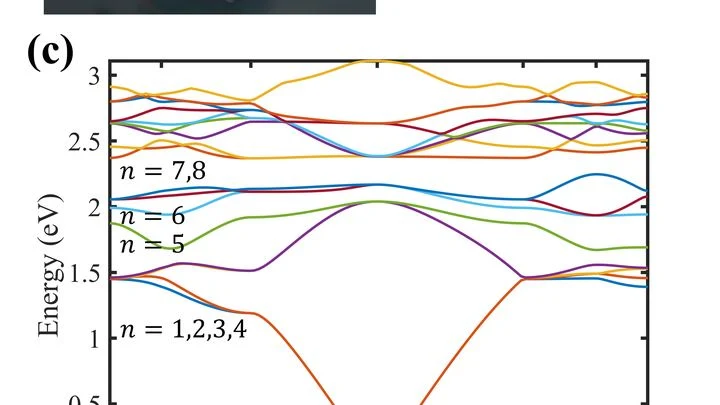
Light gets trapped in a crystal lattice, but not an ordinary one: it's turned inside out, like a honeycomb where instead of wax there's emptiness, and the edges are made of material. That's how an inverted opal is built: a three-dimensional photonic crystal that blocks light of certain colors.
In very dim light, photons arrive one by one, like drops from a leaky faucet — never in pairs. This effect, predicted by Roy Glauber and confirmed by Leonard Mandel, directly proves that light is made of particles.
A neutron star is the leftover core of an exploded giant, compressed to the size of a city. A teaspoon of its matter weighs a billion tons. Inside such a star, particles are packed so tightly that quantum effects start to show. One of them is the intrinsic rotation of particles, or spin.
Two massive spheres slowly drift apart in empty space. From the standpoint of ordinary mechanics, nothing special is happening. But Einstein's equations say otherwise: accelerating masses stir spacetime itself, and from them spread gravitational waves — ripples that stretch and squeeze everything in their path.
Light falling into a black hole carries information — for instance, the path a photon took. The horizon (the surface from which nothing returns) responds by changing its entropy — a measure of disorder, akin to the number of shuffled pages in a book.
Light loves symmetry: in an open channel, it flows equally both ways. To steer it one way, physicists often use magnets. A new approach does without, using rotation — just the speed of a vinyl record — and interference from two atoms. Rotation changes the “pitch” of light for different directions, just as a siren’s tone shifts when a car approaches or recedes.
A pendulum swings in thick syrup. In the first fractions of a second, it moves quickly, but the syrup slows it down, and then suddenly the syrup becomes thinner, and the pendulum speeds up again. Something similar might have happened to our universe.
In the quantum world, light and matter constantly exchange energy. Previously, they were described statically, like frozen poses. The new approach follows the dance itself: the transitions between states, like a continuous sequence of movements.
A juggler tosses clubs while sitting on a spinning chair. If he starts spinning the clubs all in one direction, the chair will rotate the opposite way — otherwise, the conservation of angular momentum would be violated.
If you squeeze a handful of sand in your fist, it first compacts, but then starts to resist — the grains have nowhere left to go. In the depths of a neutron star, something similar happens, except instead of sand grains, you have elementary particles, and instead of your hand, you have monstrous gravity.
If you pour sand into a glass, it settles in a flat layer. But instead of sand, take the tiniest particles of gas: in a gravitational field they don't just fall: each particle races along its own trajectory, collides with neighbors, and all this commotion creates pressure.
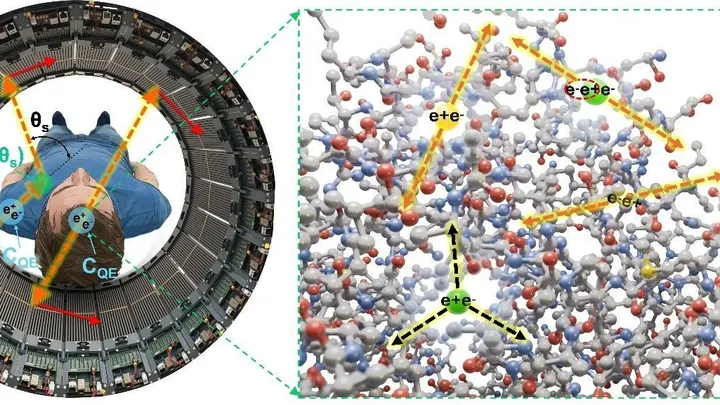
Two photons fly out from a single point in a patient's chest. They are twins: alter one, and you instantly know about the other. This connection is called quantum entanglement. In a PET scan, these pairs are born inside the body when an injected radioactive substance meets electrons in the tissues.
The degree of entanglement is not constant.
To uncover the proton's true size, physicists swapped the electron in a hydrogen atom for its heavy copy — the muon. Acting like a magnifying glass with thousandfold power, the muon gets right up against the nucleus and 'probes' the proton with unprecedented precision.
An ordinary envelope has a rectangular shape, and the letter inside does not change the envelope's properties. With photons, particles of light, the situation is different: their 'shape' in time can vary, and this shape itself carries information.
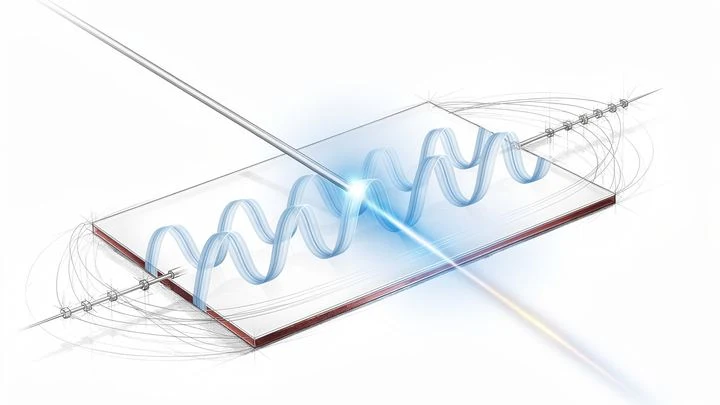
The light an atom emits is not just a flash. It carries an imprint of the atom's state at the moment of emission. Physicists took a superconducting qubit, an artificial atom the size of a microchip, and made it glow into an open waveguide, like a bulb in a long corridor.
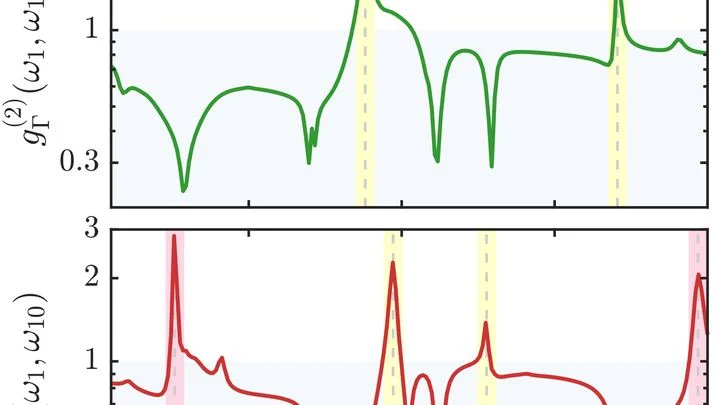
A quantum dot is like a tiny lamp that turns on and off at the command of a laser, emitting exactly one photon at a time. But this light has a quirk: the photons don't interact with each other; they fly independently, like random drops from a faucet.
A quantum dot the size of a virus, squeezed between mirrors, gives birth to two photons in a short flash of light. These photons fly out as a pair, and their polarizations, the directions of wave oscillation, are linked such that knowing one instantly tells you the other.
In a dark room, an atom and light are locked together in a mirrored box. The box is so small that the atom cannot simply release light: they constantly exchange energy, like two dancers who never let go of each other's hands.
Cosmic rays are charged particles that constantly bombard Earth from deep space. When one of these particles enters the atmosphere, it collides with air nuclei and spawns a whole cascade of secondary particles: electrons, muons, photons.
Sunlight is a turbulent stream carrying inseparable pairs of droplets. That’s what quantum entanglement looks like: two particles are so connected that a fluctuation in one instantly resonates in the other. In the past, creating such pairs required a 'calm pool' — a perfectly tuned laser beam.
A charged particle spiraling in a magnetic field doesn't stay silent: it emits light. This light is called synchrotron radiation, and it shows up everywhere — from distant galaxies to laboratory accelerators.
In the 19th century, James Clerk Maxwell imagined a tiny demon. It knows the speed of every gas molecule and opens a door: fast ones to the left, slow ones to the right. This creates a temperature difference without expending energy, seemingly violating the laws of physics.
A hot coffee cools by radiating invisible light. To maintain temperature, it must receive exactly as much light back. This silent trade of photons is what we feel as steady warmth.
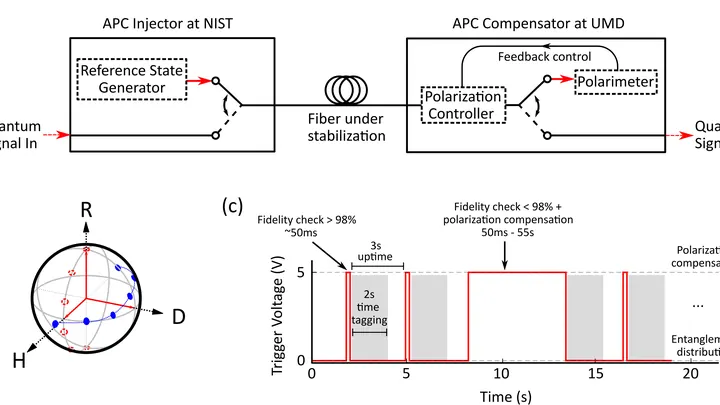
Two photons, like two halves of the same coin, fly tens of kilometers apart but remain linked: measure one, and you instantly know the state of the other. This property is called entanglement, and it underpins quantum communication.
Time flows slower near the ground than on the roof: this was predicted by Einstein in his theory of relativity. To spot the tiny difference, physicists propose using a pair of photons, linked like voices in a duet.
Entangled photons are like twins: what affects one instantly affects the other, even if they are separated by kilometers. Until recently, observing such a connection required detectors that counted each photon individually in pitch darkness. Physicists simplified the task by swapping them out for a regular scientific camera.
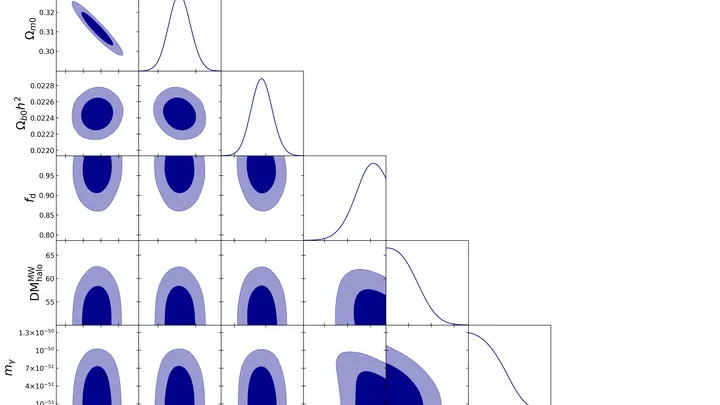
Fast radio bursts are brilliant cosmic flashes that, like a starting signal, set off a race of radio waves across the universe. Astronomers used them as a natural laboratory to test whether the photon, the quantum of light and the carrier particle of the electromagnetic interaction, has mass.
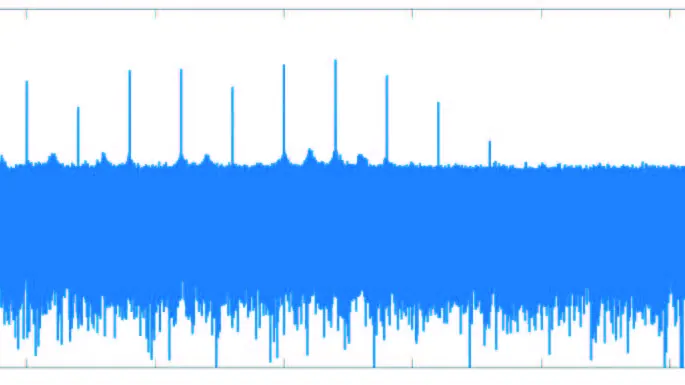
Light consists of portions — photons. Max Planck was the first to understand that light is emitted in quanta. Today, we can guide single photons. When such a photon encounters a fast shutter, it cannot be sliced — half a photon doesn't exist. Instead, a quantum mixture of states with different photon numbers emerges: zero, one, two, three..
Two great theories describe reality: one — how massive bodies cause curvature of space, the other — the Standard Model — governs elementary particles. Reconciling them remains elusive, like trying to describe an ocean storm in the language of a diamond lattice.
A single photon passes through two slits and leaves an interference pattern on a screen. Quantum mechanics describes this process with a wave function, but what happens to the particle itself?