Ghost particles reveal the secret of galactic bubbles ✛ ✎ ✦
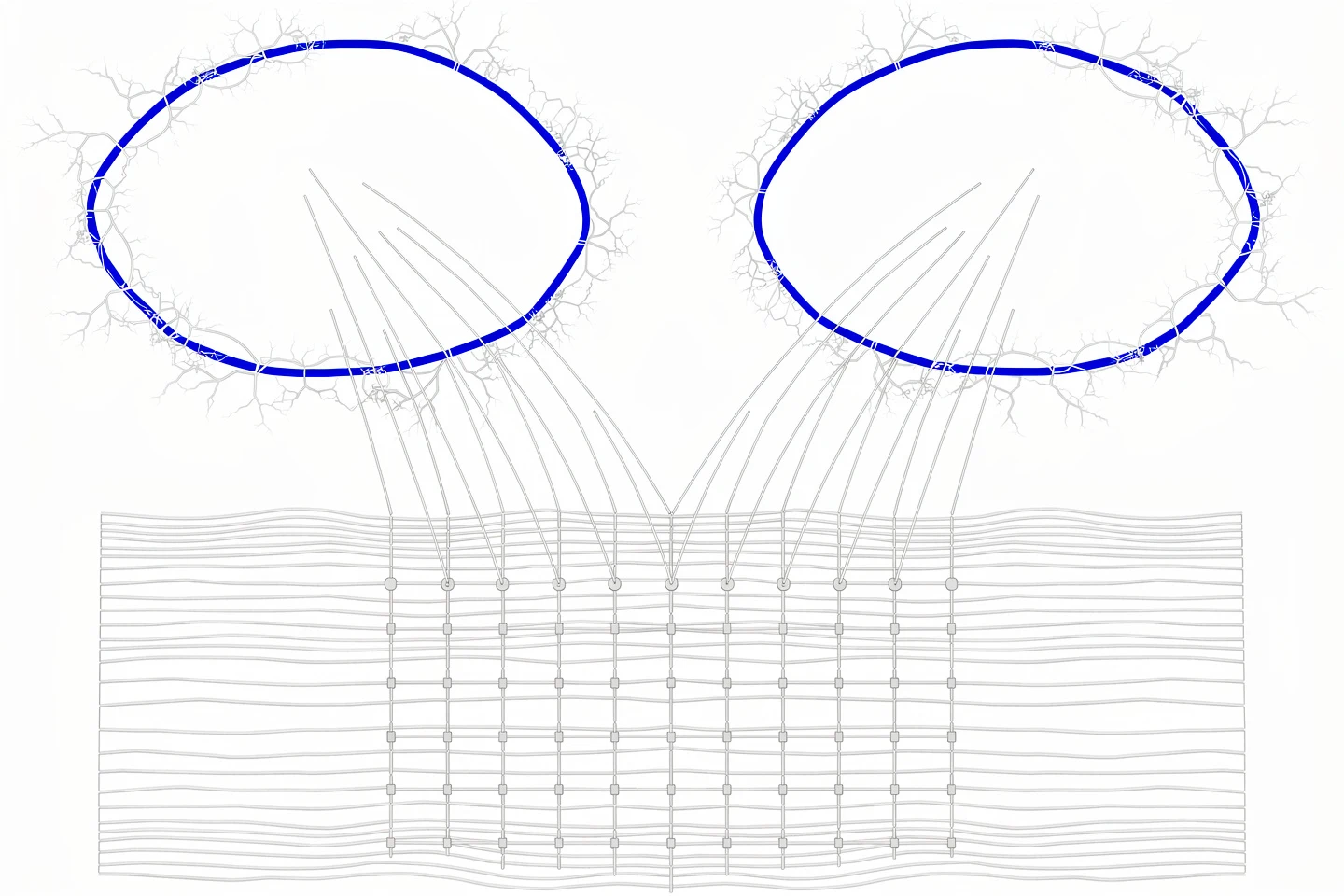
In the center of the Galaxy, a supermassive black hole once ejected two gigantic bubbles of searing plasma — gas where atoms have lost their electrons. They still hang above and below the disk of the Milky Way, and at their boundaries, shock waves collide with the interstellar medium (the thin matter between stars) and accelerate protons to nearly the speed of light. Astrophysicists suspected that this is exactly where cosmic rays — high-energy particles bombarding Earth — are churned out. There was no direct proof until the IceCube neutrino telescope, frozen into the Antarctic ice at a depth of 2.5 km, caught neutrinos — ghost particles born when protons smash into gas. Over 12 years of observation, it detected an excess of them from the direction of the bubbles.
This discovery turned guesswork into fact: Fermi bubbles are natural accelerators. Data from radio astronomy (observations in the radio band) and spectroscopy (analysis of light by wavelength) had long hinted at this, but only the elusive neutrinos became the decisive clue. Now it's clearer how active galactic nuclei spawn powerful jets of matter. And the eROSITA telescope, in the creation of which Rashid Sunyaev participated, recently found even larger bubbles — possibly from an ancient breath of the Galaxy.
The Fermi bubbles were discovered in 2010 by the Fermi gamma-ray telescope. The debate still rages: were they born from a supermassive black hole or from a burst of star formation in the Galactic center?