Magnetic Portrait of Earth's Core express
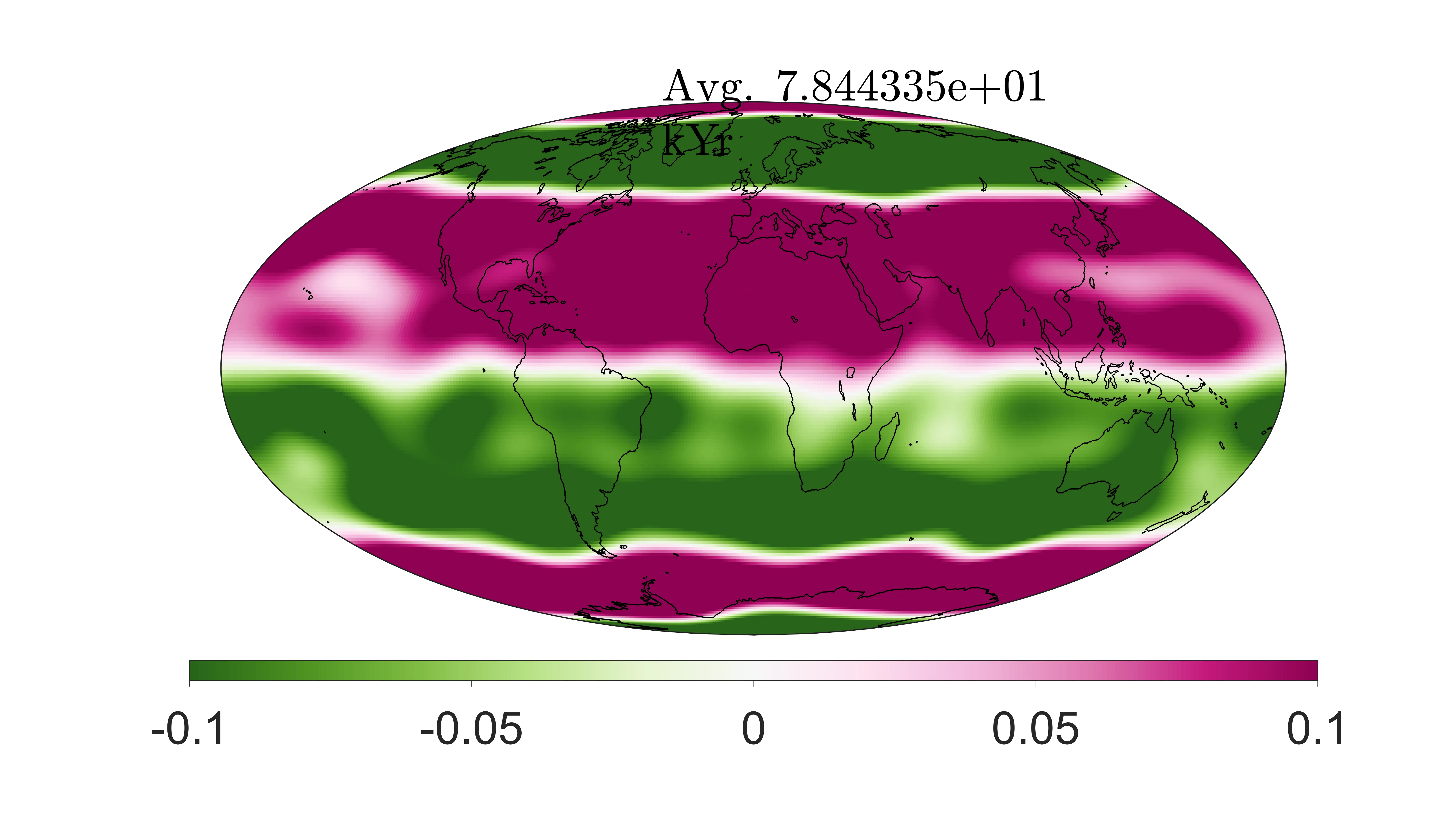
Earth's magnetic field is like an invisible shield that protects us from cosmic radiation. But if you look closely at its long-term averaged pattern, you'll notice that this shield isn't perfectly smooth: it has its own "seams" and "patches." New research using computer simulations of the geodynamo shows that these irregularities arise from two main forces churning in the planet's liquid core: heat flows from the mantle and chemical processes.
The authors created a series of models where they varied the balance between thermal and chemical energy. Heat from the mantle, it turns out, acts like an uneven heating pad: where it presses closer, the flows in the core are stronger, and this imprints as magnetic anomalies elongated along longitude. Chemical energy, linked to the growth of the solid inner core, works like a powerful mixer that stirs the material and smooths out these longitudinal patterns, but at the same time creates deep "funnels" of weakened field near the poles.
The simulation results matched real observations: to explain paleomagnetic measurements over thousands of years, both inhomogeneous heating from the mantle and chemical mixing must be taken into account. One without the other paints an incomplete picture. It turns out that Earth's magnetic portrait is the result of a delicate balance between a thermal "artist" and a chemical "sculptor."
Original abstract
as written by the authors arXiv:2606.26042
The time-averaged geomagnetic field provides crucial insights into deep Earth dynamics and thermal core-mantle interactions. Paleomagnetic observations and numerical dynamo simulations are equivocal regarding the longitudinal structure of the time-averaged field, though the latter have often considered a generic buoyancy source, which may obscure distinct signatures of thermal and chemical buoyancy that arise near the equator and poles, respectively. In this study, we present a new suite of top-heavy geodynamo simulations, varying the relative strengths of thermal and chemical driving and comparing the resultant magnetic signatures to observational field models spanning centuries to tens of thousands of years. None of the spatially-averaged measures of field morphology and variability we tested could robustly distinguish between different levels of chemical driving or the presence of heterogeneous outer boundary heat flux. On the other hand, observational constraints requiring longitudinal variations in time-averaged inclination anomaly are readily matched by simulations with heterogeneous outer boundary thermal forcing, in contrast to those with homogeneous mantle heat flux. Longitudinal field structures are reduced, but not erased, by elevated chemical driving, which also promotes the formation and deepening of polar minima in the radial magnetic field. Our simulations indicate that both the strong heat flux heterogeneity and chemical driving in Earth's core are likely to result in small but persistent departures from the geocentric axial dipole approximation.
If Earth had no magnetic field, the solar wind could "blow away" our atmosphere just as it likely did on Mars.
In the novel "The Core," magnetic anomalies trigger a global catastrophe, but our reality is far calmer: these same anomalies are simply a key to understanding how the planetary "engine" works.