Giant Atoms Solve an Unsolvable Quantum Puzzle express
A network of tiny magnets seeks the state with the lowest total energy: that's roughly what the quantum Max Cut problem looks like, one of the toughest in physics. Scientists have been hunting for its solution since the days of Werner Heisenberg. A new approach harnesses Rydberg atoms: here an electron is so far from the nucleus that the atom balloons to a size comparable to the thickness of a human hair, behaving like a giant hydrogen atom. Such atoms are studied by spectroscopy.
The system of these atoms is slowly “annealed”—like cooling metal, it naturally settles into an almost perfect arrangement of magnets. The remaining disorder, or entropy, is cleaned up by a classical optimizer algorithm. The hybrid method achieved a record accuracy of 0.651. And even if the quantum part makes mistakes, the final result still beats purely classical solutions.
These very same giant atoms are so sensitive that they can detect individual particles of light, turning into ultrasensitive detectors.
Original abstract
as written by the authors arXiv:2606.27224
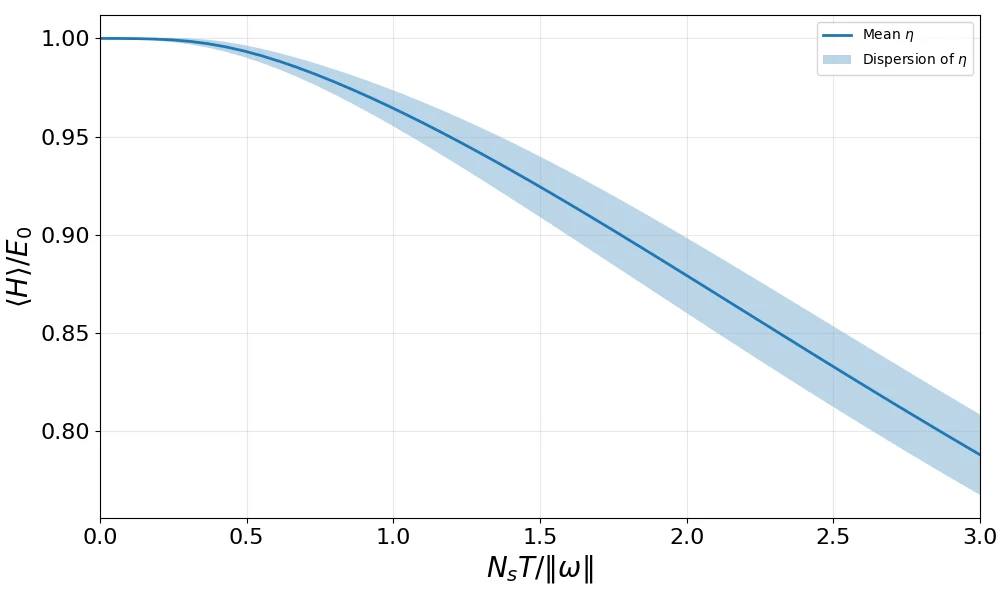
Quantum Max Cut, also known as the anti-ferromagnetic Heisenberg Hamiltonian, is a QMA-complete problem which serves as a benchmark for approximation algorithms in quantum physics. Here we develop a hybrid approximation algorithm to quantum Max Cut, which uses the natural quantum dynamics of Rydberg atom systems in combination with semidefinite programming and randomized rounding. It achieves a conditional approximation ratio of $$0.651$$, compared to the best-known ratio of $$0.614$$ that relies on semidefinite programming alone. The algorithm is robust in the sense that the advantage persists even if the annealing procedure of the Rydberg atom system obtains a state whose energy is only $$89\%$$ of its true ground state energy. Our approach opens a new route for hybrid quantum-classical algorithms that combine quantum with classical optimization methods.
Rydberg atoms are so sensitive that they can capture single photons, working as ultrasensitive light detectors.