Neutrons Holding Hands ✛ ✦
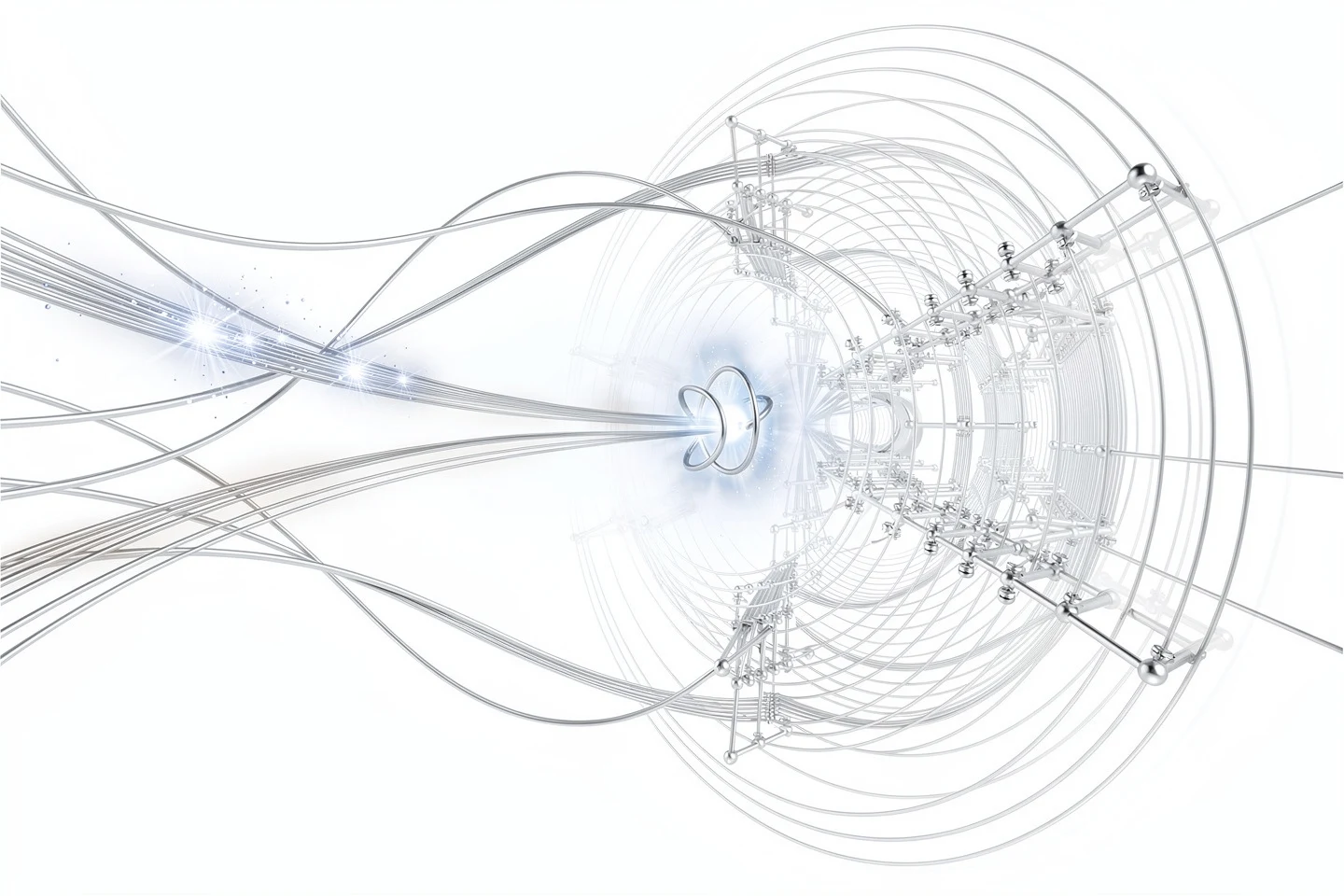
In the world of the atomic nucleus, two neutrons can move as if holding hands — like dancers in a tight embrace. Experiments showed that their separation angle is 50 degrees, not 90 — meaning they emerge already paired. Usually, the rules of nuclear physics forbid particles from getting that close. But neutrons mix their states and bypass the restriction, becoming a single duet. Computer simulations and accelerator experiments confirmed: this is a paired condensate, similar to the one predicted by Bose and Bardeen, and described by Landau in superfluidity. It’s surprising that such pairs usually require ultra-low temperatures, yet in the nucleus they arise under extreme heat. In neutron stars, dineutrons accelerate cooling, and in space they take part in the birth of gold and uranium.
The term 'dineutron' sparks debate: some physicists use it for any neutron pair, others only for an especially compact one. Nowadays, a dineutron is generally understood as a bound pair.
In science fiction, ultra-dense 'neutronium' serves as a material for alien technologies — and real dineutrons could be its building blocks.