The Quantum Tango of Neutrons: The Dineutron on the Edge of Stability ✛ ✦
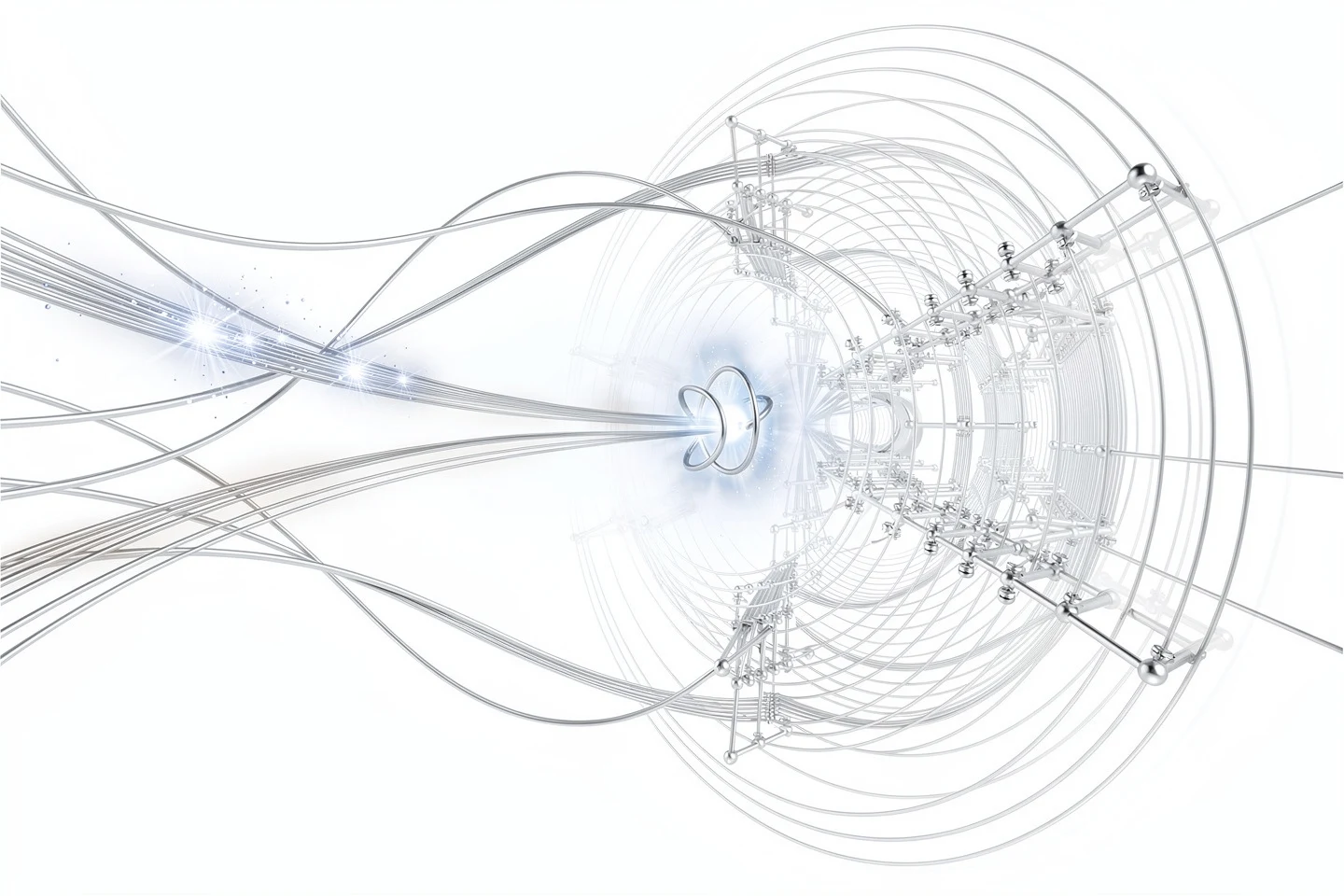
In nuclear physics, the belief long reigned that two neutrons cannot form a bound state — they attract too weakly and immediately fly apart. However, on the surface of neutron-rich nuclei, where the matter density drops to a thousandth of normal nuclear density, the situation changes dramatically. Here, neutrons perform an unprecedented quantum dance, forming a compact duo — the dineutron. This effect resembles a tango. The partners alternately approach and retreat, swapping the roles of ‘leader’ and ‘follower’. In quantum language, this is a superposition of states with different parity. It is precisely this choreography that allows the pair to overcome the Pauli exclusion and come together at distances unthinkable for free neutrons. Remarkably, the dineutron correlation disappears if the excitation energy exceeds just 1 MeV — a fragility astonishing for the nuclear world. The idea of such correlations was predicted back in the 1970s, but only in the last decade have ultra-modern experiments transformed the hypothesis into an observed fact.
The key to observing the dineutron turned out to be exotic nuclei with two-neutron halos — for example, helium-6 and lithium-11. In these systems, a pair of weakly bound neutrons moves far beyond the dense core, forming a diffuse ‘atmosphere’. When bombarding such nuclei with protons or during Coulomb breakup, physicists measure the opening angle between the neutrons. The expected average angle from an uncorrelated pair is about 90 degrees. Reality proved far more intriguing.
These data, complemented by precision laser spectroscopy and three-body calculations, confirm that the neutrons in the pair are held together not by random proximity, but by a dynamic structure where mixing of s- and p-waves plays a key role. Essentially, this is quantum entanglement, guided by nuclear forces at the edge of binding.
The discovery of the dineutron brings nuclear physics onto a universal stage, because such correlations exactly correspond to the BCS–BEC crossover — the transition between the Bardeen-Cooper and Bose-Einstein regimes. In ordinary superconductivity, Cooper pairs are huge; on the BEC side, they collapse into compact bosons. The dineutron realizes precisely this regime, but in dilute nuclear matter. This makes it akin to experiments with ultracold atoms and allows transferring the ideas of Bose, Bardeen, and Landau (from superfluidity theory) into the world of the atomic nucleus. For astrophysics, this is critical: in the crust of neutron stars, densities are just low, and dineutron clusters can influence heat transfer and, possibly, superfluidity, altering the star’s cooling rate.
Recently, the hunt for the dineutron has led to even more exotic findings. The record weakly bound nucleus oxygen-28 apparently emits neutrons in pairs — dineutron after dineutron. And the tetraneutron — a system of four neutrons without a stable core — has loomed in experiments as a resonance near 2 MeV.
Thus a bridge is cast to purely neutron matter — still terra incognita. Describing it theoretically requires going beyond the conventional shell model and invoking quantum field methods capable of accounting for strong fluctuations at the stability limit.
Future experiments at FRIB and FAIR facilities with next-generation detectors having millimeter resolution will directly measure angular correlations in the decays of 26O and 28O and settle the debate on the nature of the tetraneutron. But it is already clear: dineutron correlations are not an isolated curiosity, but a generic property of dilute neutron matter. They affect the rate of rapid neutron capture (r-process) during neutron star mergers, and hence the abundance of heavy elements in the Universe. A story that began with a narrow opening angle in lithium is turning into a new chapter in the physics of strongly interacting Fermi systems. The quantum tango of the dineutron teaches us: even at the edge of the nuclear world, where there seemed no room for binding, nature finds an elegant way to weave pairs together.
The term ‘dineutron’ was historically ambiguous: some physicists used it for any two neutrons with small relative energy, others only for a spatially compact pair. Today, the consensus leans toward the second definition, emphasizing that the dance is not a random encounter but a deliberate choreography.
In science fiction, neutron matter is often depicted as ultra-dense ‘neutronium’, from which impenetrable armor can be built. The idea of dineutron and tetraneutron clusters breathes new life into this concept: perhaps in the distant future, engineers will learn to stabilize tiny neutron droplets for exotic technologies — a kind of quantum ‘capsules’ of neutronium, familiar from the novels of Stephen Baxter.