Black Holes Grow a Fur Coat on the Fly express
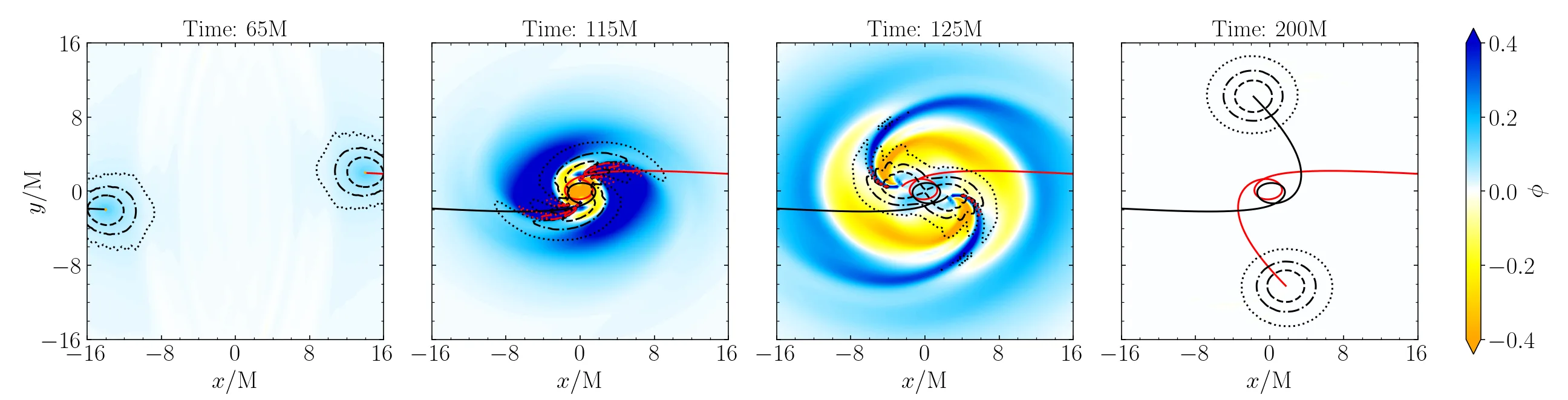
Two black holes race past each other like Formula 1 cars on opposite lanes. In standard general relativity, they remain 'bald'—no extra fields appear around them. But if you add a scalar field to the equations (something like an invisible fog permeating space), the rules change.
The authors numerically simulated such encounters in a theory where gravity interacts with a scalar field in a special way. Initially, they set a barely noticeable field around the holes, like a light haze. Then they saw that during a close flyby, this haze can suddenly thicken. For a brief moment, a scalar fur coat appears — an effect physicists dubbed dynamical scalarization.
The most interesting part happens after the flyby. If during the encounter the black holes exchange angular momentum, their spin can change. Sometimes so much that one of the holes permanently acquires scalar 'hair' or, conversely, loses it. This permanent effect was dubbed spin (de)scalarization by the researchers.
Original abstract
as written by the authors arXiv:2606.30865
We use numerical relativity to study the scalar field evolution sourced by hyperbolic encounters of black holes in quadratic scalar Gauss-Bonnet gravity. In this theory, single black holes are known to acquire a scalar hair through scalarization for certain values of their mass and spin. We work in the decoupling limit and evolve the scalar field on top of a background metric. Seeding binary black holes with an initial scalar field, we find that configurations which initially cannot sustain a scalar hair temporarily scalarize during an encounter and thereby exhibit dynamical scalarization. This is possible for both positive and negative couplings between the scalar field and curvature in black hole binaries with zero and non-zero initial spins, respectively. Furthermore, we find that the change in the spin magnitude of black holes during certain hyperbolic encounters can lead to permanent spin-induced scalarization (or descalarization), which we refer to as spin-up (de)scalarization.
The scalar field around a black hole can be imagined as an invisible 'fur coat' that appears only for certain values of mass and spin, like an animal changing its coat with the seasons.
In Robert Wilson's novel 'Spin', a mysterious barrier alters the properties of space — similar to how a scalar field manifests itself only under extreme gravitational conditions.