The Inner Horizon of a Black Hole: From Blast to Calm express
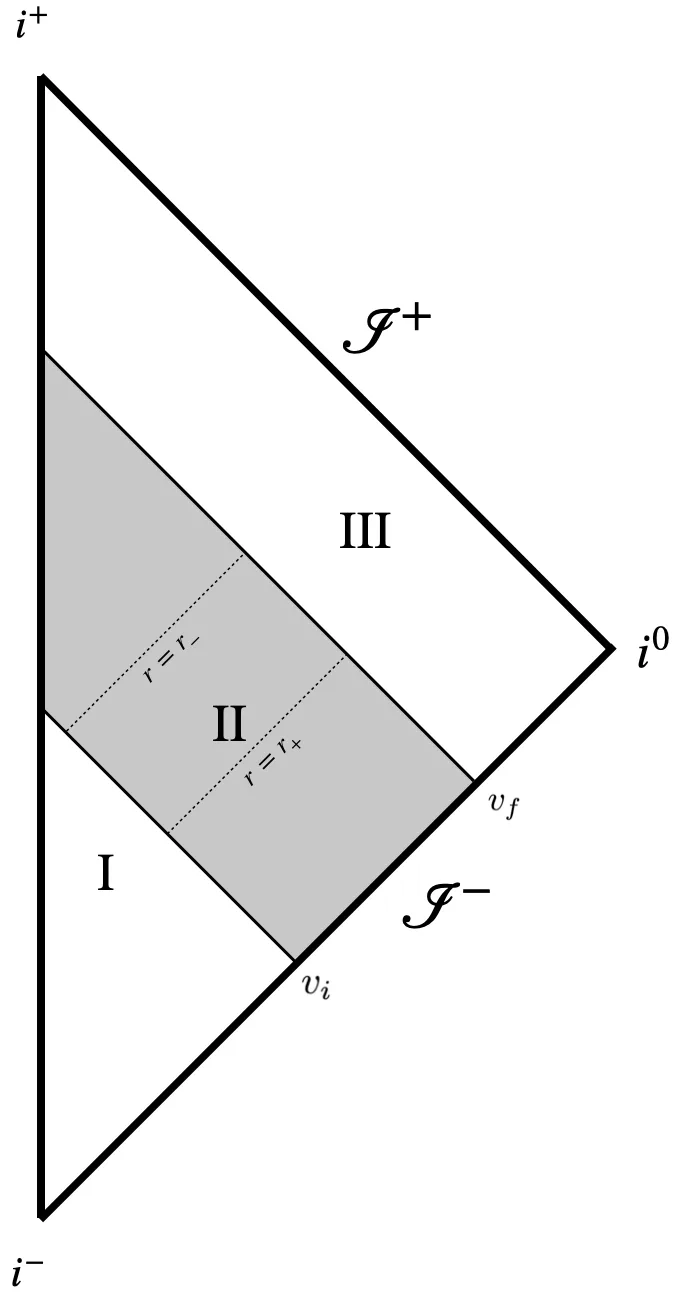
When a giant star runs out of fuel, it collapses into a black hole. Such a hole has an outer boundary — the event horizon, beyond which even light cannot escape. But many black holes also have an inner boundary — a second horizon that separates the outer layers from the singularity core. For a long time, it was believed that any such inner horizon is doomed: the slightest disturbance triggers an avalanche — energy piles up like a snowball, and spacetime tears apart. This is known as the classical instability of mass inflation.
However, a team of physicists led by Roberto Peccei discovered a subtlety. They considered not an eternal black hole but a realistic scenario: a black hole forms from collapsing matter and eventually evaporates due to quantum effects — Hawking radiation. In this picture, the inner horizon ceases to be a "Cauchy horizon" — a boundary beyond which the predictions of physics break down. Without this status, quantum fields behave much more calmly: their energy does not blow up to infinity but remains finite everywhere.
But the most interesting part is the difference between ordinary and "extreme" inner horizons. For ordinary ones, energy still grows — exponentially, like a chain reaction, but only while the hole exists. For extreme horizons, where surface gravity is zero, the growth becomes power-law — much more gradual. Such a hole can be compared to a boiler where pressure builds up not explosively but slowly, like in a cooling teapot.
This means that the interior of real black holes may be far more stable than old models suggested. The inner horizon does not necessarily tear spacetime apart — it can persist for quite a while, giving hope that an infalling observer will not meet an instant singularity but will see something more intricate.
Original abstract
as written by the authors arXiv:2607.03916
In eternal black-hole spacetimes, inner horizons are Cauchy horizons and are generically unstable. For non-extremal inner horizons, this includes both the classical mass-inflation instability and a semiclassical instability associated with divergences in the renormalized stress-energy tensor (RSET). Inner-extremal geometries, for which the inner-horizon surface gravity vanishes, evade classical mass inflation, but in stationary settings still suffer from singular behavior of the RSET. In this work, we show that the dynamical case is qualitatively different. Considering spacetimes describing the formation and evaporation of a compact trapped region in finite time, and working in the $$s$$-wave Polyakov approximation, we compute the expectation value of the stress-energy tensor in the in-vacuum state. Given that in this case the inner horizon is not a Cauchy horizon, the RSET remains finite everywhere. For generic non-extremal inner horizons, however, the RSET grows exponentially in time at the inner horizon, with a divergence emerging only in the asymptotic limit of an ever-lasting trapped region. For inner-extremal geometries this exponential growth is replaced by a considerably milder power-law growth. Such spacetimes may therefore be considered natural candidates for classically and semiclassically meta-stable black-hole interiors.
The term "Cauchy horizon" is named after the mathematician Augustin-Louis Cauchy, who studied how small causes lead to large effects — a perfect fit for describing instability inside black holes.
In the movie "Interstellar," the heroes enter a black hole and interact with the past — such a scenario is possible only if the inner horizon does not destroy everything in its path.