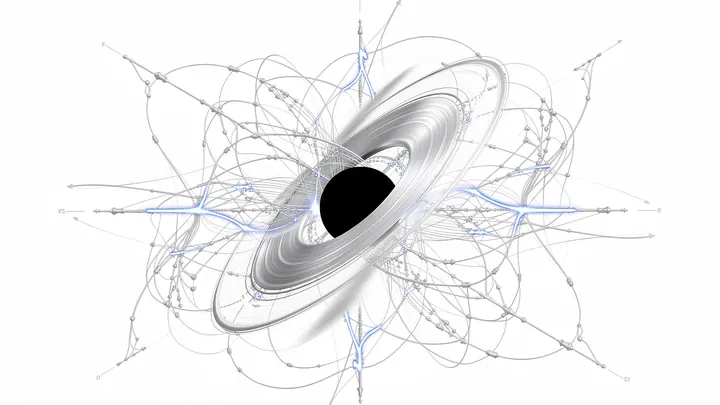
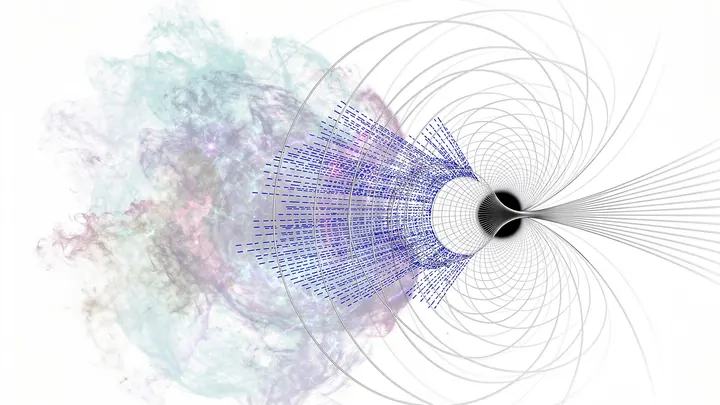
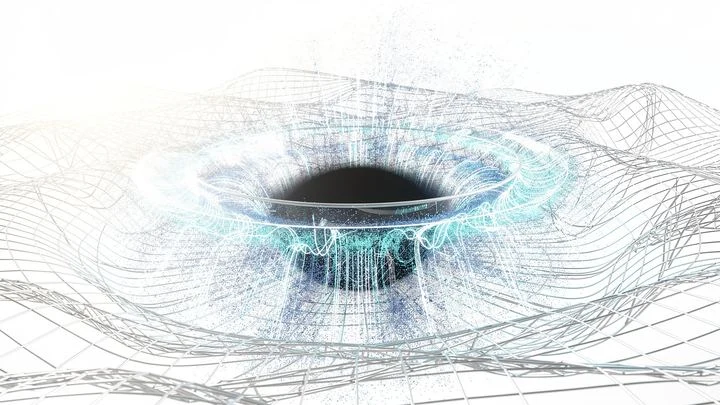
A gravitational singularity is a point in spacetime where the curvature becomes infinite, and the known laws of physics break down. In the context of a black hole, it is the central region where all the mass is thought to be compressed into an infinitely dense point. This concept represents a fundamental limit of our current understanding, as general relativity predicts its existence but cannot describe its properties.
History
The concept emerged from solutions to Einstein's field equations, particularly the Schwarzschild solution in 1916, which described a point of infinite density. Later work by Penrose and Hawking in the 1960s established the singularity theorems, showing that singularities are a generic prediction of general relativity under certain conditions.
How it works
According to general relativity, when a massive star collapses, it can form a black hole. The collapse continues until all matter is compressed into a point of zero volume and infinite density, the singularity. The event horizon, a boundary around the singularity, marks the point of no return for anything, including light. The singularity itself is hidden behind this horizon, making it impossible to observe directly.
In practice
Singularities are studied in theoretical physics to probe the limits of general relativity and to motivate quantum gravity theories, such as loop quantum gravity and string theory, which aim to resolve the singularity.
Fun fact
Some theoretical models suggest that quantum effects could replace the singularity with a region of extremely high but finite curvature, sometimes called a 'naked singularity' if it were observable.
Space is expanding, and that expansion is accelerating. But what if, in the first instants after the Big Bang, gravity behaved differently? The authors of a new study added an invisible field to Einstein's equations that siphons energy from ordinary matter and radiation.
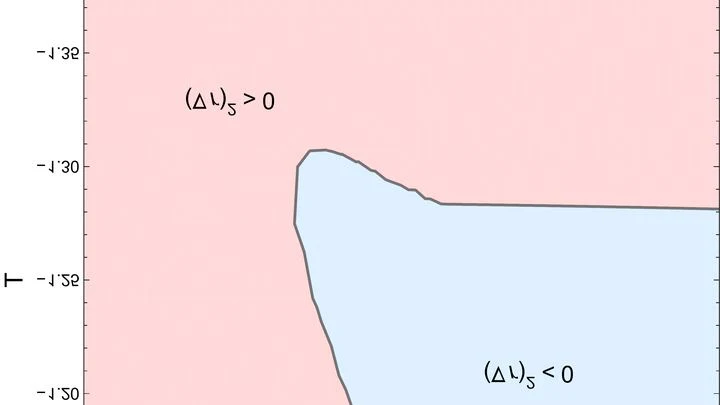
The idea was elegant: take a BTZ black hole (the three-dimensional analog of a regular black hole) and smooth its horizon with a special function. The hope was that inside, the spacetime signature might change — time becoming space, and space becoming time. But the calculations showed otherwise.
In the far reaches of space, there exists a hypothetical object: an ultracold black hole. It is charged and resides in an expanding universe (de Sitter space). Its temperature hovers just above absolute zero — about one trillionth of a degree above it.
A black hole spun up almost to its limit is like an athlete balancing on the edge of a record. The most interesting action isn't inside the hole itself, but in the thinnest film of spacetime at its horizon. It's there that tiny corrections to Einstein's gravity can suddenly swell to gigantic proportions.
A translator gets distracted by every rustle in the hall, and a one-hour meeting stretches into two. A single wrong intonation changes the meaning beyond recognition. That's roughly how a particle with spin 3/2—the gravitino — behaves. It cannot exist in isolation: its "speech" must be perfectly coordinated with its surroundings, or the whole structure falls apart.
Light freezes at the edge of the abyss: that's what the event horizon of an ordinary black hole looks like. But at the center of this abyss lurks a singularity, a point where the laws of physics break down. What if, instead of a point, there were a hard shell?
A gravastar is not a black hole.
Two houses with identical facades. Windows, doors, wall color — everything matches. But inside, one is empty, while the other buzzes with life. How can you tell without stepping inside? In space, there's a similar puzzle: a black hole and a gravastar look the same from the outside, but they are built differently.
A cloud of waves collapses under its own gravity. While it's loose, everything goes by the book: the field oscillates gently in nearly flat space, and approximate formulas work perfectly. But add just a bit more energy, and the picture changes.
Physicists used a numerical model to catch the moment when simple calculations stop describing reality.
At the center of nearly every galaxy lurks a supermassive black hole. Its gravity is so strong that it warps space itself. But few stop to wonder: what does it do to the very fabric of reality — the fields that permeate the cosmos?
One such field is the Higgs field.
Hot tea cools down, a pendulum comes to rest — nature loves equilibrium. But a charged black hole can reach a special, extreme state: the mass becomes minimal, and the temperature drops to zero.
Two balls dropped from different heights fall to the ground with different accelerations. In space, things are more complicated: even emptiness makes bodies move differently.
An eardrum at the very edge of a waterfall. Sound behaves strangely here: echoes don't multiply: they fade. That's exactly what gravitational waves look like at the horizon of a black hole — the boundary beyond which even light disappears.
A campfire burns steadily and long. But when the wind blows, the flame flickers out, leaving only embers. A similar story plays out with the gravastar — a hypothetical object that was supposed to replace the black hole.
An ordinary black hole hides a singularity — a point where the laws of physics break down.
Gravity is the invisible glue that holds stars and planets together. But what if this glue has a tiny mass? In massive gravity, the carrier particles (called gravitons) weigh a minuscule but nonzero amount. This changes the rules near black holes.
The authors of the new study built on a mathematical tool — eigenvalue decomposition.
10⁻¹²⁰. That's not just a small number: it's a chasm. That's the ratio of dark energy density to the Planck density, the natural scale of quantum gravity. The colossal difference of 120 orders of magnitude has long seemed an unsolvable puzzle. But the answer might lie in a drama played out at the dawn of time.
At the center of the Milky Way, shrouded in dust and glare, lurks a supermassive black hole — Sagittarius A*. Around it, like moths around a flame, swarm dozens of guide stars. Two of them, S2 and S38, with eccentric orbits and periods of just a few years, have become the protagonists in testing the fundamental laws of the cosmos.
The world around us is three-dimensional, but perhaps that's just an illusion. Some theories allow for extra dimensions of space, curled up or stretched in special ways. One such model depicts a five-dimensional universe with a "diluted" dimension (called a linear dilaton).
Two light rays meet at a point and then diverge. Their paths form two intersecting surfaces in spacetime — null hypersurfaces (boundaries along which light propagates). It is on such a pair of surfaces that physicists can set initial data for Einstein's equations. This is called the characteristic Cauchy problem.
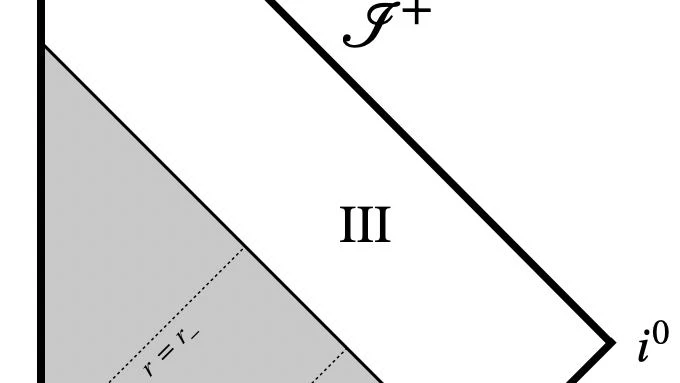
When a giant star runs out of fuel, it collapses into a black hole. Such a hole has an outer boundary — the event horizon, beyond which even light cannot escape. But many black holes also have an inner boundary — a second horizon that separates the outer layers from the singularity core.
The explosion of a distant supernova told us something hard to believe: the universe is expanding faster and faster. The engine of this acceleration is dark energy — nearly 70% of everything that exists.
An object cannot be a point. At least, not in Einstein's gravity. The equations of general relativity require that the source of the field, matter, be smeared out in space, not concentrated in an infinitesimal volume. Otherwise, infinities appear in the formulas, and a smooth spacetime cannot be constructed.
The story began with a missing mass. In the 1930s, Fritz Zwicky, measuring velocities in galaxy clusters, first suspected the presence of invisible matter. Later, Vera Rubin showed that the outskirts of spiral galaxies rotate too fast for the visible matter.
The boundary sets the rules
Quantum gravity is like a theater where spacetime is the stage and fields are the actors. When the stage has an edge, you need to know exactly what happens at the boundary; otherwise, the play falls apart. In 2018, Edward Witten proposed an elegant recipe for such a case.
The early universe was a restless place. Space trembled with gravitational waves — ripples in the very fabric of reality. In this churning cauldron, dark matter is thought to have been born. But the newborn particles had no mass: it had to come from somewhere.
Usually, the Higgs field is responsible for mass.
Light passing near a massive body slightly changes its path — gravity pulls even on rays. In ordinary situations, a beam of light from a distant star is squeezed as if drawn together by an invisible rubber band. This property is called the null convergence condition: gravity makes light trajectories converge rather than diverge.
The Schwarzschild black hole is the simplest model in general relativity. But when you switch to teleparallel gravity (TEGR), where torsion replaces curvature, the horizon develops a problem. Some quantities built from torsion tend to infinity.
The black hole paradox has haunted physicists for decades. If a hole evaporates, where does its contents go? Discoveries by Stephen Hawking and Jacob Bekenstein showed that saving the laws of nature requires an unconventional move.
Imagine the universe as a woven blanket of invisible threads.
Ordinary gravity, as described by general relativity, behaves like a soft rubber membrane. When a massive star exhausts its fuel and collapses, it deforms this membrane so strongly that a black hole forms — a region where spacetime curvature becomes infinite, and nothing, not even light, can escape.
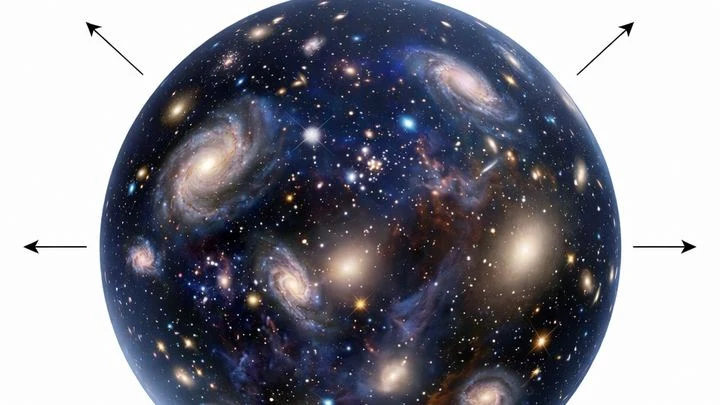
The Universe behaves like a soap bubble swelling in a multidimensional foam. The dark bubble model explains why it's expanding ever faster: the spacetime bubble grows, and its membrane gains a tiny thickness — about a micron, like a bacterium. At such distances, gravity 'blurs' across this thickness and weakens.
A star contracts under its own gravity, and at some point its fate hangs on a razor-thin balance. Classical physics paints a grim picture: if the mass and the force of compression are tuned with terrifying precision, what emerges is not a black hole but a 'naked' singularity.
Space is like a sheet of paper: gravity bends it, making lines converge toward the center. But if you bend too hard, the paper tears, just as space, under monstrous curvature, doesn't collapse into a point but forms a torn edge. That edge is the quantum boundary.
A wormhole is a hypothetical tunnel in curved spacetime connecting two distant regions of the universe and potentially shortening the journey between them.
Drop a handful of sand into calm water — the ripples spread and fade. Drop it into a running blender — the vortices mix everything in an instant. Physics has a similar rule: chaos cannot grow faster than a certain rate.
In the standard picture, black holes are the undisputed density champions: all their matter is squeezed into a single point. Imagine the entire mass of Mount Everest packed into a grain of salt. But physicists have found a theoretical trick.
A single graviton, a quantum of spacetime, is incredibly weak. For detectors like LIGO, built by Rainer Weiss and colleagues, quantum effects are suppressed by a factor of 10⁻³⁸: it's like trying to hear a grain of sand changing the wind's direction in a hurricane.
Dark matter is the great cosmic invisible. It neither emits, absorbs, nor reflects light, yet its gravitational grip is felt in every motion of galaxies. Seventy years ago Vera Rubin showed that the outskirts of galaxies rotate too fast — as if spurred on by an unseen shepherd.
Our Solar System isn't an island in the void: it's a sensitive web stretched in a dark cosmic corner. Planets circle their orbits like dewdrops on threads, and we are the spider sensing the faintest tremor. That tremor betrays the approach of the catastrophe astronomers call the Big Rip.
A dying star is not just fading away. In its final moments, the core, starved of fuel, collapses into itself at colossal speed. Classical gravity leaves no choice: if the mass is large enough, a black hole is born — a region from which not even light can escape.
Imagine an orchestra tuning up: the violins rise in pitch: that's the familiar 'chirp' of black hole mergers in LIGO detectors. Now picture a funeral march: a sound that descends, like a fading siren. That's exactly the gravitational-wave signature a system with one negative mass should leave.