Spindle Black Hole: The Shadow Changes Shape express
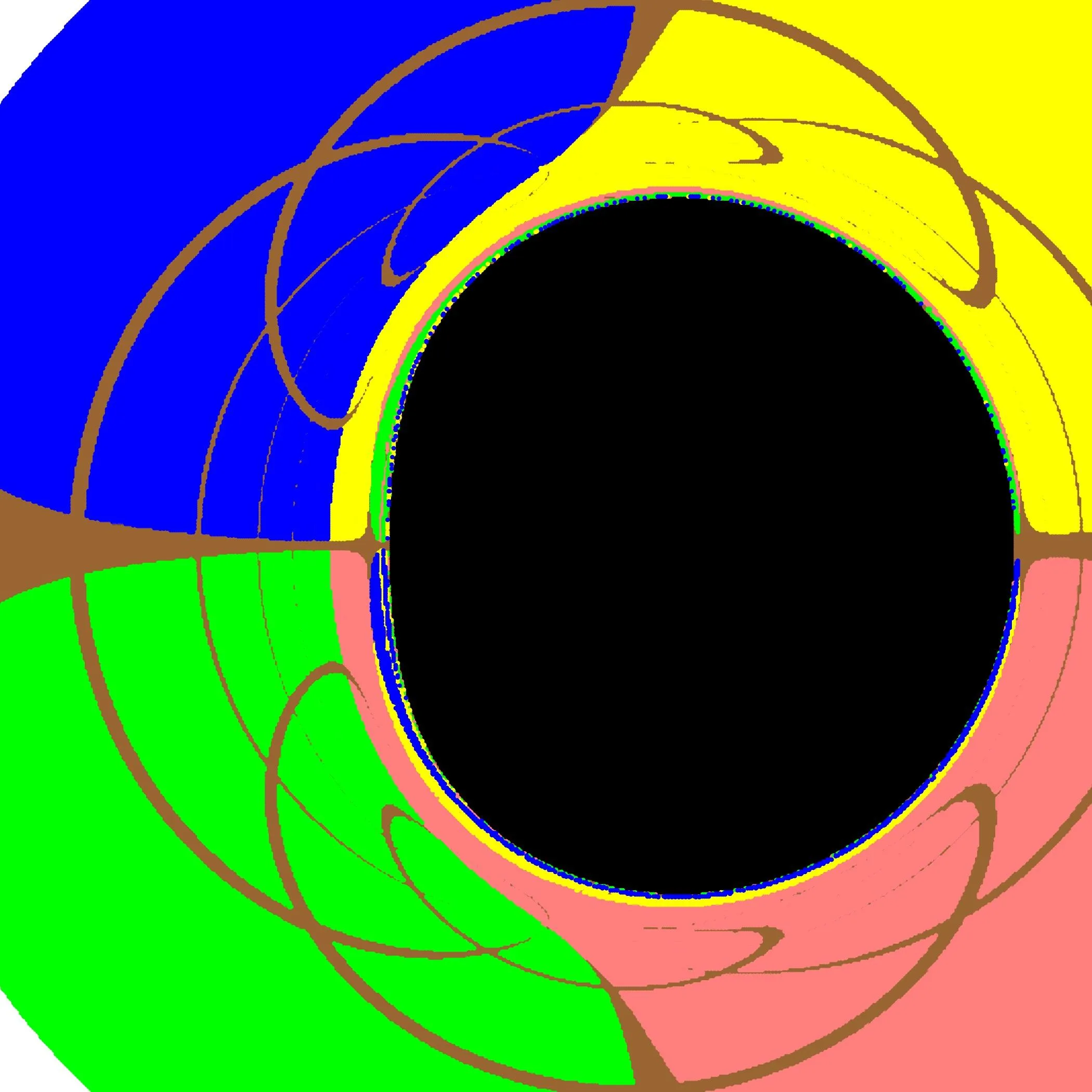
At the center of attention is a black hole of unusual shape. Its geometry resembles a spindle: a slight elongation is added to the usual rotation. The parameter B measures this deformation.
The motion of particles changes. For massive bodies, the inner stable circular orbit (ISCO) shifts, and an outer stable orbit (OSCO) appears — something that did not exist before. Light rays (photons) behave differently: their trajectories could only be separated into parts approximately, to first order in B². This allowed constructing the photon region and the black hole shadow.
Numerical verification confirmed that the shadow indeed differs from the Kerr one. The deviations are small but noticeable, like a familiar silhouette slightly stretched in one direction.
Original abstract
as written by the authors arXiv:2607.10533
Recently, a new exact Ricci-flat rotating black-hole solution was constructed in four-dimensional general relativity, in which an additional parameter $$B$$ characterizes a spindle deformation of the Kerr geometry. We study geodesic motion and black-hole shadows in this spacetime. The Hamilton-Jacobi equation is not exactly separable for either timelike or null geodesics. Remarkably, however, at the leading nontrivial order, $${\cal O}(B^2)$$, null but not timelike geodesics become separable. In the timelike sector, the spindle deformation shifts the innermost stable circular orbit and can give rise to an outermost stable circular orbit. In the null sector, exploiting the perturbatively separated equations, we analytically determine the photon region, equatorial photon orbits, and black-hole shadow, and compare the resulting predictions with direct ray tracing in the exact spacetime. The numerical results validate the perturbative treatment and quantify the deviations from Kerr.
The deformation parameter B is so small that the shadow is almost indistinguishable from the Kerr one to the naked eye, but precise measurements can catch the difference.