Spindle Black Hole: The Shadow Changes Shape express
Original: "Geodesics and shadows of the spindle-deformed Kerr black hole"
· Hong-Da Lyu, Mingzhi Wang, Shoulong Li
arXiv:2607.10533 · 2026-07-12 · CC BY 4.0 · 1 min
A new solution for a rotating black hole with a spindle deformation reveals how orbits and the shadow change.

📄 Showing the "Simple" version — "Popular" is not ready yet. Add it to favorites to help prioritize it.

At the center of attention is a black hole of unusual shape. Its geometry resembles a spindle: a slight elongation is added to the usual rotation. The parameter B measures this deformation.

The spindle deformation is not just a mathematical toy. Such solutions help test how much general relativity allows deviations from the standard Kerr form.

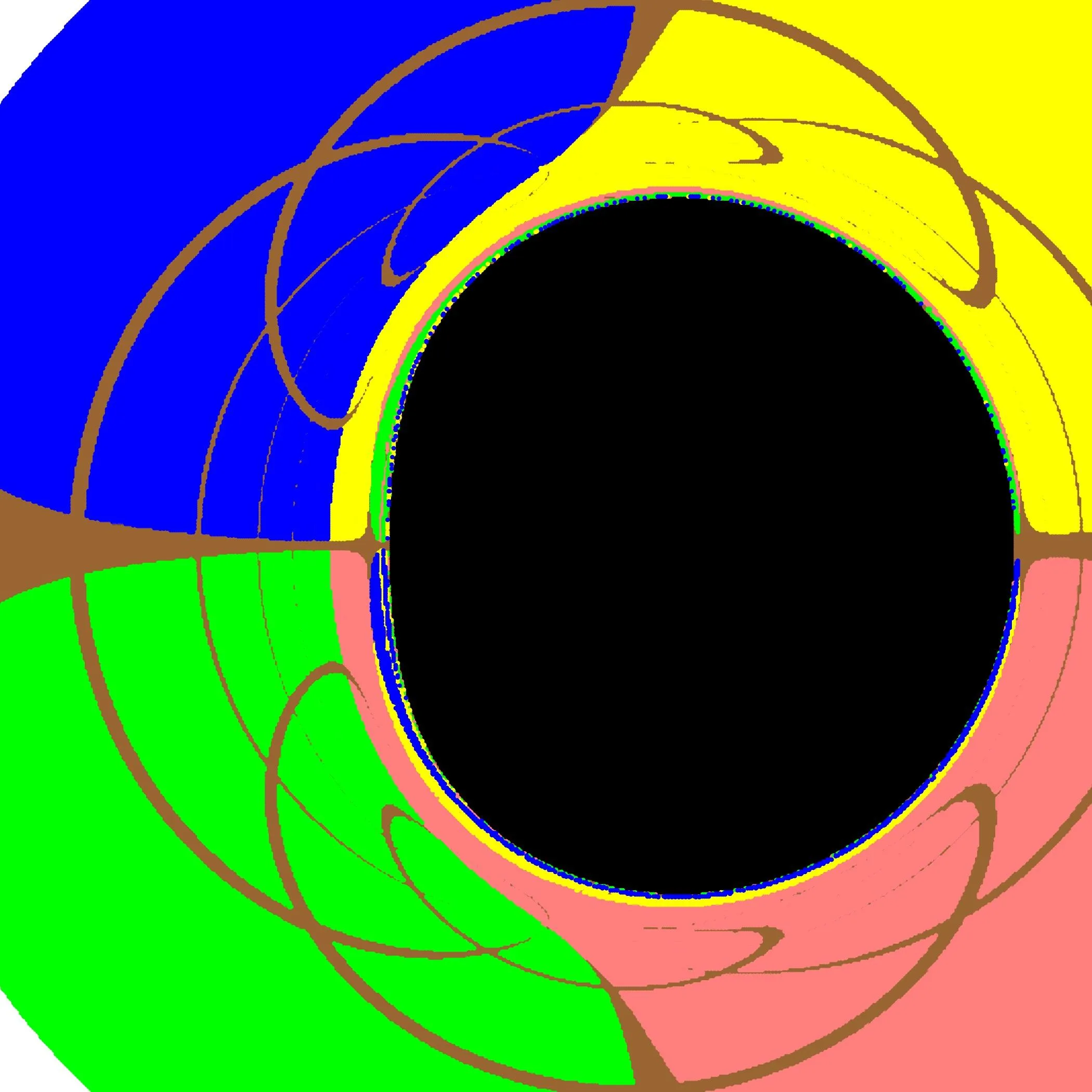
The motion of particles changes. For massive bodies, the inner stable circular orbit (ISCO) shifts, and an outer stable orbit (OSCO) appears — something that did not exist before. Light rays (photons) behave differently: their trajectories could only be separated into parts approximately, to first order in B². This allowed constructing the photon region and the black hole shadow.

Numerical verification confirmed that the shadow indeed differs from the Kerr one. The deviations are small but noticeable, like a familiar silhouette slightly stretched in one direction.

The black hole shadow is not just a picture. Its shape reveals the geometry of spacetime in the strong-field regime.

The deformation parameter B is so small that the shadow is almost indistinguishable from the Kerr one to the naked eye, but precise measurements can catch the difference.

Scientists
John Archibald WheelerJacob BekensteinStephen HawkingFritz ZwickyKarl SchwarzschildSubrahmanyan Chandrasekhar
Concepts
rotating black hole kerr black hole geodesic equation kerr metric photon sphere spin parameter schwarzschild metric modified gravity singularities horizon area naked singularity ringdown flat space massless scalar field gravitational radius orbital eccentricity scalar perturbations schwarzschild radius Birkhoff's theorem Wheeler-DeWitt equation hills mechanism