How Dancing Galaxies Reveal Their Masses express
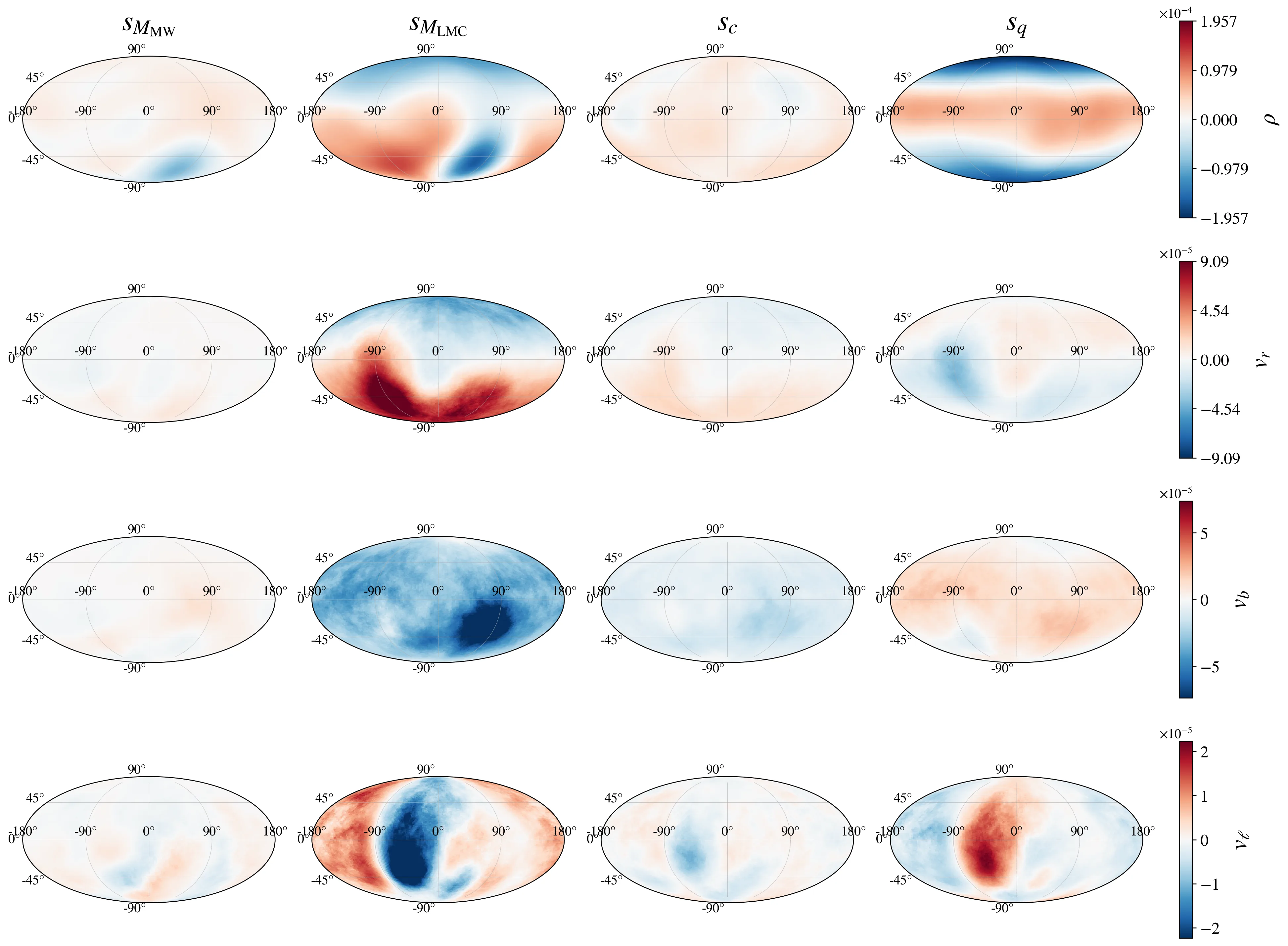
Two galaxies (our Milky Way and its satellite, the Large Magellanic Cloud) slowly circle each other. Their gravitational pull stirs the distant outskirts of the Milky Way, like a pebble thrown into a pond makes the water ripple. From these ripples, the motions of stars at distances from 30 to 120 thousand light-years from the center, one can reconstruct a great deal: how much both galaxies weigh, how densely their invisible dark matter (the mysterious substance that adds extra gravity) is concentrated toward the center, and what shape this enormous dark halo takes.
A team of researchers led by astrophysicists from the HaloDance project asked: how much information is lost when we describe this dance in a simplified way? Usually, scientists use summary statistics — for example, average stellar velocities in different regions or decomposing the motion into basic waves, like transcribing a musical recording into notes. But the full picture is hidden in the so-called 6D distribution: for each star, you need three coordinates and three velocity components. To estimate the losses, the authors built a benchmark — a neural network model that can compute the exact probability of observing such a set of stars given the galaxy parameters. This method, called flow matching, showed that traditional velocity summaries miss 2.5 to 9.9 times more information.
But the benchmark model is complex and doesn't provide physical intuition. So the scientists developed a compromise path. They decomposed the stellar density and velocities into spherical harmonics (like breaking a complex sound into simple tones) and compressed these coefficients down to four numbers sensitive to key parameters. The analysis showed that these compressed harmonics and the old velocity summaries complement each other: together they reduce uncertainty by an additional 15–71% and come close to the ideal benchmark — the gap shrinks to 1.3–2.9 times. Thus, the dance of two galaxies teaches us to listen to the cosmos more attentively.
Original abstract
as written by the authors arXiv:2607.20006
The gravitational interaction between the Milky Way (MW) and the Large Magellanic Cloud (LMC) drives the outer halo into dynamical disequilibrium, imprinting the masses and structural parameters of both galaxies onto the 6D phase-space distribution of halo tracers. This signal has been characterised with summary statistics ranging from low-order velocity moments to basis function expansions, yet how much information these summaries discard, and whether they are complementary, remains unclear. We address these questions by comparing a field-level likelihood benchmark with physically interpretable summaries for constraining $$(M_{\mathrm{MW}}, M_{\mathrm{LMC}}, c, q)$$, where $$c$$ and $$q$$ are the MW halo concentration and flattening. A Conditional Flow Matching (CFM) model trained on the HaloDance $$N$$-body suite provides an exact likelihood at a held-out fiducial point; for 5,000 tracers in $$30$$--$$120$$~kpc it tightens marginal constraints by factors of $$2.5$$--$$9.9$$ over an all-sky velocity-moment forecast. We then expand the halo density and velocity fields in a multipole basis-function expansion (BFE) and compress the coefficients with the Massive Optimised Parameter Estimation and Data compression (MOPED) algorithm into four parameter-sensitive summaries that preserve their Fisher information. A variational mutual-information analysis shows that the BFE+MOPED summaries and the velocity moments are complementary, so we combine them into a joint $$19$$-dimensional vector as our primary inference pipeline: it tightens the marginal constraints by up to $$15$$ per cent over BFE+MOPED alone and by $$30$$--$$71$$ per cent over velocity moments alone, reaching within a factor of $$1.3$$--$$2.9$$ of the field-level benchmark. We thus establish a physically interpretable summary-level route to MW--LMC inference alongside the field-level benchmark that bounds its information content.
The Large Magellanic Cloud is not just a satellite but a real troublemaker: its mass is about 10–20% of the Milky Way's mass, and it is so massive that it makes the entire galactic disk wobble slightly.
In Liu Cixin's novel "The Three-Body Problem," aliens try to solve the chaotic motion of three suns — here, astronomers solve the inverse problem, reconstructing invisible masses from the gravitational dance.