The Pulse of Young Stars Runs Hotter Than Expected express
A young star cluster resembles an orchestra before a concert: each instrument tunes up in its own way, and the overall hum seems like chaos. But if you listen closely, you can pick out individual notes. That's roughly how astronomers study Delta Scuti variables: their brightness changes with periods from half an hour to several hours, and encoded in this pulsation are mass, age, and internal structure.
To decode the "melody," the scientists built a computer model of an entire population of stars with masses from 1.4 to 2.5 solar masses. They included rotation, the possibility of being a binary system, natural scatter in properties, and measurement errors. Then they compared the synthetic population with real data on young stellar associations, and the match was excellent.
And there's more. The well-known period–luminosity relation for these stars has two ridges, and the second one has long been a puzzle. The model showed that it is created by stars where the dominant mode is not the fundamental but the fifth or sixth overtone (a higher tone). Such stars make up about a third, and their fraction grows in young populations. Unresolved binarity, contrary to suspicions, does not explain the second ridge.
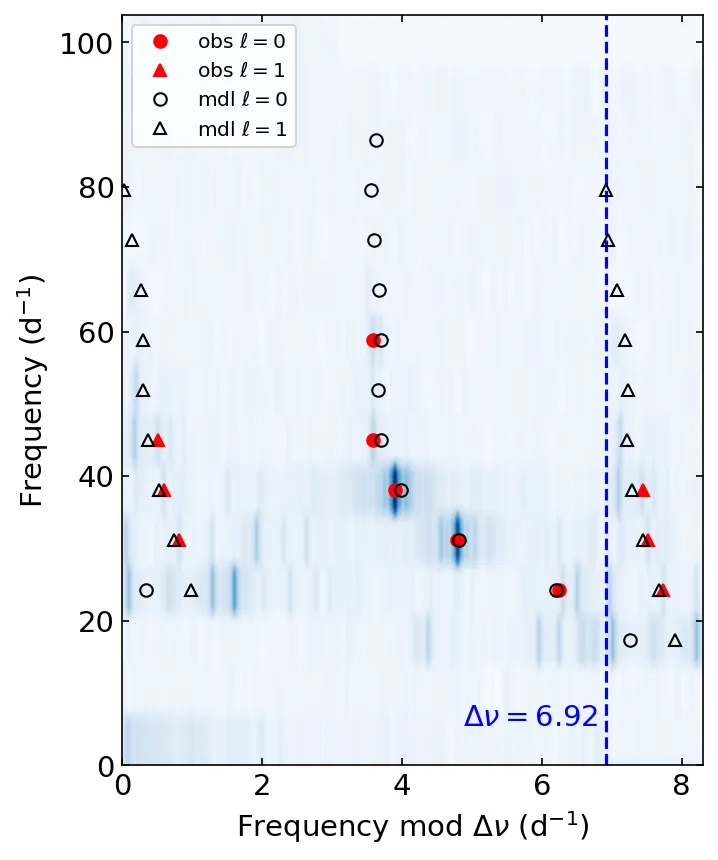
Finally, the authors predicted the distribution of large frequency separations (Δν)—a sort of "spectral fingerprint" of a star. The peak fell at 6–7 cycles per day, matching recent observations. And an important practical tip: the most reliable way to measure Δν is the "échelle" method, while autocorrelation methods alone can produce false signals.
Thus, population synthesis becomes a tuning fork for stellar astrophysics: it links evolution, pulsations, and observations into a single coherent picture.
Original abstract
as written by the authors arXiv:2607.22060
Interpreting the observed properties of intermediate-mass stars requires accounting for rotation, binarity, intrinsic population diversity, and measurement uncertainty. We combine these effects in population-synthesis models of 1.4-2.5 M$$_{\odot}$$ stars that include pulsation properties of $$\delta$$ Sct variables. The synthetic populations successfully reproduce the distributions of stars observed in young associations, validating the mapping between intrinsic and observed stellar properties. Using these models, we infer a semi-empirical $$\delta$$ Sct instability strip by matching synthetic and observed populations. The resulting instability strip is systematically hotter than widely used theoretical prescriptions, implying that $$\delta$$ Sct stars are on average 0.1 M$$_{\odot}$$ more massive than previously assumed, with 95% of the population spanning approximately 1.50-2.30 M$$_{\odot}$$. We then investigate the $$\delta$$ Sct period-luminosity relation and reproduce its recently identified second ridge with mixture models in which roughly one-third of stars have the fifth or sixth radial overtone as their dominant mode; the fraction increases in younger populations. In contrast, unresolved binarity does not account for the second ridge. Finally, we predict the population-wide distribution of asteroseismic large separations, $$\Delta u$$, finding a peak between 6 and 7 d$$^{-1}$$, in agreement with recent observations. We also demonstrate that $$\Delta u$$ is most reliably measured with the \'echelle technique, while autocorrelation methods can produce spurious detections when used in isolation. These results show that population synthesis provides a powerful framework for interpreting populations of $$\delta$$ Sct stars and for linking stellar evolution, pulsation, and observation.
Delta Scuti is a real star in the constellation Scutum, and its pulsations were discovered as early as 1900. Since then, thousands of similar stars have been found, but their precise masses remained a matter of debate for a century.