Frozen Complexity of a Black Hole express
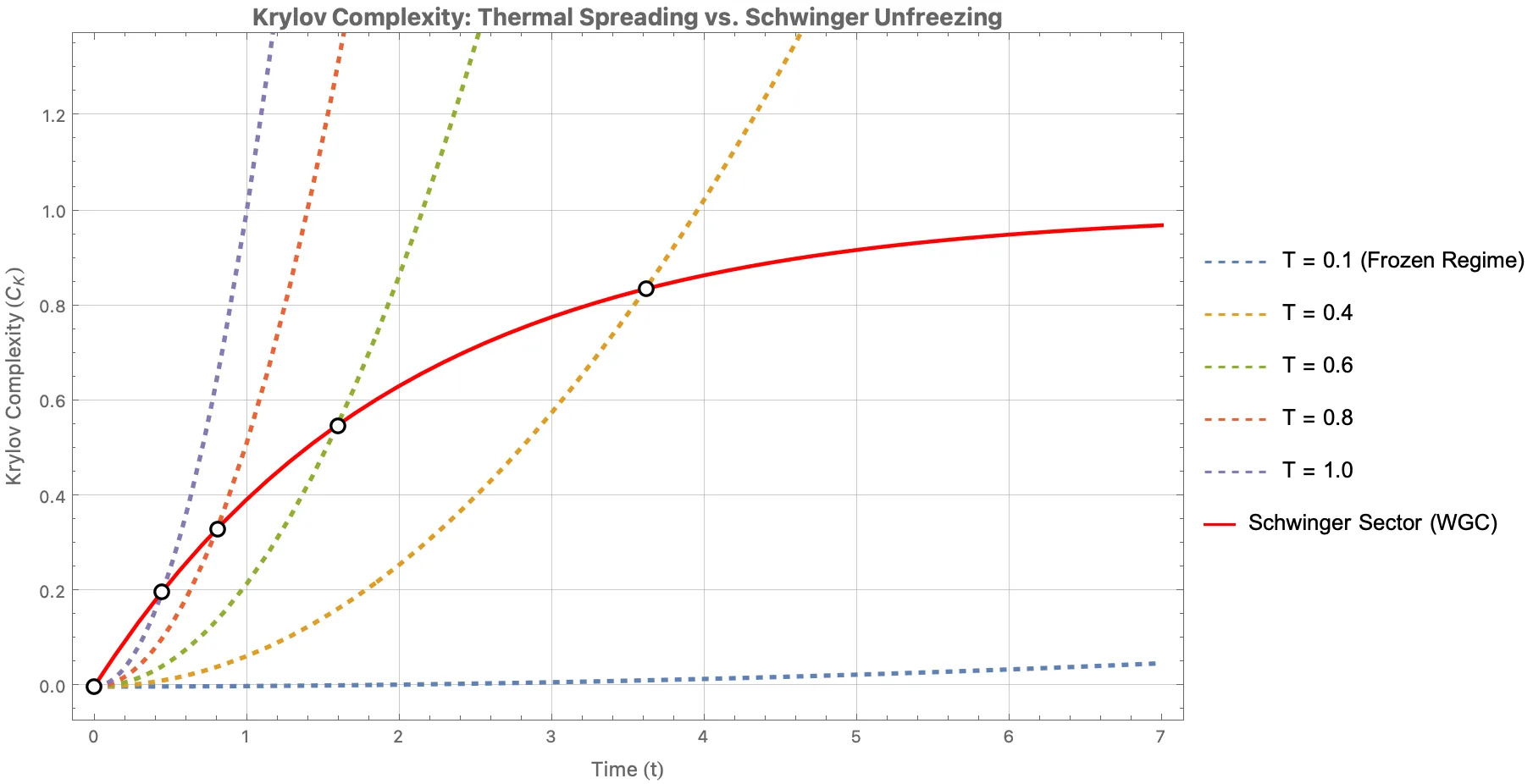
Hot tea cools down, a pendulum comes to rest — nature loves equilibrium. But a charged black hole can reach a special, extreme state: the mass becomes minimal, and the temperature drops to zero. This is not just a halt of thermal motion — in a new study, it turns out that at such a point, quantum complexity also freezes.
The authors of the work studied a Reissner-Nordström black hole in anti-de Sitter space — a model of the universe with negative curvature. Using the holographic principle, they linked it to a quantum state known as the thermofield double state. It turned out that in the extreme limit, the return amplitude, a measure of how much the system 'remembers' its initial state, becomes a pure phase. Like a clock hand that spins but never moves forward. The growth of complexity in Krylov space (a mathematical tool for describing operator evolution) effectively halts.
Then charged particles entered the scene. Near the horizon of an extreme black hole, the electric field is so strong that it spawns particle pairs from the vacuum. This process is called Schwinger pair production. As soon as a discharge channel appears, the frozen complexity thaws: the dynamics become nontrivial again. This all echoes the old weak gravity conjecture. It states that gravity must be the weakest force capable of discharging a black hole. Now this idea gains a new, 'complexity' face.
The result bridges three areas: black hole physics, quantum information theory, and the swampland program. This program separates consistent theories of quantum gravity from inconsistent ones. The freezing and thawing of complexity might be a universal indicator of which theories survive in the full quantum picture of the world. Thus, the frozen hand begins its motion again, and with it, the very fabric of theory comes alive.
An extreme black hole resembles a perfect refrigerator: its temperature is absolute zero, but its entropy (a measure of hidden information) remains enormous — proportional to the horizon area.