Why Do Baby Black Holes Grow So Fast? ✛
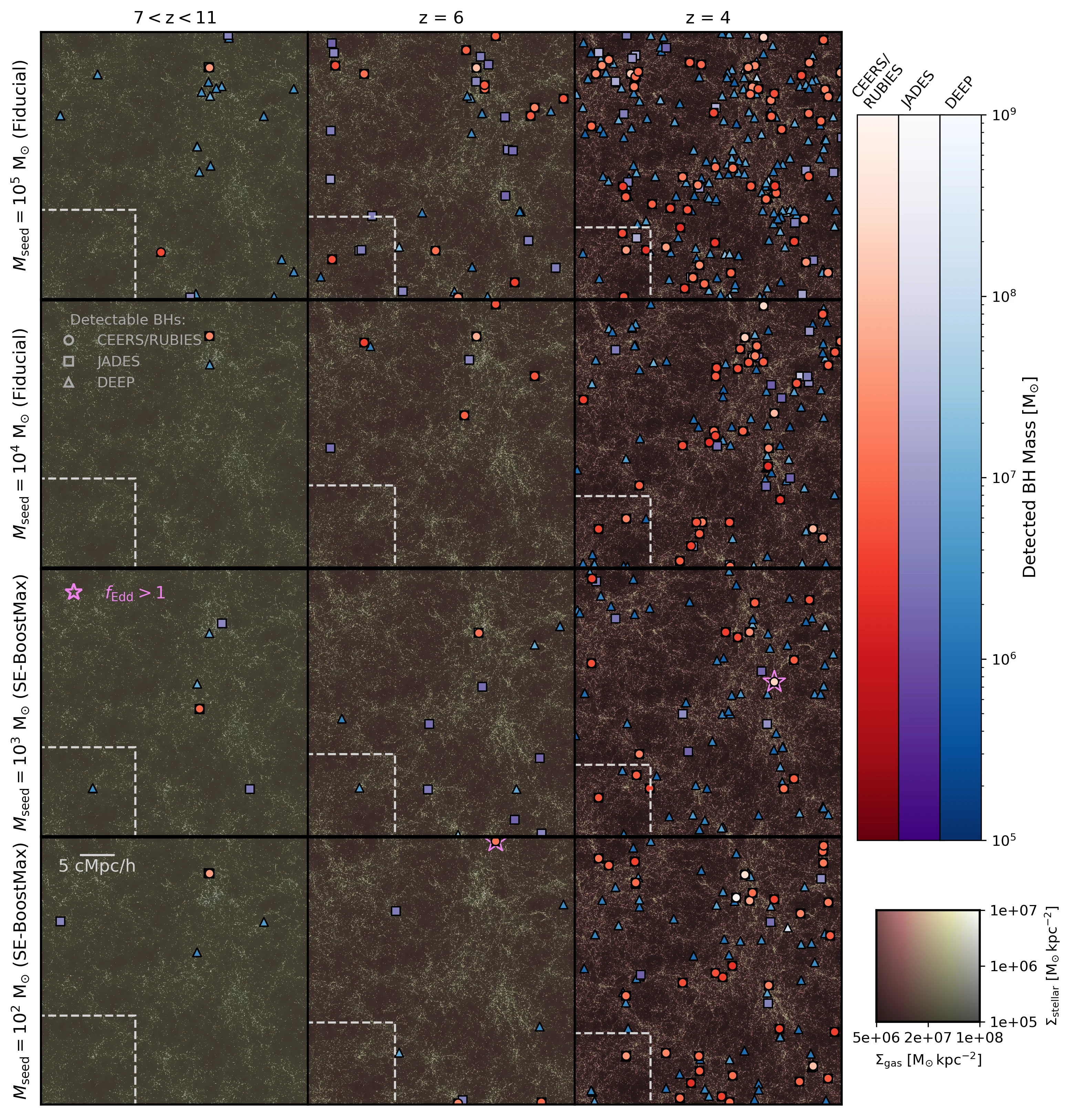
At the starting line — 13 billion years ago — the future supermassive black holes were tiny 'seeds'. Mass from a hundred to a hundred thousand solar masses. That's a range from a cloud to an elephant. The JWST telescope spotted them a few hundred million years after the big bang and was surprised: the holes turned out to be tens of times more massive than expected based on the size of their galaxies.
The team of Sophie Koudmani tested two hypotheses in computer simulations. Either the seeds were born heavy from the start. Or light holes occasionally 'released the brakes' and swallowed gas tens of times faster than normal. This limit — the so-called Einstein field equations (the maximum feeding rate) — is well known: when a hole 'eats' too fast, the radiation pushes the infalling gas away. But in the early Universe, the dense gas is so abundant that the barrier can be breached.
Conclusion: to grow to billions of solar masses in hundreds of millions of years, a black hole doesn't have to be born a giant. It just needs to know how to 'overeat' at the right moments. And the telescope only catches the final sprint of the leaders. The light runners remained in the shadows.
The twelve AESOPICA simulations span seed masses from 100 to 100,000 solar masses: if you imagine them as athletes, the lightest one weighs as much as a kitten, while the heaviest is like a full-grown elephant, and both are running a 13-billion-year marathon.