Baby Black Holes: A Handicap Race in the Early Universe ✛
Context
At the dawn of the Universe, just a few hundred million years after the big bang, the JWST caught a glimpse of active active galactic nucleus that don't fit the usual picture. Their black hole had already packed on billions of solar masses while their host galaxies were still piecing together stars. Where does such a sprint come from? Either nature gave them a head start with a heavy seed, or they found a way to guzzle gas at a breakneck pace, or we are simply seeing the brightest members of a much larger, hidden population. Figuring this out means understanding how supermassive black holes come to be in the first place.
Methods
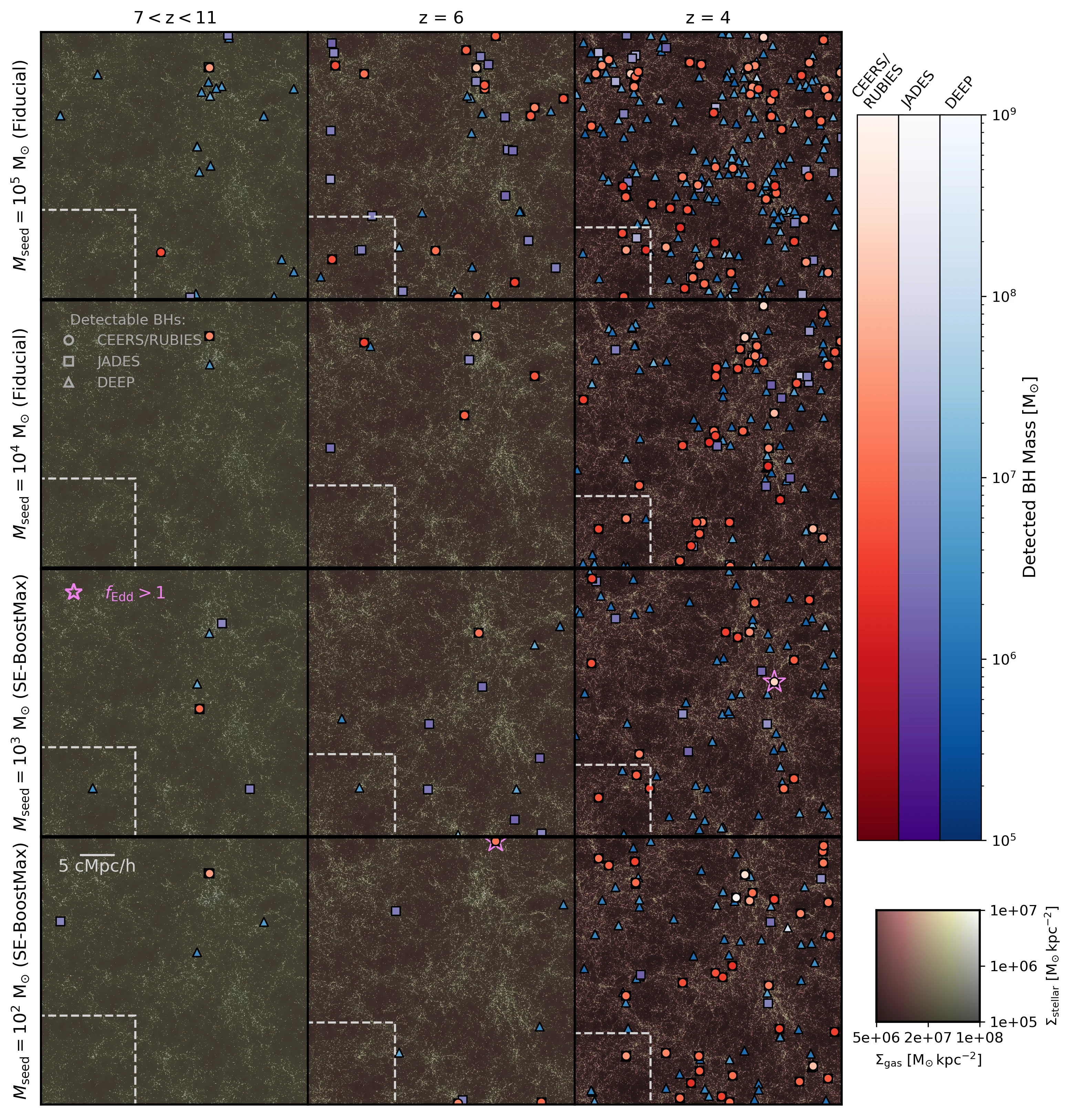
A team led by Sophie Koudmani built twelve cosmological numerical simulation in a cube of 60 megaparsecs. They varied the black hole seed mass from one hundred to one hundred thousand solar masses, covering the main theoretical channels: from remnants of the first stars to direct gas collapse. Accretion efficiency was also tweaked: in the standard mode it is capped by the Einstein field equations, while the optimistic mode permits tenfold super-Eddington bursts. Each simulation was run from redshift 18 down to the present day. But the real innovation is the balmersopica package, which applies an observational selection filter to the virtual catalogs: for a given grid and exposure time, it determines whether the broad hydrogen emission spectroscopy would be detectable by Webb. That makes the comparison fair.
Results
The virtual handicap race gave a clear answer: the bulk of detected black holes can be grown from a seed of any mass, provided accretion was efficient enough. With standard, sluggish feeding, only the heavy seeds reach the observed 'overmassive' region relative to local mass–stellar mass relations. If bursts above the Eddington limit are allowed, however, even the lightest seeds manage to catch up with their rivals by redshift six. Selection plays a key role: the detectable active nuclei sit well above the mean luminosity lines of all models—we only see the champions, not the average runner. When the team applied the balmersopica artificial sampling technique to the simulations, they obtained an almost perfect match with real measurements of galaxy masses and black hole masses. Moreover, all models converge to local relations by star formation zero: by the present day, the seed signatures get erased in massive galaxies, but remain noticeable at the dwarf end. An analysis of gas metallicity showed that the most extreme 'pristine' objects like QSO1 are not reproduced even in the most optimistic simulations—perhaps a hint of primordial black holes or insufficient resolution of the interstellar medium.
Implications
These results suggest that the early Universe was an arena for a fierce black hole race. The 'hole first, galaxy second' scenario gains strong support: black holes were able to 'anchor' themselves in the host potential before the galaxy finished building its stellar body. This explains why, on a plot of black hole mass versus velocity dispersion, high-redshift points fall on the local relation without evolution. For galaxy formation theories, it means that accretion feedback must be tied to gas supply much more tightly than previously thought. Observers, meanwhile, should brace for the fact that a majority of black holes remain invisible—we are only detecting the 'tip of the iceberg'.
Future development
The planned expansion of AESOPICA will include accretion disks computed according to physical laws and a realistic multiphase interstellar medium. This should reveal how justified the effective boost factors used as a proxy for high resolution really are. Together with future deep Webb surveys in the NIRSpec slitless mode and the first direct black hole mass measurements with Gravity+ at VLTI, by the end of the decade we may learn whether the seeds were predominantly light, heavy, or a mix.
Impact
The discovery will influence the interpretation of JWST data, models of galaxy growth, and forecasts for future gravitational-wave observatories like LISA, which will detect mergers of intermediate-mass black holes.
Next steps
The immediate next steps are to compare the predicted black hole mass functions at various redshifts with actual counts in deep fields, and to build synthetic spectral catalogs for a complete accounting of line selection.
Key open problems
The work directly tackles the unsolved problem of supermassive black hole origins: where do seeds of hundreds or thousands of solar masses come from, and how do they manage to grow within the first 700 million years after the big bang.
The knowledge machine's view
This section is addressed to the author of the paper and their colleagues. Neighbouring works were found by meaning-based search across our archive, not by word overlap. We do not review: we show the field around the work.
What the work does
This work presents the AESOPICA cosmological simulations, which vary the seed black hole mass and accretion efficiency, and introduces the balmersopica package that applies an observational selection filter. It shows that the observed 'overmassiveness' of black holes can be explained either by super-Eddington accretion or by selection of the brightest objects, with all models converging to local scaling relations.
Where its strength is
The strength of this work lies in its honest comparison of simulations with observations through an instrumental filter, revealing that we see only the champions, not the typical population. This allows us to distinguish between seed formation and accretion scenarios without resorting to exotic assumptions.
Where it could go next
- It might be interesting to see how alternative seed formation channels, such as 'dark stars', affect predictions for dwarf galaxies, where, as shown in this work, signatures of initial masses are preserved.based on: Dark Stars: Cradle of Giant Black Holes arXiv:2511.08578
- A related study suggests that the detected 'little red dots' are just the tip of a more numerous population of hidden black holes; this resonates with the conclusion about the role of observational selection and could help estimate the full mass function.based on: The Telescope's Red Dots Are Just the Tip of the Iceberg arXiv:2605.31077
- Since the most extreme objects like QSO1 are not reproduced even in optimistic simulations, one could turn to the idea of gravitational wave background influencing collapse, discussed in a neighboring paper, to understand what limits the growth of the first holes.based on: How the Jitters of Space Can Stifle the Birth of Black Holes arXiv:2608.07264v1
Worth trying
- Apply the balmersopica methodology to simulations with 'dark star' seeds and compare predictions for dwarf galaxies with JWST data.
- Estimate what fraction of the hidden population from 2605.31077 could be detected with longer exposure times in virtual surveys.
- Test whether the metric fluctuations considered in 2608.07264v1 could suppress accretion at early times and explain the deficit of extreme objects.
Why this may matter
Understanding how seeds form and grow is crucial for the overall picture of galaxy evolution: if black holes form before stars, it changes the causal relationships in hierarchical clustering and may explain why local scaling relations are universal.
Nearby works in our archive
- How Giant Black Holes Are Born in the Early Universesimilarity 0.71
- The Telescope's Red Dots Are Just the Tip of the Icebergsimilarity 0.68
- How the First Black Holes Are Bornsimilarity 0.68
- Dark Stars: Cradle of Giant Black Holessimilarity 0.67
- Tiny Black Holes Warm the Universe Longer Than Thoughtsimilarity 0.65
- Tiny Black Holes Build Giantssimilarity 0.65
- How the Jitters of Space Can Stifle the Birth of Black Holessimilarity 0.64
The archive is crowded around this work: 6 reviews nearby, closest at 0.71. This ground is well walked — and there is plenty to compare against.
Original abstract
as written by the authors arXiv:2607.26177v1
The active black holes uncovered by JWST in the early Universe are highly abundant and seemingly overmassive with respect to local scaling relations, challenging standard models of black hole formation and growth. Yet it remains unclear whether they trace an efficient early growth channel, the observable tail of a broader population, or suffer from systematic uncertainties in mass estimates. We introduce the AESOPICA project, a suite of twelve mid-volume ($$L = 60\,\mathrm{Mpc}$$) cosmological simulations based on the FABLE galaxy formation model, varying the black hole seed mass across the theoretical formation channels ($$M_\mathrm{seed} = 10^{2}$$-$$10^{5} \, \mathrm{M_{\odot}}$$), the accretion efficiency, including super-Eddington bursts, and the supernova feedback strength. We forward-model observational selection with BALMERSOPICA, a mock JWST broad-line survey pipeline that assesses the detectability of each simulated AGN for a given grating and exposure time. We find that the bulk of the JWST AGN population can be assembled from any seed mass provided the accretion efficiency is high, although light seeds require the most favourable accretion conditions explored. Applying broad-line selection naturally recovers the apparently overmassive population, with the detected AGN lying furthest above the intrinsic $$M_\mathrm{BH}$$-$$M_\mathrm{stellar}$$ relation for inefficient accretion models. Notably, the selected AGN lie on the local, weakly evolving $$M_\mathrm{BH}$$-$$\sigma_\mathrm{stellar}$$ relation, supporting a scenario where black holes assemble before the stellar component is fully established. Since efficient accretion rapidly erases the imprint of the initial seed mass, the low-mass end of the black hole mass function and host gas-phase metallicities offer the most promising discriminants between seeding channels.
The twelve AESOPICA simulations span seed masses from 100 to 100,000 solar masses: if you imagine them as athletes, the lightest one weighs as much as a kitten, while the heaviest is like a full-grown elephant, and both are running a 13-billion-year marathon.
Key numbers
- seed masses: from 102 to 105 M☉
- simulation size: 60 Mpc
- redshift of detectable AGN: 4–11
- typical duration of a super-Eddington flare: ~10 million years
- fraction of time the infant is visible: up to 56% for heavy seeds with weak accretion