Black Hole Infants: A Handicap Race in the Early Universe ✛
A marathon lasting 13 billion years started with different weights. A hundred solar masses — lighter than some gas clouds. A hundred thousand — gravitational dominance, comparable to an elephant among kittens. That's what black hole seeds looked like, ones that by our time should have turned into supermassive giants. The JWST caught them in infancy and was surprised: tiny galaxies, but at their center a hole with a mass of billions of suns. Such a sprint needed an explanation.
Two explanations exist. Either the seeds were born heavy — through direct collapse of gas, bypassing the star formation stage. Or the light remnants of the first stars managed to accrete gas at enormous rates, tens of times exceeding the limit set by the Einstein field equations (maximum accretion rate). To settle this contest, astrophysicist Sophie Koudmani and her colleagues built twelve virtual universes, AESOPICA. In each, a runner got its own initial mass and feeding regime. And the observer-judges in the guise of Webb added the main condition of a fair race: they only timed those that could actually be seen.
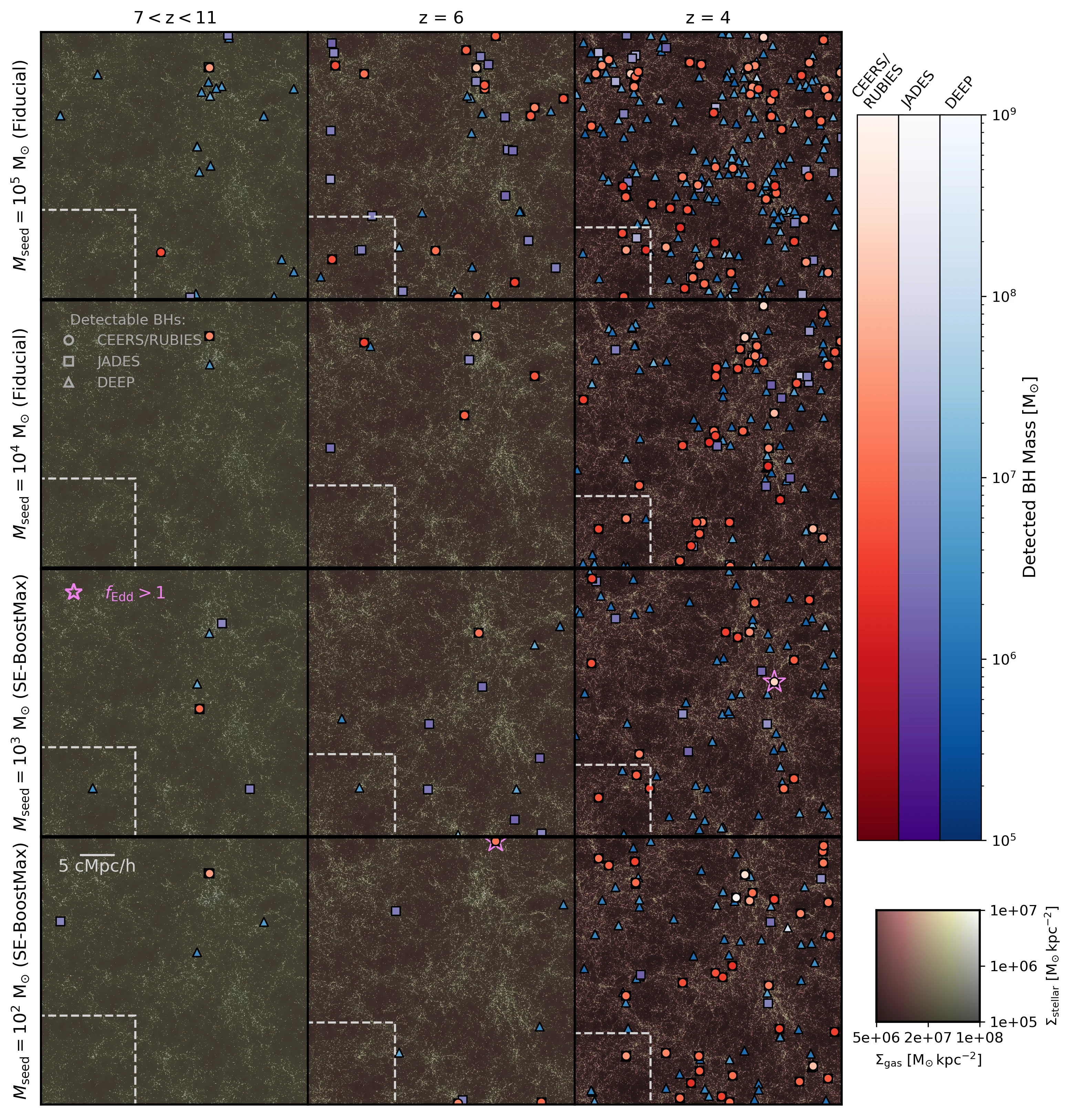
A cube of space 60 megaparsecs across (about 200 million light-years) was simulated from when the Universe was just 200 million years old to today. Seeds started with masses from 100 to 100,000 solar masses. In the standard regime, gas accretion was limited to the Accretion disk rate — a kind of 'allowed ration'. In the superfast scenario, tenfold bursts of 'gluttony' were allowed. But the main tool was the balmersopica filter. It took virtual catalogs and looked at which active galactic nucleus would have lit up in real Webb exposures, via the broad hydrogen line — a spectroscopy marker of activity. Without this, any comparison of model with data is mere fine-tuning.
The results were clear: by redshift six (Universe age about a billion years), practically any runner shot into the lead if it occasionally exceeded the Eddington limit. With the most modest feeding, only heavyweights maintained a noticeable advantage. But most important — almost all detectable objects lie far above the model's mean line. This means the telescope selects the brightest, most hyperactive nuclei. In other words, the frame captures not ordinary runners, but only sprinters at peak form.
These simulations support the 'hole first, galaxy later' scenario: the black hole anchors itself in the host's potential during the star assembly stage. By today, the seed signature is erased in massive systems, but persists in dwarf galaxies: there, where the runner never caught up with competitors. The race continues, but now it's clear that participants started from different points and ran at different paces. The weight of a kitten or an elephant is only part of the story. The main thing is who got to eat first.
The twelve AESOPICA simulations span seed masses from 100 to 100,000 solar masses: if you imagine them as athletes, the lightest one weighs as much as a kitten, while the heaviest is like a full-grown elephant, and both are running a 13-billion-year marathon.