We have retold 4 papers by this author. 3 of them with a full read. most often about: large-scale structure, Hubble Space Telescope, galaxy. 30 co-authors across our retellings.
Light from the galaxy PAN-z14-1 began its journey when the universe was 400 million years old — a cosmic infancy. The expansion of space made it travel to us for nearly 13.5 billion years.
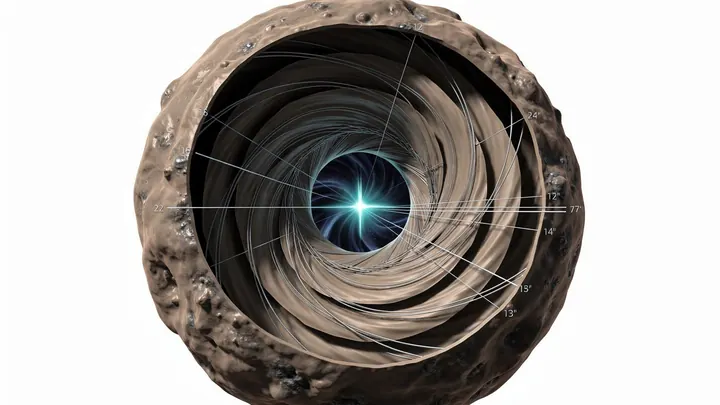
The Universe is less than a billion years old, yet at its centers already sit black holes with masses of a billion suns. According to the conventional picture, they grew by voraciously devouring matter, but calculations show that 'feeding' must have been almost continuous, while visible quasar flares last only a few million years. So where does all the accreting fuel go?
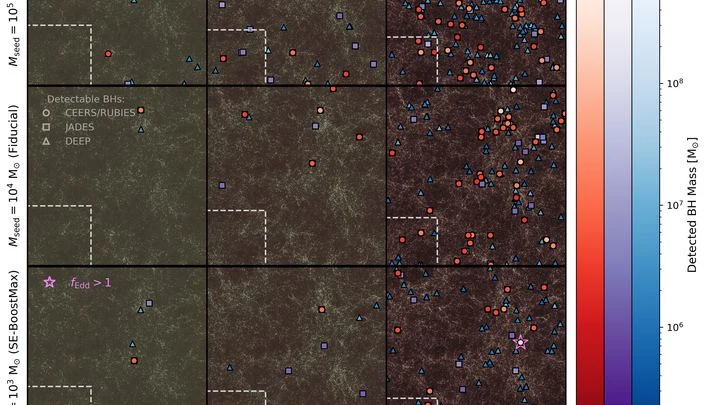
A marathon lasting 13 billion years started with different weights. A hundred solar masses — lighter than some gas clouds. A hundred thousand — gravitational dominance, comparable to an elephant among kittens. That's what black hole seeds looked like, ones that by our time should have turned into supermassive giants.
In a distant galaxy, light from hot gas should reveal its composition. The James Webb Telescope split that light into a spectrum, and astronomers saw: oxygen lines too weak.