Chaos in the Shadow of a Black Hole express
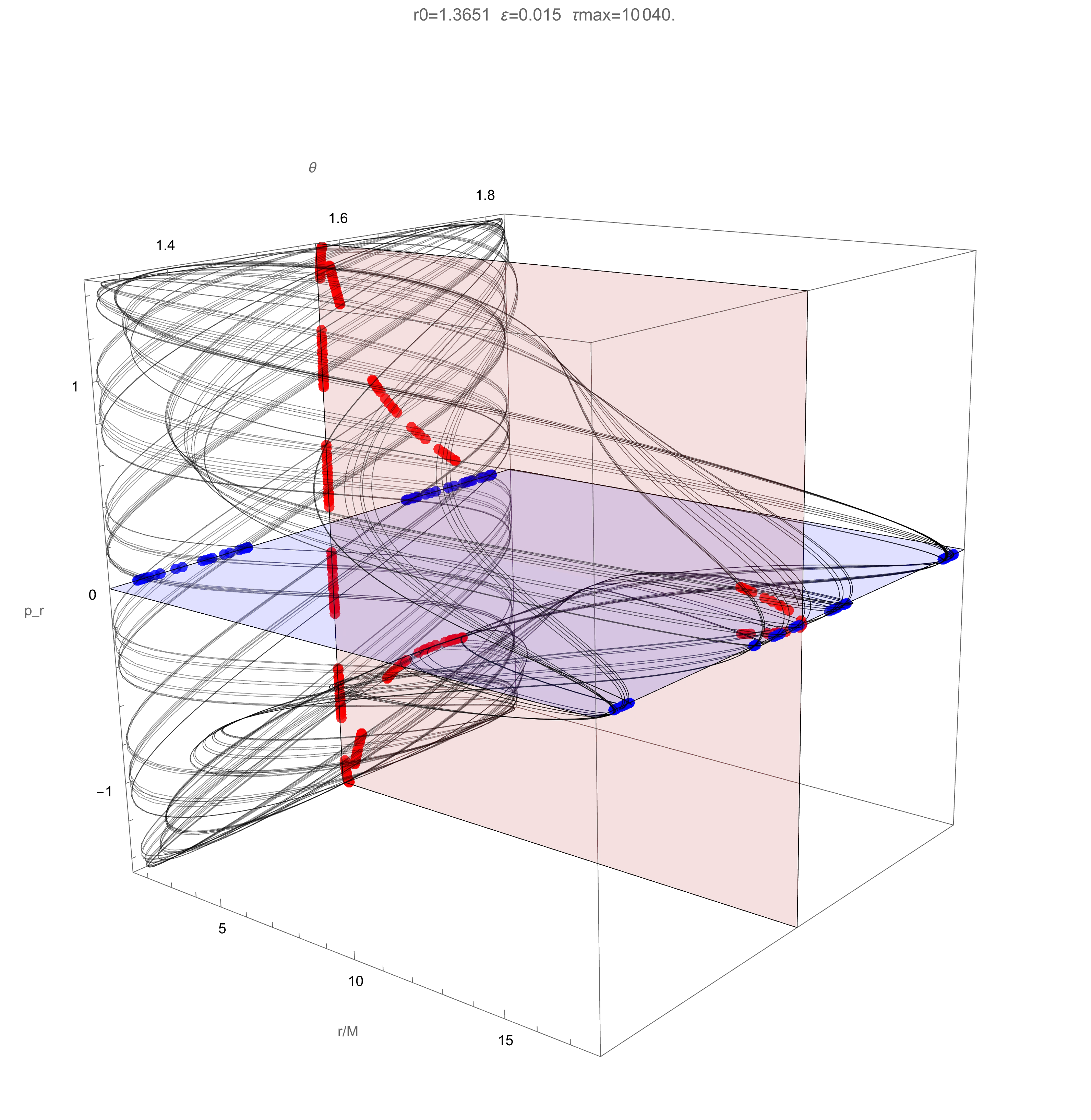
A star circles a rotating black hole like a figure skater at the center of a rink. While it is far away and can be treated as a point, the dance remains predictable: the orbit follows clear laws, like music that is easy to glide to. But as it approaches, gravity begins to act unevenly. Tidal forces stretch the star, turning it from a point into an elongated body.
From that moment on, each orbit becomes unpredictable. The slightest change at the start leads to completely different trajectories: this is chaos. The authors of the study proved mathematically that a deformed star no longer has the constant that previously helped calculate the orbit precisely. Computer simulations confirm the picture: in phase space, intricate layers appear, sensitivity to initial conditions, and strange boundaries resembling a coastline with many inlets.
The discovery changes the approach to future observations. Gravitational wave detectors like LISA will pick up signals from pairs where a small star or black hole falls into a larger one. If chaos is not taken into account, the data could be misinterpreted, like trying to guess a melody from noise. And then the dance that began on the rink turns into a cacophony in which meaning is lost.
Original abstract
as written by the authors arXiv:2607.27129
In general relativity, the motion of a test mass around a rotating black hole is described by Kerr geodesics. Owing to the symmetries of the Kerr spacetime, these geodesics possess four constants of motion, rendering the associated Hamiltonian system integrable. This integrability underlies much of the analytical framework used to model asymmetric-mass-ratio inspirals, key sources for future gravitational-wave detectors. Real compact bodies, however, are not test masses: their internal structure couples to the background curvature. In this work, we show that a non-spinning body endowed with a tidally induced quadrupole admits no deformation of the geodesic Carter constant that remains conserved, for generic tidal couplings and generic Kerr spin. Consequently, the leading-order tidal dynamics is generically non-integrable. The proof is analytic and relies on two key ingredients: a covariant Hamiltonian formulation of tidal dynamics on the same phase space as the geodesic problem, valid in arbitrary background spacetimes, and a novel relation between curvature tidal scalars and the geodesic Carter constant derived from the algebraic and Killing symmetries of Kerr spacetime. We complement this result with numerical diagnostics of the tidally perturbed dynamics, including Poincar\'e sections, Lyapunov exponents, and escape-time maps. These reveal chaotic structures in phase space, such as stochastic layers, sensitivity to initial conditions, and fractal basin boundaries, consistently with the analytic non-integrability result.
Chaos in the motion of celestial bodies is not rare. For example, the rotation of Hyperion, a moon of Saturn, is so irregular that it cannot be predicted even a few days ahead.
In the movie Interstellar, tidal forces on Miller's planet cause giant waves, but the chaos of the orbit is not shown, the planet moves along a clear path.