Chaos in the Shadow of a Black Hole express
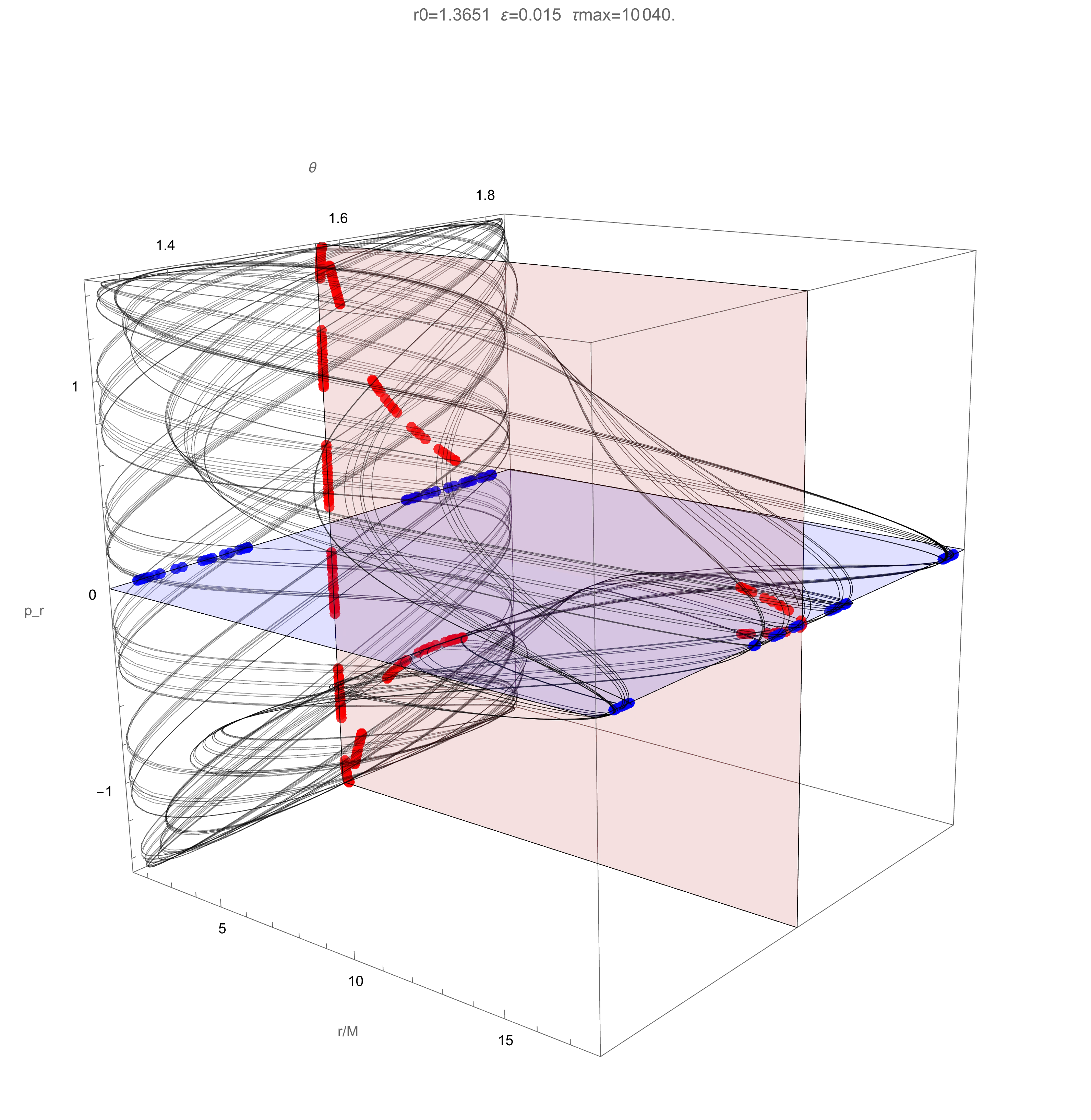
A star circles a rotating black hole like a figure skater at the center of a rink. While it is far away and can be treated as a point, the dance remains predictable: the orbit follows clear laws, like music that is easy to glide to. But as it approaches, gravity begins to act unevenly. Tidal forces stretch the star, turning it from a point into an elongated body.
From that moment on, each orbit becomes unpredictable. The slightest change at the start leads to completely different trajectories: this is chaos. The authors of the study proved mathematically that a deformed star no longer has the constant that previously helped calculate the orbit precisely. Computer simulations confirm the picture: in phase space, intricate layers appear, sensitivity to initial conditions, and strange boundaries resembling a coastline with many inlets.
The discovery changes the approach to future observations. Gravitational wave detectors like LISA will pick up signals from pairs where a small star or black hole falls into a larger one. If chaos is not taken into account, the data could be misinterpreted, like trying to guess a melody from noise. And then the dance that began on the rink turns into a cacophony in which meaning is lost.
Chaos in the motion of celestial bodies is not rare. For example, the rotation of Hyperion, a moon of Saturn, is so irregular that it cannot be predicted even a few days ahead.
In the movie Interstellar, tidal forces on Miller's planet cause giant waves, but the chaos of the orbit is not shown, the planet moves along a clear path.