Magnetic Jitters Give Rise to Superconductivity in Nickelates express
Lossless current is the dream of energy technology. Some materials become superconductors, but usually only at extreme cold. Recently, in the family of nickelates, compounds based on nickel, candidates were found that work at higher temperatures. A group of theorists took three such substances (with lanthanum, praseodymium, and neodymium) and calculated their behavior "from scratch," without fitting to experiment.
The calculation revealed a surprising picture. Electrons in these crystals form pairs not through thermal vibrations of the atomic lattice, as in conventional superconductors. Instead, collective magnetic excitation, spin fluctuations, does the job. They resemble a wave that sweeps through the ranks of electron spins, making them move in sync. If this mechanism is "switched off" in the model, superconductivity disappears: the critical temperature drops to 0.01 kelvin — colder than interstellar space.
The main result is the predicted shape of the superconducting gap. It resembles a four-petaled flower: in some directions, the binding energy of electrons is maximal; in others, it drops to zero. This pattern arises from peaks in the response of the electron liquid at the corners of the Brillouin zone — a kind of map of allowed electron states in the crystal. The calculations agree well with existing experiments, and detailed predictions for scanning tunneling microscopy await verification in the lab.
The magnetic dance of electrons, not the jitter of atoms, opens the path to superconductivity in nickelates. This changes the view of an entire class of materials.
Original abstract
as written by the authors arXiv:2608.00512v1
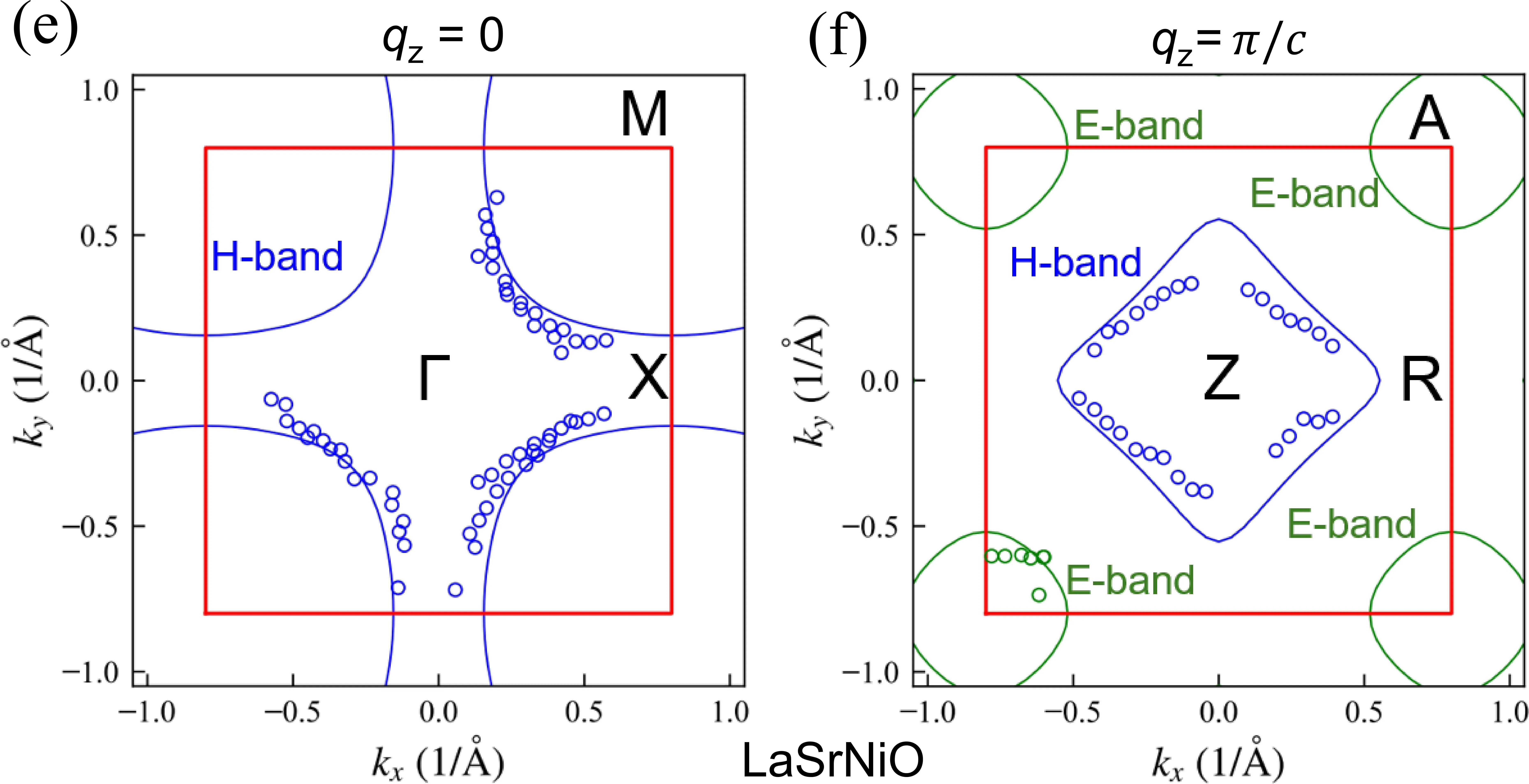
Infinite-layer nickelates have recently emerged as a new family of potential unconventional high critical temperature ($$T_c$$) superconductors. However, fundamental questions such as their superconducting (SC) pairing mechanism and gap symmetry remain under intense debate. Here we present a fully {\it ab initio} theoretical study on the SC properties of optimally doped nickelates $$Re$$$$_{0.8}$$Sr$$_{0.2}$$NiO$$_2$$ ($$Re=$$ La, Pr, Nd), based on the density functional theory for superconductors calculations with electron-phonon coupling (EPC), screened Coulomb repulsion and spin fluctuation (SF) interaction treated on an equal footing. We find that $$Re_{0.8}$$Sr$$_{0.2}$$NiO$$_2$$ are two-band superconductors with sign reversal $$d_{x^2-y^2}(\pm)$$-wave gap functions on the different Fermi surface (FS) pockets. Interestingly, when the SF interaction is turned off, $$T_c$$ becomes negligibly small ($$\sim$$0.01 K), thus demonstrating that the superconductivity in $$Re_{0.8}$$Sr$$_{0.2}$$NiO$$_2$$ is driven by SF interaction. Moreover, our {\it ab initio} calculations reveal that the SF interaction is an order of magnitude stronger than both EPC and Coulomb repulsion on the large quasi-two-dimensional FS pocket around the Brillouin zone (BZ) center, thus leading to the SF-mediated pairing mechanism, although the EPC dominates on the small three-dimensional electron FS pockets at the BZ corners. The emergence of nodal $$d_{x^2-y^2}(\pm)$$-wave gap structure is traced to the pronounced peaks in the Lindhard response function at the BZ corners. Our calculated FS, SC critical temperature, nodal gap structure and SC quasiparticle density of states are consistent with most available experiments. Furthermore, predicted unconventional SC properties such as scanning tunneling spectra of La$$_{0.8}$$Sr$$_{0.2}$$NiO$$_2$$ and Pr$$_{0.8}$$Sr$$_{0.2}$$NiO$$_2$$ are ready for immediate experimental verifications.
The critical temperature of a superconductor without spin fluctuations—0.01 K — is close to the record-low temperature ever achieved in a laboratory (about 100 picokelvins).
In Peter Watts's novel Blindsight, alien ships use superconducting circuits to control magnetic fields without energy loss — much like spin fluctuations control electrons in nickelates.