Superconductivity Withstood Pressure of 210 Gigapascals express
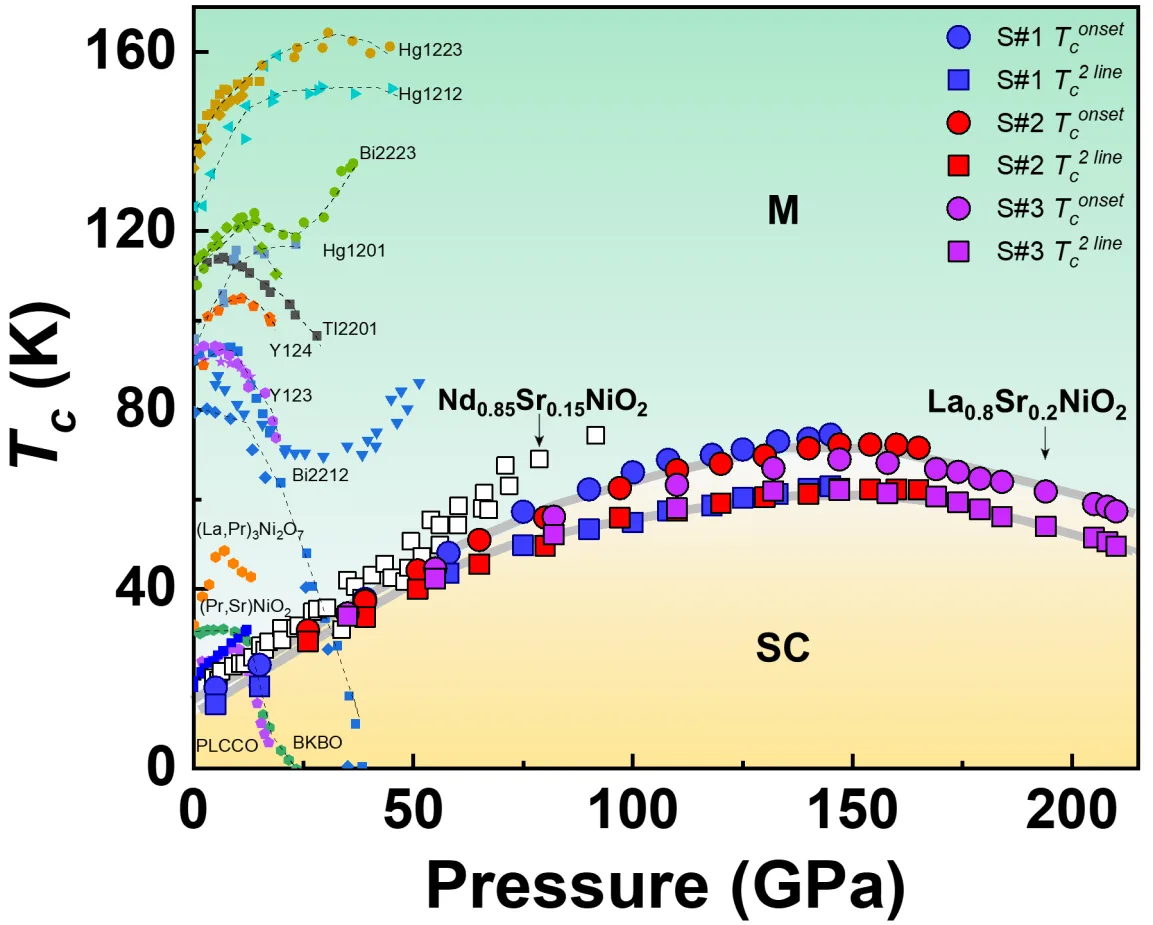
A film sliver thinner than a human hair was placed between diamond anvils and squeezed. The pressure climbed — a hundred thousand atmospheres, half a million, a million… Yet the material kept conducting electricity without resistance.
The membrane of lanthanum strontium nickelate (La₀.₈Sr₀.₂NiO₂) revealed a surprising picture. At ambient conditions, it becomes a superconductor at 16 kelvin (−257 °C). As pressure rose, the transition temperature crept upward like mercury in a thermometer, hitting a peak of 74.5 kelvin at 146 gigapascals — nearly 60 degrees above the starting point. Then came a gentle decline: at 210 gigapascals, the transition was observed at 57.4 kelvin.
Previously, no oxide superconductor had retained its properties under such extreme loads. Usually, the crystal lattice gives way and the effect vanishes. Here, the material held up to the very end of the experiment. This endurance calls to mind a mountaineer who not only summits but also descends without an oxygen mask.
Original abstract
as written by the authors arXiv:2608.02042v1
The discovery of superconductivity in infinite-layer nickelate thin films has opened a new frontier for exploring unconventional oxide superconductors beyond the copper oxide family. However, the presence of substrate hampers investigations under very high pressure. Recently, this problem was circumvented by a study of freestanding Nd0.85Sr0.15NiO2 membranes, which revealed that superconducting transition temperature kept increasing as the pressure was ramped up to 91 GPa, without showing signs of saturation. Naturally, one wonders what would happen at even higher pressures. Here, we report that superconductivity in a freestanding La0.8Sr0.2NiO2 membrane persists under applied ultrahigh pressures up to 210 GPa. The superconducting transition onset temperature exhibits a continuous dome-like evolution, increasing from 16 K at ambient pressure to a peak of 74.5 K at 146 GPa, and then gradually decreasing to 57.4 K at 210 GPa. Such robustness of superconductivity against ultrahigh pressure has not been observed in high-Tc oxide superconductors before.
The diamond anvils used to generate such pressure are two polished diamonds that squeeze the sample between tips smaller than a pinhead.