Superconductivity Withstood Pressure of 210 Gigapascals express
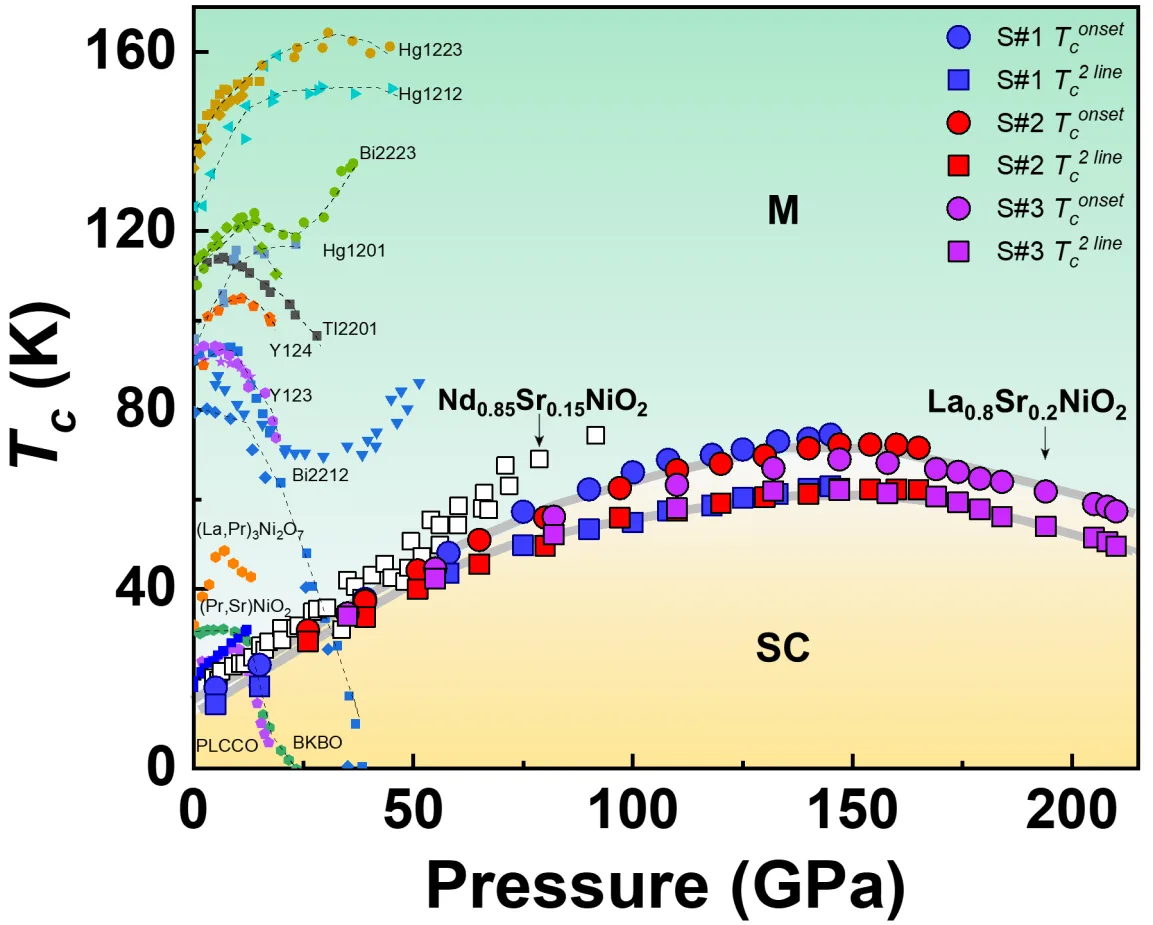
A film sliver thinner than a human hair was placed between diamond anvils and squeezed. The pressure climbed — a hundred thousand atmospheres, half a million, a million… Yet the material kept conducting electricity without resistance.
The membrane of lanthanum strontium nickelate (La₀.₈Sr₀.₂NiO₂) revealed a surprising picture. At ambient conditions, it becomes a superconductor at 16 kelvin (−257 °C). As pressure rose, the transition temperature crept upward like mercury in a thermometer, hitting a peak of 74.5 kelvin at 146 gigapascals — nearly 60 degrees above the starting point. Then came a gentle decline: at 210 gigapascals, the transition was observed at 57.4 kelvin.
Previously, no oxide superconductor had retained its properties under such extreme loads. Usually, the crystal lattice gives way and the effect vanishes. Here, the material held up to the very end of the experiment. This endurance calls to mind a mountaineer who not only summits but also descends without an oxygen mask.
The diamond anvils used to generate such pressure are two polished diamonds that squeeze the sample between tips smaller than a pinhead.