A Star Sneezes and Drifts Away express
A balloon that lets out air in bursts zips around the room — the jet blasts first one way, then another. A dying star behaves the same way as it sheds its bloated shell. Only instead of air, it's superheated gas, and instead of a balloon, it's a future white dwarf (the dense stellar remnant about the size of Earth).
Recent observations have shown that white dwarfs receive a kick of about one kilometer per second. The authors of the new study built a simple model: the shell doesn't come off in a smooth flow, but in discrete chunks: each about one ten-thousandth of a solar mass at a time. Each such "sneeze" gives the star a weak shove — about five meters per second. But over the course of shedding the shell, about ten thousand such events occur, and their random directions add up to a net kick. This is like a drunkard's walk: each step is small, but in the end, he staggers far from the lamppost.
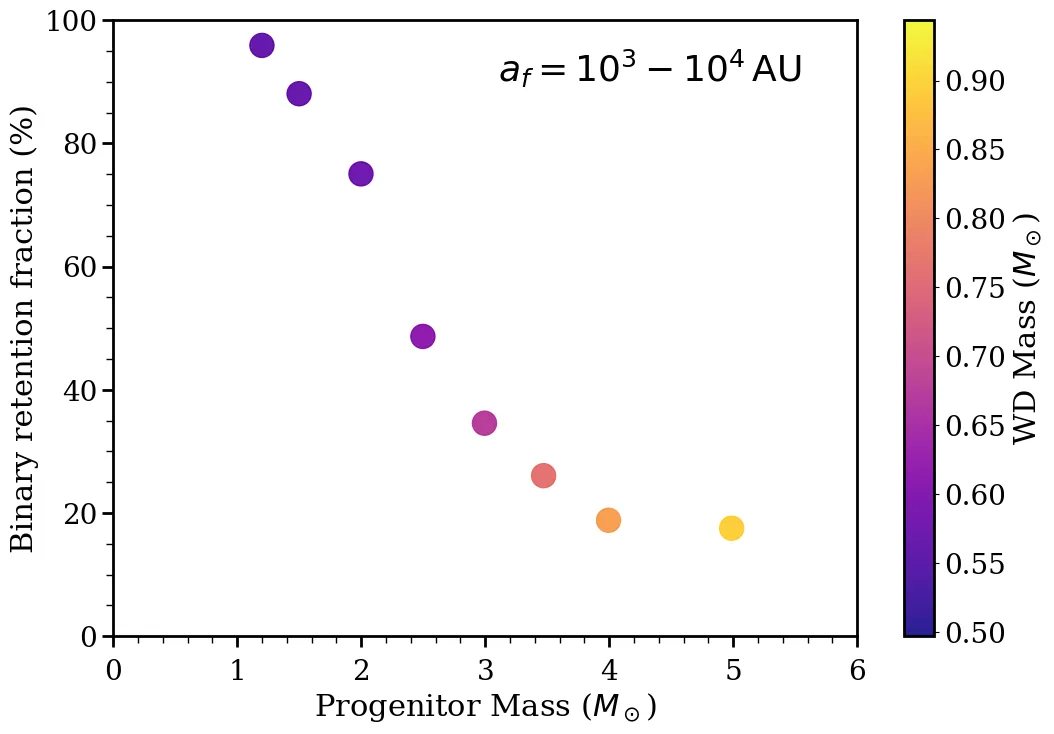
For more massive white dwarfs, the kick should be noticeably stronger. And if the star isn't alone but is part of a wide binary system (with a separation greater than a thousand astronomical units, i.e., a thousand times farther than Earth is from the Sun), then such shoves can tear the pair apart. The orbit stretches to the limit, and the stars either fly apart forever or collide. A collision produces a brilliant flash, a cosmic firework that can be spotted from Earth.
A white dwarf is a star the size of Earth but with a mass nearly that of the Sun. A teaspoon of its material would weigh several tons.
In Stanisław Lem's novel Solaris, the planet's ocean moves its orbit — here, the star itself gets a kick from its own "breathing."