Mass loss is the process by which an object sheds some of its mass, typically through the ejection of particles, gas, or radiation. In astrophysics, this is a critical phenomenon for comets, stars, and even planets. For example, a comet loses mass as it approaches the Sun, with ices sublimating into gas and dust streaming away to form its tail. For stars, mass loss drives stellar evolution, determining whether a star ends its life as a white dwarf, neutron star, or black hole.
History
The concept of mass loss in stars was developed in the mid-20th century, with key contributions from astronomers like Otto Struve and later George Herbig, who studied mass ejection in young stars.
How it works
Mass loss can occur through several mechanisms. For comets, solar radiationheats the surface, causing volatile ices to sublimate and carry dust away. For stars, strong stellar winds—driven by radiation pressure or magnetic activity—can eject outer layers. In extreme cases, a supernova explosion ejects a large fraction of the star's mass in a single event. The rate of mass loss depends on the object's composition, temperature, and proximity to other bodies.
In practice
Understanding mass loss is essential for predicting comet behavior, modeling stellar lifecycles, and interpreting observations of interstellar objects like 'Oumuamua, whose changing trajectory revealed mass loss as it passed near the Sun.
Fun fact
The Sun loses about 1.5 million tons of mass every second due to the solar wind, yet this is only a tiny fraction of its total mass—it would take over 10 billion years to lose just 0.01% of its mass this way.
A stone thrown into water quickly loses speed. A meteor entering the atmosphere should behave the same way: air slows it down, and friction burns up its material. But cameras of the Global Fireball Observatory network have captured hundreds of bright fireballs over ten years that streak across the sky with almost no deceleration.
A balloon that lets out air in bursts zips around the room — the jet blasts first one way, then another. A dying star behaves the same way as it sheds its bloated shell. Only instead of air, it's superheated gas, and instead of a balloon, it's a future white dwarf (the dense stellar remnant about the size of Earth).
Remember the sensational comet 1I/‘Oumuamua — the first object to come to us from another star? Its hyperbolic trajectory left no doubt: it was a wanderer from the interstellar void. But astronomers wondered: could some of these visitors not be strangers at all, but our own, escaped from the Solar System millions of years ago?
On the periphery of the Solar System lurk thousands of objects comparable in size to an exoplanet — a body of planetary mass not bound to our star. Their orbits are chaotic, and from time to time the trajectory of such a wanderer crosses Earth's path.
Among the icy chunks hurtling through the void, there are special travelers — interstellar comets. They were born around distant stars and happened to wander into our neighborhood. One of them, 3I/ATLAS, came under the gaze of telescopes as it approached the Sun. Its material, frozen gases and refractory dust, began to evaporate, leaving a glowing tail behind.
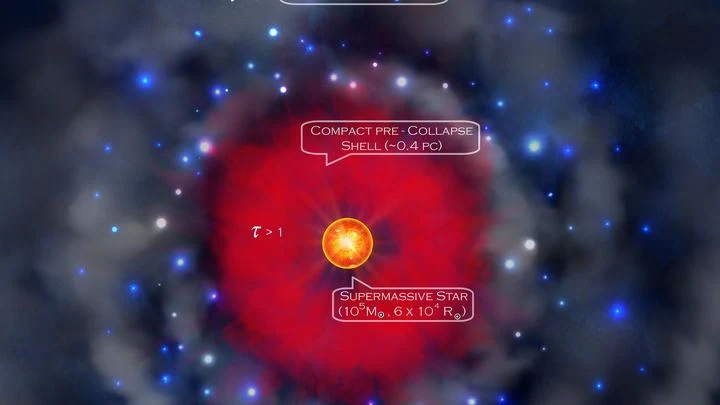
A star weighing a hundred thousand Suns lives bright and brief. Its finale is a rapid collapse into a black hole. But just before the end, it manages to wrap itself in a dense gas cocoon.
A planet hugging its star is like an ice cube forgotten on a scorching skillet. The ice melts and evaporates, except instead of water, it's hydrogen and helium from the planet's upper layers.
The first stars ignited from clouds that contained nothing but hydrogen and helium. Heavy elements (carbon, oxygen, iron) came later, forged inside stars. But among those pioneers, there could have been lightweight stars, with masses just below that of the Sun.
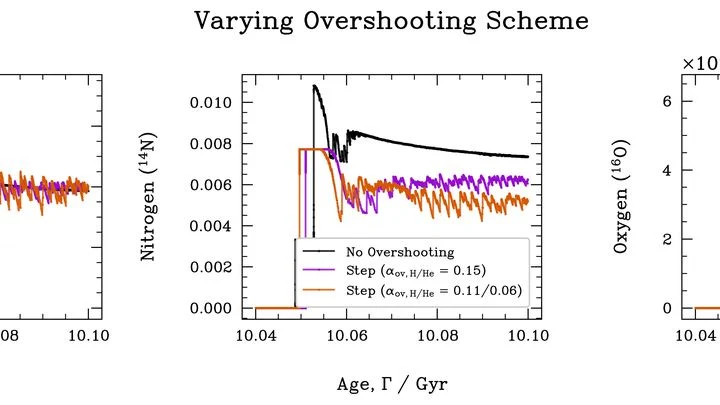
A red giant is like a balloon slowly letting out gas. The star swells, its outer layers weaken, and stellar wind carries mass into space. But exactly how much does a star lose? This is a crucial question: the answer determines what kind of remnant it will leave behind — a white dwarf, a neutron star, or a black hole.
An ordinary lump of coal left under the blazing sun just heats up. But if you take it into space and bring it twenty times closer to the Sun than Earth is, it won't survive for more than a few minutes. That's roughly how dark, carbon-rich asteroids behave. They are rarely found on orbits that dive deep inside Mercury's orbit.
Some stars fizzle out like a dud firework: instead of a bright blast, just a cloud of smoke. Usually, a massive star ends with a supernova explosion, leaving a black hole. But sometimes there's no bang: the star collapses straight into a black hole, almost unnoticed.
In the darkness of interstellar space drift millions of rogue planets — worlds not bound to any star. They are almost impossible to see, but when such a wanderer passes in front of a distant star, its gravity bends the light and momentarily creates a cosmic magnifying glass.