Magnetic Hearing at Your Fingertips express
A magnet weighing just a few grains of sand hovers in midair with no support. It doesn't touch the walls, doesn't rub against bearings — it just hangs in a magnetic trap like a speck of dust in a sunbeam. Researchers have turned this tiny object into an ultra-sensitive compass: the device detects changes in the magnetic field of 23 femtotesla. To get a feel for that number, think of a typical fridge magnet — its field is roughly a billion times stronger.
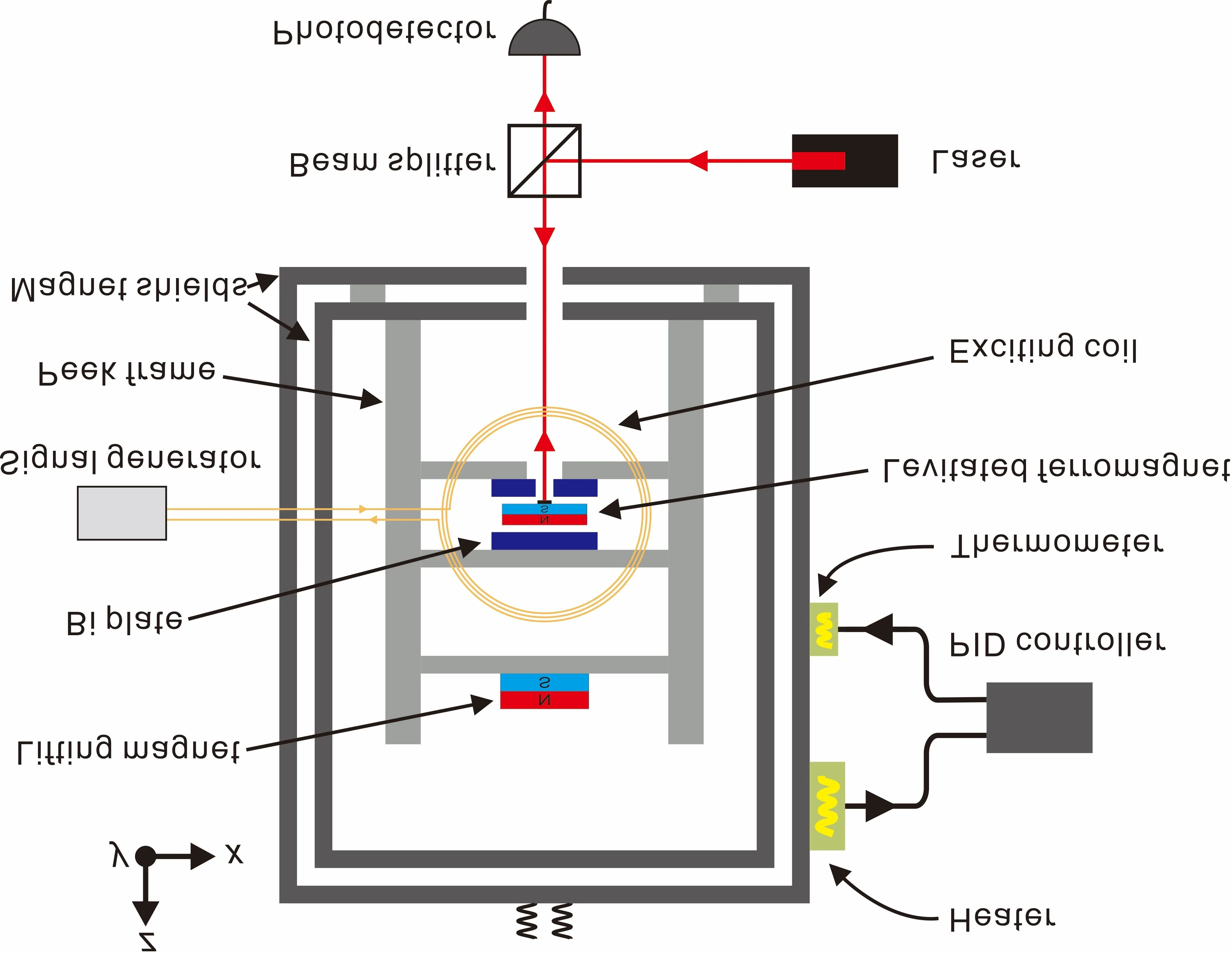
The secret to this sensitivity is perfect isolation. A levitating magnet knows no friction, so the slightest external nudge makes it tremble. The authors took a milligram-sized piece of ferromagnetic material (a substance that becomes magnetized and stays magnetic) and suspended it in the field of a stronger magnet — creating a contactless spring. When the external field changes, the "spring" compresses or stretches slightly, and by tracking the magnet's motion, you can calculate the disturbance with femtotesla precision.
Such sensitivity isn't just for setting records. Magnetic fields reveal the workings of the heart and nerves, and a sensor that doesn't need supercooling could fit into an ordinary clinic. Moreover, an ultra-precise compass could detect ultra-light dark matter particles or unknown forces that are still hiding between the lines of the Standard Model. The levitating speck becomes a window into both the human body and the frontiers of physics.
Original abstract
as written by the authors arXiv:2608.08544v1
Levitated mechanical oscillators are emerging ultrasensitive sensors with tremendous potential in both applied and fundamental physics. Levitated ferromagnets, with internal spin noises rapidly averaged, promise ultrahigh magnetic sensitivity. Here, we demonstrate a milligram-scale diamagnetically levitated ferromagnet system operating at room temperature. Through optimized geometry and multi-channel dissipation control, we achieve a magnetic sensitivity of 23~fT$$/\sqrt{\text{Hz}}$$ at frequency of 100-Hz level. We anticipate that a ferromagnetic magnetometer with subfemtotesla sensitivity is within reach, after modest technical improvements. This platform establishes a high-performance magnetometer for biomagnetic field detection and beyond-standard-model force searches.
Earth's magnetic field, which turns a compass needle, is about 50 microtesla — two million times stronger than the new sensor's sensitivity threshold.
In Carl Sagan's novel "Contact," an alien signal is received by a network of radio telescopes — an ultra-sensitive magnetic sensor could pick up a much fainter "whisper" from extraterrestrial technology.