Light in an Air Pipe: Laser Guides Beam 100 Meters in the Open Air express
An ordinary flashlight shines in all directions, and after just a couple of dozen meters its beam fades so much it barely lights a wall. The atmosphere scatters light, and wind and heat currents distort it even more. But if you lay an invisible pipe for light right in the air, the beam will travel through it like water through a hose.
That is exactly what they managed to do with short laser pulses. The laser briefly heats a narrow channel in the air, and it becomes like a lens: light inside no longer spreads sideways but moves forward. Such a channel is called an air waveguide. Previously, it was created only in the lab, over distances up to 42 meters. Now, for the first time, they stepped outside and guided light over 100 meters — with real wind up to 2 meters per second, fog, and temperature swings. The channel held up.
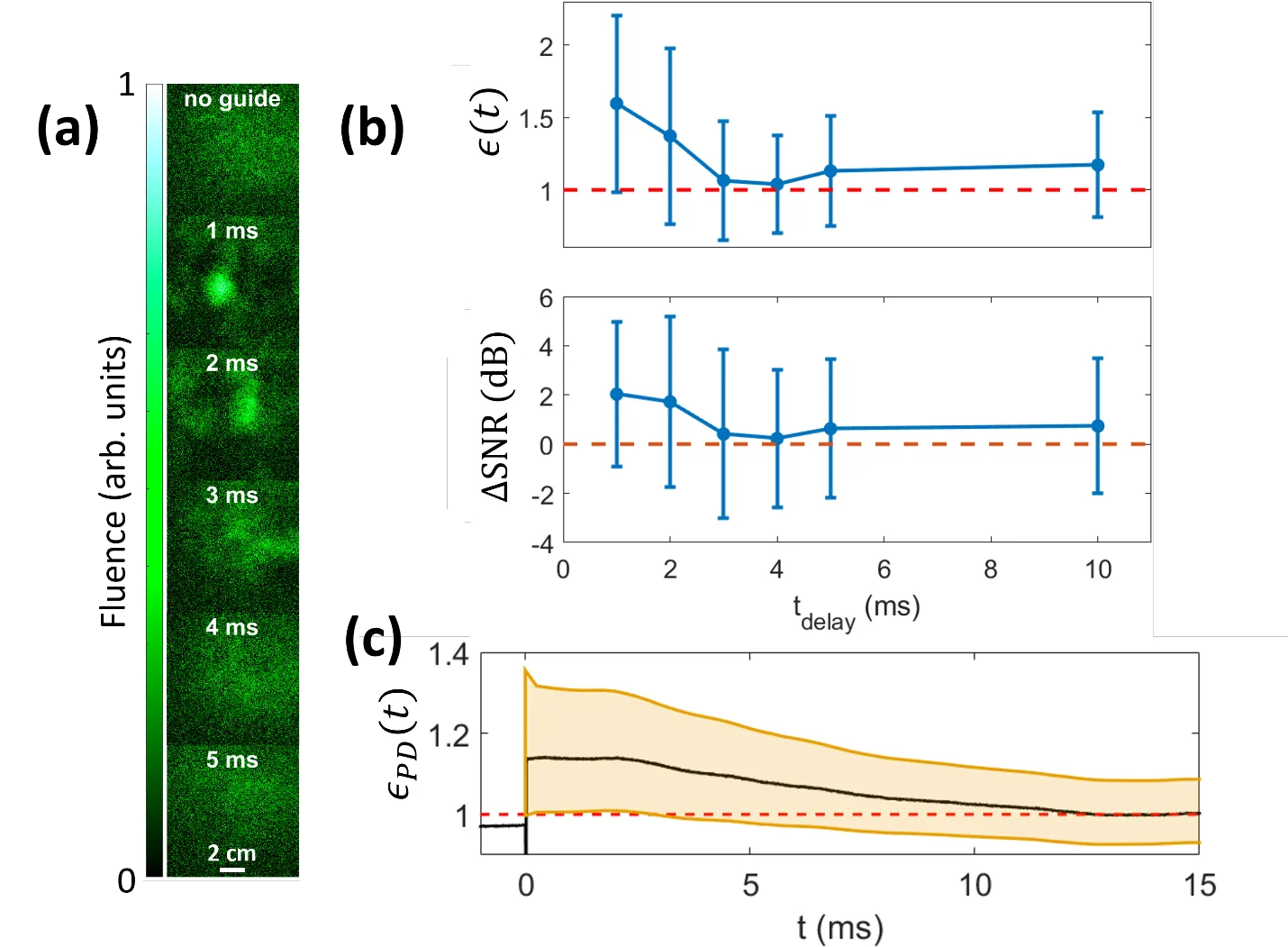
The tests showed that the main enemy of such a channel is crosswind. It blows the heated air aside, bending the pipe. But even in gusts, the channel lasted long enough to transmit a signal. The scientists combined experiments with calculations and figured out exactly how wind shortens the waveguide's life. Now they can tune the laser's operation to the weather.
Why does this matter? To send energy or communication over long distances without wires or bulky mirrors. A drone gets power not from a cable but from a thin beam that doesn't scatter even in rain. Or a ship at sea keeps in touch with the shore through fog. A hundred meters is just the first step, but already in the open air.
Original abstract
as written by the authors arXiv:2608.10369v1
Optical power densities for standoff spectroscopy, remote sensing, directed energy, and free-space optical communications are limited by diffraction and adverse atmospheric conditions such as turbulence, fog, and wind. Air waveguides, generated by ultrashort-pulsed laser filamentation, are a promising approach for transmission and collection of optical signals over long distances, overcoming beam diffraction and, for point-like sources, inverse square signal falloff with distance. In this work, we demonstrate outdoor guiding for the first time over a record length of ~100 m, exceeding the prior (indoor) record of 42 m. We correlate air waveguide performance to a range of real atmospheric conditions including turbulent refractive index structure parameter ($$C_n^2$$) values up to ~$$2.5\times10^{-14} m^{-2/3}$$, crosswind speeds up to ~2 m/s, as well as temperature, pressure, and humidity variations. Accompanying propagation simulations provide insight into the real effects of these environmental perturbations, particularly crosswind, on waveguide performance and lifetime. Our results pave the way for quasi-continuous air waveguiding with kHz-scale repetition rate filaments in challenging outdoor environments.
The speed of light in an air waveguide is almost the same as in a vacuum — the slowdown is less than one thousandth of a percent.
In Arthur C. Clarke's novel "Light of Other Days," characters use wormholes to see through any barrier; the air waveguide is a modest but real step toward controlling light in space.