Dust in Galaxies: Clumps Instead of Haze express
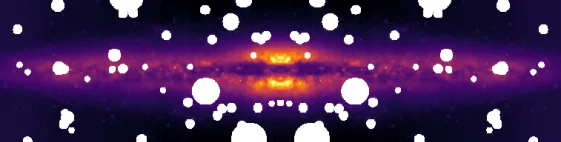
Light from a distant galaxy reaches us through its own dust. This dust is not a smooth haze but ragged clouds, like wisps of cotton. Old models treated it as a uniform mist, and then the galaxy didn't add up energetically: too much light disappeared in the ultraviolet and too little came back in the infrared.
Astronomers did what a cook does when they dice a potato instead of tossing it in whole. They replaced each dense dust cloud with a virtual 'pseudo-grain' having the same properties — how it absorbs light, how it scatters, how it glows when warm. These pseudo-grains were added to the standard dust model. The absorption curve became flatter: the dust stopped gobbling up blue light so greedily.
They applied the model to seven galaxies with different inclinations. It turned out that clumpy dust lets more light through than previously thought: the maximum optical depth in the blue filter dropped by a factor of 1.3–2.8. Two galaxies remained opaque at their centers, two were moderately transparent, and three were clear.
Clumps change the picture: you need less dust to explain the same absorption. So estimates of dust mass in galaxies may be too high. And light from distant stars reaches us more easily than we used to think.
Original abstract
as written by the authors arXiv:2608.14023v1
We attempt to resolve the long-standing energy balance problem encountered by Radiative Transfer (RT) models, particularly in edge-on galaxies by incorporating a treatment for the clumpy structure of the Interstellar Medium (ISM). A subgrid approach is adopted, treating the quiescent dust clouds as pseudo-dust grains, with equivalent optical and thermal emission properties. Deriving key quantities such as the absorption, scattering and extinction cross-sections enables the virtualisation of the macroscopic clump into a microscopic pseudo-grain that can be included alongside the existing dust model constituents. The addition of the pseudo-grain results in a flatter extinction curve. A library of clump emission spectral energy distributions (SEDs) is constructed for radiation fields of various colours and intensities. The new clumpy model is applied to the edge-on galaxy NGC 891 and, for the first time, is able to achieve a good energy balance, simultaneously fitting both the submm and Near Infrared (NIR) data. The clumpy model is further applied to a small sample of seven galaxies of various inclinations, and the results are compared with those from the purely diffuse models. The clumpy models are characterised by a reduction in dust opacity, and therefore attenuation, compared to their purely diffuse counterparts. Thus, the maximum face-on optical depth in the $$B$$-band, $${\mathrm max}(\tau^{\mathrm f}_{\mathrm B})$$, derived from the clumpy models is found to be lower by factors ranging from 1.3 to 2.8. Of the seven galaxies, two are found to be optically thick in their centres, two are found to be moderately optically thick, and three are found to be optically thin.
In the galaxy NGC 891, dust is gathered into clouds that resemble giant 'filaments'—visible in images as dark streaks across the disk.
In Charles Pellegrino's novel 'Dust', interstellar dust becomes a threat to a starship — the clumpy structure of the dust makes collisions more dangerous.