Why One Metal in a Crystal Obeys a Magnet and Another Doesn't ✛
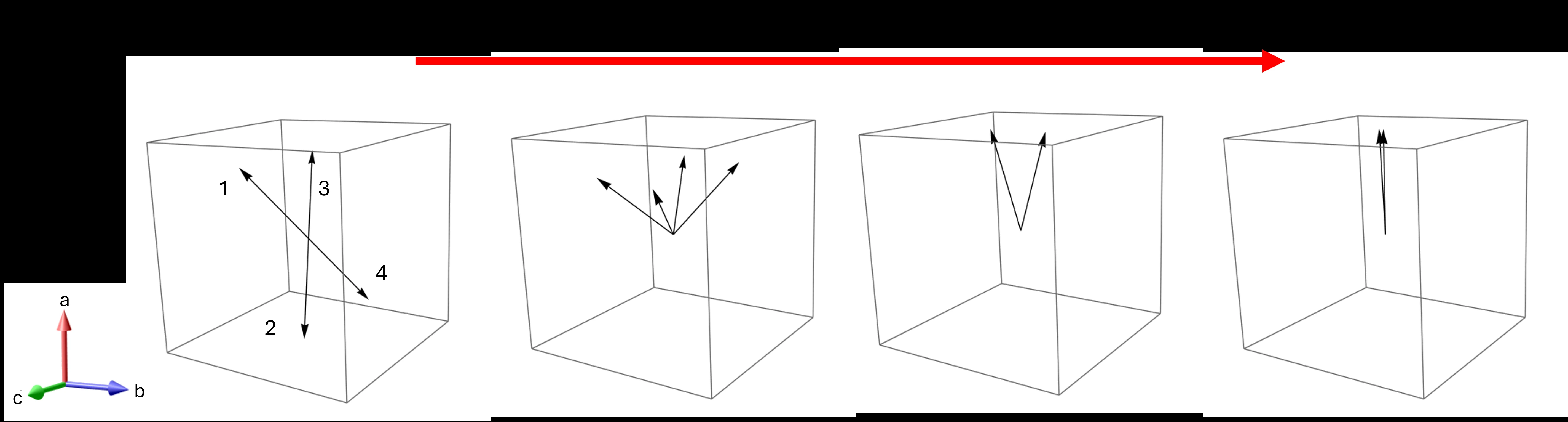
In the EuMnSb2 crystal, manganese and europium atoms act like tiny magnets. It was previously unclear how the europium magnets were oriented at rest and what happens when an external field is applied. Conventional neutron measurements didn't give a precise answer: europium strongly absorbs neutrons, and the signal is lost.
To get around this, physicists used a method that compares neutron scattering with different spin directions. This way, absorption doesn't interfere, and the picture becomes clear. The same crystal was also probed with X-rays in strong magnetic fields — up to 30 tesla. It's like shaking a magnetic 'sandwich' and watching each layer separately.
In zero field, manganese magnets are aligned along one axis, while europium ones are tilted from it by 35 and 15 degrees in different planes. In a weak field, europium reorients sharply, then gradually saturates. Manganese remains a static background. This simplifies calculations and helps understand how magnetic order relates to the crystal's unusual electronic properties.
Natural europium absorbs neutrons so strongly (cross-section 4530 barns at a wavelength of 1.8 Å) that conventional neutron diffraction requires complex corrections. Spherical neutron polarimetry sidesteps this problem by measuring only intensity ratios.