Magnetic framework of a Dirac semimetal: how spins order in EuMnSb2 ✛
Context
Magnetic topological semimetals are intriguing because their electronic topological states can be controlled through magnetism and external fields. EuMnSb2 is one such candidate, but its magnetic structure has been a matter of debate: different groups reported different orientations of europium spins. The discrepancy stems from the strong neutron absorption by natural europium and crystal twinning. This work joins the line of research on magnetic Dirac materials, where the central question is how magnetic order relates to the topology of electronic bands.
Methods
A single crystal of EuMnSb2 grown from a tin flux was studied. To determine the magnetic structure, spherical neutron polarimetry was performed on the D3 diffractometer at the ILL—a technique that measures intensity ratios for opposite neutron polarizations, thereby canceling the absorption factor. Additionally, unpolarized neutron diffraction was carried out on ZEBRA at PSI and D9 at ILL, along with time-resolved X-ray magnetic circular dichroism (XMCD) at BESSY II in fields up to 30 T, and magnetization measurements in static and pulsed fields up to 35 T.
Results
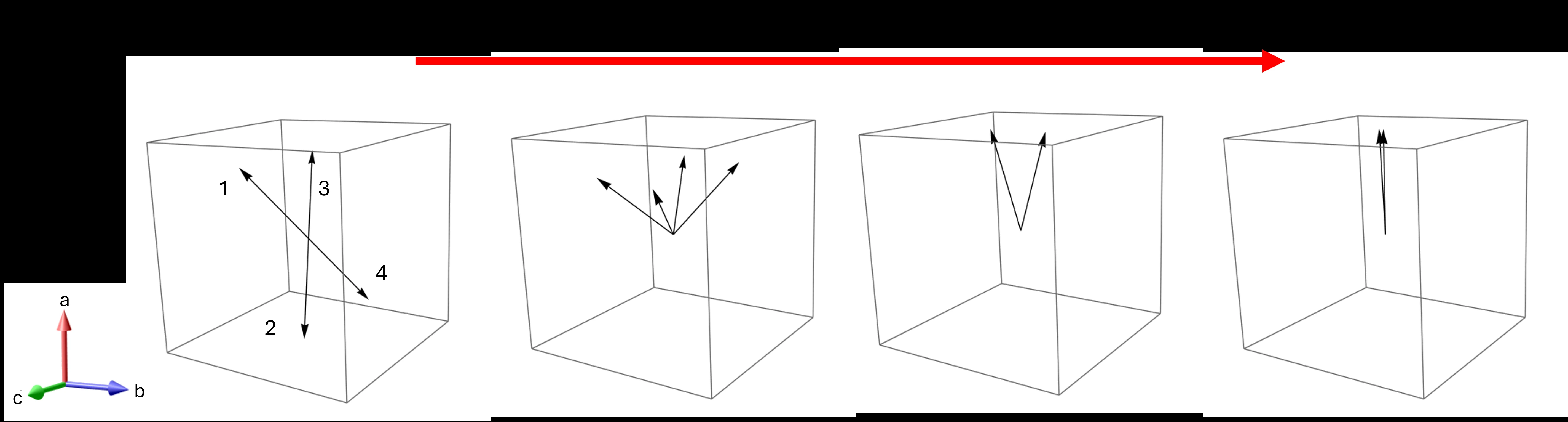
In zero field, the manganese sublattice exhibits C-type antiferromagnetic order with spins along the a-axis, consistent with previous work. The europium sublattice below 21 K forms a canted antiferromagnetic structure: spins are tilted by 35° from the a-axis in the ac plane and by 15° from the c-axis in the bc plane. When a field is applied along the a and c axes, spin-flop transitions occur at 1.5 T and 0.5 T, respectively. XMCD showed that manganese spins remain unchanged up to 30 T, while europium spins begin to saturate around 15 T. For a field along c, an additional transition Hc2 was observed just before saturation. A mean-field model with effective staggered fields from manganese reproduces the main features of the behavior.
Implications
This work resolves a long-standing debate about the magnetic structure of EuMnSb2 by providing reliable data from a single crystal. Unlike neighboring studies that used different samples and methods, here spherical neutron polarimetry—free from absorption issues—was employed, making the result more trustworthy. It demonstrates that the manganese sublattice acts as a rigid magnetic background, and all field effects are associated with europium—this simplifies modeling and understanding the connection between magnetism and topology.
Future development
Likely, attempts will be made to microscopically calculate exchange interactions between Eu and Mn, including anisotropic contributions such as the Dzyaloshinskii–Moriya interaction, to explain the origin of the effective staggered fields. It is also interesting to investigate how magnetic transitions affect topological properties, such as the Berry phase or surface states, using ARPES or quantum oscillations in a field.
Impact
The results are important for the physics of magnetic topological materials and spintronics, where controlling topology by magnetic fields could lead to new devices.
Next steps
Perform microscopic calculations of the Eu-Mn exchange tensors and investigate the behavior of the electronic structure at magnetic transitions using ARPES and quantum oscillations.
Key open problems
In the physics of magnetic topological semimetals, the microscopic mechanism linking magnetic order and topological electronic states remains an open question. This work provides the precise magnetic structure and exchange interaction parameters, which are necessary for theoretical modeling of topological phases in EuMnSb2.
The knowledge machine's view
This section is addressed to the author of the paper and their colleagues. Neighbouring works were found by meaning-based search across our archive, not by word overlap. We do not review: we show the field around the work.
What the work does
This work settles a long-standing debate over the magnetic structure of EuMnSb2: using spherical neutron polarimetry and pulsed XMCD on the same single crystal, the researchers determined a canted antiferromagnetic structure for the europium sublattice and a rigid magnetic background for the manganese sublattice, and they built a mean-field model that describes the field-induced transitions.
Where its strength is
The use of spherical neutron polarimetry, which is insensitive to the strong absorption by europium, and the acquisition of consistent data on a single crystal make the magnetic structure reliably established and provide a basis for linking magnetism to topological electronic states.
Where it could go next
- It might be interesting to compare the observed spin-flop transitions and the canted structure with spin-wave dynamics: the archive contains an analysis of a work on chiral magnons on a checkerboard pattern, where magnetic interactions are derived from excitation spectra.based on: Plaid Pattern of Chiral Magnons arXiv:2607.02114
- Nearby is a study where a magnetic field splits a transition in an alloy; perhaps a similar approach to analyzing field anomalies in EuMnSb2 could help clarify the role of the two sublattices near critical fields.based on: Magnetic Field Splits a Transition in an Alloy arXiv:2603.27390
- Since the work emphasizes the field independence of the manganese sublattice, it would be interesting to consider surface effects: the archive contains an analysis of switching magnetic states on a surface, which may be related to topological surface states in a Dirac semimetal.based on: A magnet's surface as a switch arXiv:2601.06646
Worth trying
- Check whether the rigidity of the manganese sublattice persists under doping or changes in stoichiometry, using methods from the work on magnetic swings of a crystal.
- Measure spin excitations by inelastic neutron scattering and compare them with the predictions of the mean-field model.
- Investigate the influence of a magnetic field on topological surface states using ARPES in fields exceeding the spin-flop transitions.
Why this may matter
Determining the exact magnetic structure and its field evolution in EuMnSb2 opens the way to controlling topological properties through magnetic transitions, which is important for applications in spintronics and magnetoelectronics.
Nearby works in our archive
- A Crystal Where Electrons Dance to the Tune of Magnetssimilarity 0.57
- Magnetic Patterns on a Crystalsimilarity 0.54
- Magnetic Axis Switches Charge Flows in a Flat Crystalsimilarity 0.54
- Magnetic Field Splits a Transition in an Alloysimilarity 0.53
- Plaid Pattern of Chiral Magnonssimilarity 0.52
- A magnet's surface as a switchsimilarity 0.52
The archive is sparse around this work: the closest review is only 0.57, against a usual 0.64. It looks like few have drilled nearby.
Original abstract
as written by the authors arXiv:2608.16724v1
The magnetic structure of a magnetic topological semimetal EuMnSb$$_2$$ is investigated in fields up to 30 T using polarized and unpolarized neutron diffraction, pulsed-field x-ray magnetic circular dichroism and pulsed-field magnetometry. We determine the zero-field magnetic structures of the Eu and Mn sublattices, and find that magnetic transitions induced by applied fields below 2 T correspond to changes in the magnetic order of the Eu spins alone without detectable perturbation to the order of the Mn spins. An additional magnetic transition is observed at fields close to the saturation field for the Eu spins. We present a mean-field model which describes key features of the magnetic behavior and allows us to estimate the dominant Eu--Eu and Eu--Mn exchange interactions responsible for the coupling between magnetism and electronic topology.
Natural europium absorbs neutrons so strongly (cross-section 4530 barns at a wavelength of 1.8 Å) that conventional neutron diffraction requires complex corrections. Spherical neutron polarimetry sidesteps this problem by measuring only intensity ratios.
Key numbers
- Manganese Néel temperature: 320–350 K
- Europium ordering temperature TEu1: 21 K
- Europium reorientation temperature TEu2: 9 K
- Europium saturation field: 19 T
- Spin-flop transition for H∥c: 0.5 T