A Magnetic Framework of Two Metals: Why Europium Follows the Field and Manganese Doesn't ✛
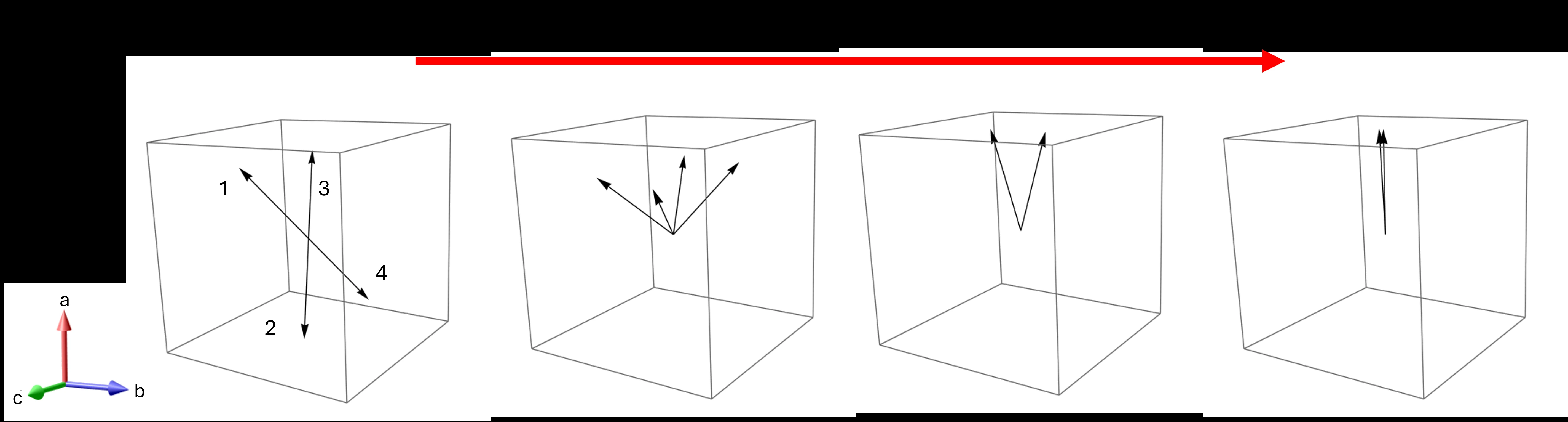
The magnetic framework of the EuMnSb2 crystal resembles scaffolding: manganese atoms form rigid vertical pillars, while europium atoms act as movable crossbars. Until now, there was no consensus on the angle at which these crossbars rest and how they rotate when a magnetic field presses on the scaffold. Conventional methods failed to give a precise answer: europium atoms greedily absorb neutrons, drowning the signal in noise.
To circumvent this, the physicists employed spherical neutron polarimetry — a technique that compares how neutrons with opposite spin directions scatter. Absorption is reduced, and the picture becomes clear. The same crystal was also probed with X-rays in pulsed fields up to 30 tesla — imagine shaking the scaffold with varying force and watching each crossbar individually.
In zero field, the manganese spins align along one axis, while the europium spins tilt away from it by 35 degrees in one plane and 15 degrees in another. In a weak field, the crossbars suddenly reorient — a jump physicists call a spin-flop. As the field grows further, europium gradually saturates and stops responding, while manganese remains a motionless backdrop.
A model built from these data describes the interaction between the two sublattices as an effective step-like field: manganese acts on europium as if a permanent magnet stood nearby, unchanging. This simplifies calculations and paves the way to understanding how magnetic order relates to the crystal's unusual electronic properties — for instance, the fact that its electrons behave like massless particles.
Now that the framework is precisely measured, theorists can build models of topological states without guessing the spin structure. And experimentalists can test how these switches affect electric current. The scaffold is no longer a mystery, and new floors can be confidently built upon it.
Natural europium absorbs neutrons so strongly (cross-section 4530 barns at a wavelength of 1.8 Å) that conventional neutron diffraction requires complex corrections. Spherical neutron polarimetry sidesteps this problem by measuring only intensity ratios.