A Compass Inside the Atom ✛
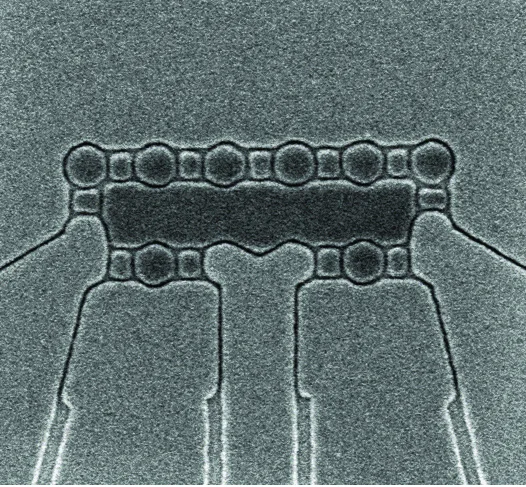
Two electrons sit in tiny silicon cells, like birds in neighboring cages. They can spin in the same direction or in opposite directions, and these two configurations are called spins. Usually, switching electrons requires a strong magnet. But it turns out that the nuclei of silicon and germanium atoms themselves create a weak jitter that acts like a bumpy road. The electrons feel this bumpiness and switch without any external field.
To keep the electrons from getting out of sync too quickly, scientists sent short pulses that nudged them back into place. It's like pushing a swing at just the right moment each time. With seventy such pulses, the quantum state lived for 74.8 microseconds instead of 1.17, which is sixty times longer. During that time, you can measure how strongly the electrons are coupled and how quickly they lose their synchronization.
This method will be useful for quantum chips, where semiconductor and superconducting elements sit side by side. An external magnet ruins everything there, but the internal jitter of the nuclei always works. So random noise has turned into a useful tool that reveals how a quantum system is organized.
Earth's magnetic field in the lab is about 58 microtesla, giving a Zeeman splitting of 1.6 MHz. This is enough to suppress mixing with T± triplets, but the gradient from nuclei is 100 times weaker.
The idea of using random nuclear spins as an in-built compass echoes Greg Egan's novel 'Quarantine', where quantum states are controlled through interaction with the environment, not despite it.