A Quantum Compass in Earth's Magnetic Field ✛
Context
Silicon spin qubits based on exchange interaction are promising for scaling, but their characterization typically requires calibration of multiple control axes or a deliberately engineered magnetic field gradient. In hybrid systems with superconductors, an external field degrades resonators and qubits. Nearby in the archive are works on protecting qubits from noise, controlling magnetic fields, and suppressing heating, but this article stands apart: it uses not suppression but the very noise of nuclear spins as a tool.
Methods
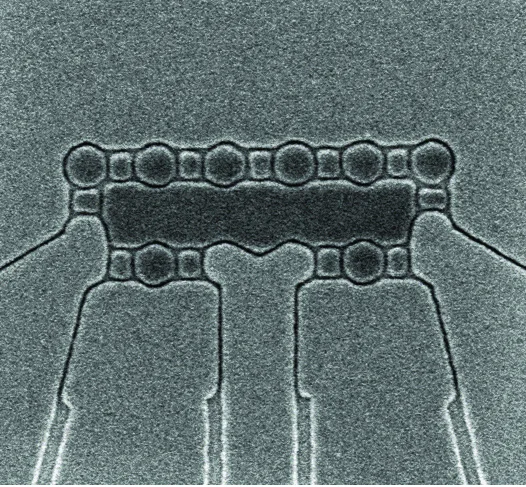
The Si/SiGe device with six quantum dots was fabricated at HRL Laboratories, but only two dots under gates P5 and P6 were used. Spin state was read out via Pauli spin blockade, and a charge detector on a neighboring dot measured conductance. At zero external field, residual 29Si and 73Ge nuclei create a random magnetic field gradient between the dots. By applying pulses to the barrier gate X5, exchange interaction was controlled and singlet-triplet oscillations were observed. To extend coherence, Carr-Purcell-Meiboom-Gill sequences with refocusing pulse counts from 2 to 70 were applied.
Results
Singlet coherence time increased from 1.17±0.02 μs under free evolution to 74.8±1.8 μs with 70 refocusing pulses. The oscillation phase allowed measurement of residual exchange in the tens of kilohertz range and mapping it across the charge cell (1,1): 30±5 kHz at the center and 64±8 kHz at the edge. The singlet decay rate showed a broad maximum at exchange frequencies of 20–40 MHz, indicating an additional relaxation or leakage channel.
Implications
Unlike neighboring works that combat noise or use external fields, here nuclear noise itself becomes a measurement tool. This is the first demonstration of exchange oscillations on an internal gradient in isotopically enriched silicon without a micromagnet and without dynamic nuclear polarization. The method provides a simple and fast way to characterize devices operating at zero field, which is critical for hybrid superconducting circuits.
Future development
The method can be extended to three-spin exchange qubits and other encodings based on singlet and triplet states. In hybrid systems with strong magnetic shielding, where Earth's field is suppressed below the hyperfine level, dynamics will become more complex due to mixing with T± triplets, but the approach remains applicable. Automation of measurements for rapid characterization of many devices on a wafer is possible.
Impact
The results will influence the development of quantum processors based on silicon spin qubits, especially in hybrid architectures with superconducting resonators. Simplified diagnostics will accelerate the selection of high-quality devices and calibration of logical operations.
Next steps
Verify the method's reproducibility on other devices and compare with traditional techniques. Investigate the nature of the decay maximum at 20–40 MHz by varying gate configurations and adding calibrated noise.
Key open problems
For silicon spin qubits, the problem of precise characterization of charge noise and residual interactions in idle mode remains unsolved. This work provides a direct way to measure residual exchange and the dependence of decoherence on exchange frequency, bringing us closer to understanding error sources in multi-qubit systems.
The knowledge machine's view
This section is addressed to the author of the paper and their colleagues. Neighbouring works were found by meaning-based search across our archive, not by word overlap. We do not review: we show the field around the work.
What the work does
The study demonstrates singlet-triplet exchange oscillations in a Si/SiGe double quantum dot at zero external magnetic field, where the gradient is created by residual nuclear spins rather than a micromagnet. Using a Carr-Purcell-Meiboom-Gill sequence with 70 pulses, the coherence time was extended from 1.17 to 74.8 microseconds, and the residual exchange and decay rate were measured.
Where its strength is
The key strength is the use of internal nuclear noise as a diagnostic tool, which eliminates the need for external fields and micromagnets, making the method compatible with hybrid superconducting systems.
Where it could go next
- It might be interesting to compare your approach with the work on mapping inhomogeneities in silicon: that work likely discusses spatial variations in properties that could affect the distribution of nuclear spins and hence the field gradient.based on: Mapping the Invisible Differences in Silicon arXiv:2603.01844
- Related work on protecting qubits using singlet states exists; perhaps their noise suppression methods could be combined with your use of nuclear gradients to improve coherence or measurement accuracy.based on: A Qubit in Singlet Armor arXiv:2604.15419
- Since your method operates at zero field, it may be useful to look at the quantum state measurement technique from work 2603.28307: it could offer faster or more accurate readout methods applicable to your scheme.based on: Shadows of Quantum States: How to Measure Faster and More Accurately arXiv:2603.28307
Worth trying
- Test combining your technique with noise suppression methods from work 2604.15419 to further increase coherence times.
- Use the mapping approach from 2603.01844 to predict and select operating points with optimal nuclear gradients.
- Evaluate the applicability of fast readout methods from 2603.28307 to improve the signal-to-noise ratio in your measurements.
Why this may matter
This method could become a standard tool for fast and non-invasive characterization of spin qubits in environments where external magnetic fields are not permissible, which is important for scaling up hybrid quantum devices.
Nearby works in our archive
- Quantum Whisper: Squeezed Light Yields to New Statessimilarity 0.55
- A Qubit for Two: Reading Two Bits in One Gosimilarity 0.54
- A Qubit in Singlet Armorsimilarity 0.54
- Mapping the Invisible Differences in Siliconsimilarity 0.53
- Quantum Geometry Imprints in the Black Hole Shadowsimilarity 0.52
- Quantum compass fails without a mapsimilarity 0.52
- Shadows of Quantum States: How to Measure Faster and More Accuratelysimilarity 0.52
The archive is sparse around this work: the closest review is only 0.55, against a usual 0.64. It looks like few have drilled nearby.
Earth's magnetic field in the lab is about 58 microtesla, giving a Zeeman splitting of 1.6 MHz. This is enough to suppress mixing with T± triplets, but the gradient from nuclei is 100 times weaker.
The idea of using random nuclear spins as an in-built compass echoes Greg Egan's novel 'Quarantine', where quantum states are controlled through interaction with the environment, not despite it.
Key numbers
- coherence time without refocusing: 1.17 ± 0.02 μs
- coherence time with 70 pulses: 74.8 ± 1.8 μs
- residual exchange at the center of cell (1,1): 30 ± 5 kHz
- residual exchange at the edge of cell (1,1): 64 ± 8 kHz
- width of decay maximum: 20–40 MHz